Key takeaways
- Bracket adjustment range not listed. You cannot know whether your saw will bolt on.
- Material supports with no fine height adjustment. Long boards will rock at the cut.
- Load rating under 300 pounds for a 12-inch slider. The stand will bounce.
- Aluminum beam extending past 8 feet with no intermediate leg. Expect sag with heavy stock.
- Wheels under 6 inches on a rolling stand. It will stop at the first extension cord.
- No length stops on the supports. Repeat cuts become a tape-measure exercise.
- Mounting hardware not included and not specified. A trip to the hardware store before the first cut.
- Stand weight omitted from the listing. Either it is too light to be rigid or too heavy to carry; the seller does not want you to know which.
Most miter saw stands are bought after the saw, in a hurry, on price. The results are predictable: a stand whose mounting brackets do not fit the saw’s base, material supports that sit 1/8 inch below the saw table so every long board rocks at the cut, or a folding frame so light that a 55-pound 12-inch slider makes it bounce on every cut. The other common error is the opposite one, buying a 70-pound rolling stand for a 10-inch saw that lives in a garage and never leaves it. A stand has three jobs: hold the saw dead level and rigid, support long stock at exactly table height, and move or store easily. Everything else on the spec sheet is secondary to those three.
Decide These 3 Things First
1. Does the saw travel or stay put? A saw that goes to jobsites or gets stored against the wall between projects needs a folding stand, either a compact rail type that carries under one arm or a rolling gravity-rise type with wheels. A saw that lives in the garage on one wall is better served by a fixed bench or a stationary stand with long wings and storage, and you can skip paying for wheels and folding hardware.
Our top picks


As an Amazon Associate we earn from qualifying purchases at no extra cost to you.
2. How heavy and how big is your saw? A 10-inch compound miter saw weighs 25 to 40 pounds; a 12-inch dual-bevel slider weighs 50 to 70 pounds and has a footprint up to 30 inches deep. Stand capacity should be at least twice the saw weight plus the material, so 300 pounds is a floor for a 10-inch saw and 400 to 500 pounds is right for a big slider. Also check the mounting bracket span: it must adjust to the bolt pattern of your saw’s base, typically 12 to 24 inches apart.
3. How long is the stock you cut most? Baseboard and casing arrive in 8-, 12-, and 16-foot lengths. Deck boards and framing are 8 to 16 feet. A stand with a 40-inch beam that extends to 6 or 8 feet supports a 12-foot board with a helper; a 10-foot extension handles 16-foot stock alone. If most of your work is under 8 feet, a compact stand is enough.
Type and Footprint
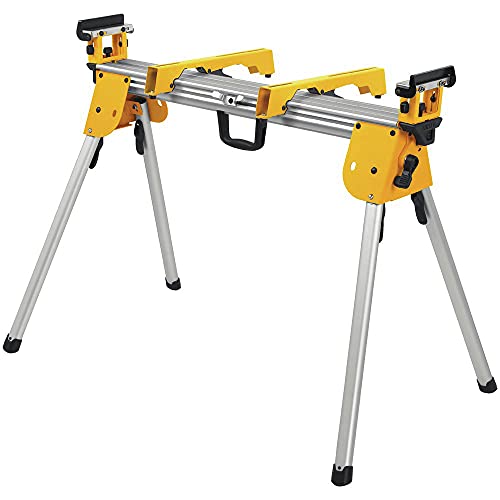
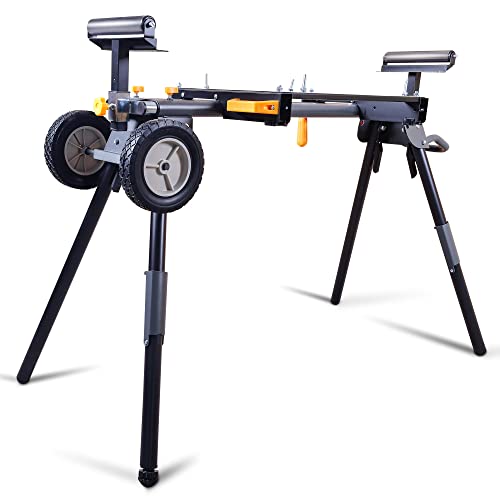
Three designs cover the market. Compact rail stands are a single aluminum or steel beam on folding legs, about 40 to 44 inches long closed and 6 to 8 feet extended, weighing 30 to 40 pounds; the DEWALT DWX724, rated for 500 pounds with a 40-inch beam that extends, is the archetype at about $229. Rolling gravity-rise stands add a wheeled frame that lets you tilt the saw down to floor level and roll it like a hand truck; they weigh 60 to 75 pounds, stand about 32 by 60 inches open, and support 8 to 10 feet of material. The DEWALT DWX726 with 8-foot material support (about $299) and the WK-MS029E-2 heavy-duty rolling stand with 8-inch wheels and a 330-pound rating (about $139) represent this class at two price points. Universal folding stands like the WEN MSA200, rated 350 pounds (about $64), are the budget entry: lighter tubing, shorter extensions, but the same basic rail-and-bracket layout. Measure your storage spot: a rolling stand folded is about 5 feet tall and 2.5 feet wide; a compact rail stand stores in a 44-by-10-inch space.
Frame Material and Load Rating
Frames are steel, aluminum, or a mix. Steel tube of 1.25 to 1.5 inches in 16 gauge gives the most rigidity per dollar and adds weight; aluminum beams save 10 to 15 pounds but flex more when extended past 6 feet with a heavy board on the end. Load ratings run from 300 to 500 pounds, and the rating matters less than where the weight sits: a 500-pound rating on a 40-inch beam with the saw in the center is very different from a heavy board hanging 4 feet off one end. Look for a beam of at least 2 by 3 inches in cross section and for leg braces that triangulate the frame. Powder coating is standard on steel; bare aluminum is fine. Rubber or plastic feet with some adjustment for uneven ground are essential on a stand that will sit on a driveway or a subfloor.
Saw Mounting Brackets
Brackets are the interface between saw and stand, and they are where compatibility fails. Universal brackets slide along the beam and adjust in width to match your saw’s bolt holes; check the adjustment range (typically 12 to 24 inches) against your saw’s base. Quick-release brackets let you lift the saw off in seconds to use on the ground or swap tools, but they add $30 to $60 and are only worth it if you will do that. The brackets should hold the saw with four bolts and have some fore-aft adjustment so the saw’s fence can be set parallel to the beam. If you own a saw with an unusual base, such as a slider with a deep rear footprint, confirm the bracket depth before buying; a mismatch here is the number one reason stands get returned.
Material Supports and Extensions
The supports are what turn a stand into a cutting station. They must adjust in height to match the saw table exactly, ideally with a fine adjustment such as a threaded post or a cam, so a long board lies flat and does not rock into the blade. Look for at least two supports that slide along the beam and lock, with a total reach of 6 to 8 feet on a compact stand and 8 to 10 feet on a rolling one. A flip-up length stop on each support lets you make repeat cuts to the same dimension without a tape; it is standard on mid and premium stands and missing on most budget models. Roller-topped supports help feed heavy stock but can let a board drift sideways; flat supports are better for trim.
Portability and Setup
For a rolling stand, wheel size determines whether it crosses gravel and thresholds: 8-inch wheels roll over most jobsite debris, 4- to 6-inch wheels struggle. The gravity-rise mechanism should let one person raise or lower a 60-pound saw with a foot pedal or a single lever, and it should lock in both positions. Total rolled weight of stand plus saw is often 110 to 140 pounds, so check the handle height and the balance point. For a compact stand, look at how the legs fold: a single latch per leg pair is far faster than four separate pins. Setup time from folded to cutting should be under two minutes for either type.
Price Tiers and Warranty
At $50 to $90, universal folding stands with a 300- to 350-pound rating, 5- to 6-foot support reach, basic brackets, and a 1- to 2-year warranty. Adequate for a 10-inch saw used at home. At $130 to $230, sturdier steel or aluminum frames, 8-foot supports with length stops, better brackets, and either compact rail or entry-level rolling designs; warranties of 3 years are common. At $250 to $400, full gravity-rise rolling stands with 500-pound ratings, 8- to 10-foot support, quick-release brackets, and 3-year warranties. In 2026 the mid tier is the right buy for most homeowners; pay for the rolling premium only if the saw actually moves between rooms or sites.
Delivery and Assembly
Compact stands ship in a box of 35 to 45 pounds and assemble in 20 to 30 minutes with a wrench and a socket. Rolling stands arrive at 70 to 90 pounds in a box about 50 by 20 by 12 inches and take 45 to 90 minutes; a second person helps when attaching the beam to the frame. Mounting the saw takes another 15 to 20 minutes and requires bolts that may not be included, so have 3/8-inch or M10 hardware on hand. After assembly, set a straightedge across the saw table and both material supports and adjust until all three are dead level; this step is what makes the stand worth having.
Spec Checklist
| Spec | Budget ($50 to $90) | Mid ($130 to $230) | Premium ($250 to $400) |
|---|---|---|---|
| Type | Universal folding rail | Compact rail or basic rolling | Gravity-rise rolling |
| Load rating | 300 to 350 lb | 350 to 500 lb | 400 to 500 lb |
| Frame | Light steel, 18 gauge | Steel 16 gauge or aluminum beam | Heavy steel frame, aluminum or steel beam |
| Stand weight | 25 to 35 lb | 30 to 60 lb | 60 to 75 lb |
| Material support reach | 5 to 6 ft | 6 to 8 ft | 8 to 10 ft |
| Support adjustment | Coarse, pin or friction | Fine height adjust, flip stops | Fine adjust, flip stops, rollers optional |
| Brackets | Basic universal | Universal, some quick release | Quick release, wide adjustment |
| Wheels | None | None or 6 to 8 in | 8 in or larger, never-flat |
| Folded size | About 44 x 10 x 8 in | 44 x 10 x 8 in or 60 x 30 x 15 in | About 60 x 32 x 20 in |
| Warranty | 1 to 2 years | 3 years | 3 years |
Red Flags
- Bracket adjustment range not listed. You cannot know whether your saw will bolt on.
- Material supports with no fine height adjustment. Long boards will rock at the cut.
- Load rating under 300 pounds for a 12-inch slider. The stand will bounce.
- Aluminum beam extending past 8 feet with no intermediate leg. Expect sag with heavy stock.
- Wheels under 6 inches on a rolling stand. It will stop at the first extension cord.
- No length stops on the supports. Repeat cuts become a tape-measure exercise.
- Mounting hardware not included and not specified. A trip to the hardware store before the first cut.
- Stand weight omitted from the listing. Either it is too light to be rigid or too heavy to carry; the seller does not want you to know which.
FAQ
Do I really need a miter saw stand?
If you cut anything longer than about 4 feet, yes, or you need a bench with wings at exactly table height. A saw on the floor or a sawhorse produces inaccurate cuts on long stock and is hard on your back. A $60 to $90 universal stand fixes both problems for a 10-inch saw; a 12-inch slider deserves a stand rated at 400 pounds or more.
Compact rail stand or rolling stand: which is better?
Compact rail stands are lighter (30 to 40 pounds), cheaper, and store in a small space, but you lift the saw on and off or carry the whole assembly. Rolling gravity-rise stands weigh 60 to 75 pounds, cost $130 to $300, and let one person wheel a 60-pound saw around like a hand truck. If the saw moves more than a few times a year, rolling is worth it.
Will a universal miter saw stand fit my saw?
Almost always, if the bracket width adjusts across your saw’s mounting bolt spacing, typically 12 to 24 inches, and the bracket depth accommodates the saw’s base. Sliders with deep rear rails are the exception; measure the base and compare to the bracket specs. You may need to supply your own 3/8-inch or M10 bolts.
How much weight should a miter saw stand hold?
At least twice the saw’s weight plus a heavy board. For a 35-pound 10-inch saw, 300 pounds is adequate. For a 60-pound 12-inch slider, look for 400 to 500 pounds, and pay attention to beam size and leg bracing rather than the rating alone, because a heavy board hanging off an extended support loads the stand very differently than the saw sitting in the middle.