Key takeaways
- Choosing the right ADF scanner comes down to a single practical question: how much paper do you actually process each week, and what happens when the feeder chokes on a wrinkled receipt or a batch of double-sided pages mid-scan? A…
Choosing the right ADF scanner comes down to a single practical question: how much paper do you actually process each week, and what happens when the feeder chokes on a wrinkled receipt or a batch of double-sided pages mid-scan? A document scanner is not a photo scanner — it earns its keep by moving bundles of paper from physical to digital fast enough that you never think about it again, and the difference between a feeder that swallows 25 sheets cleanly and one that jams on 12 is the difference between a tool you reach for daily and a frustration that ends up on a shelf.
Across the eight machines in this roundup, published specs and recurring owner feedback point to a few patterns. Build quality in the ADF mechanism separates the dependable mid-range units from the bargain-bin ones. Duplex speed matters more than raw page-per-minute ratings when your workflow involves contracts, invoices, or two-sided forms. And software polish — especially wireless setup and cloud integration — quietly becomes the reason people stay happy with a scanner or grow to resent it. The comparison below uses manufacturer specs and aggregated owner reports to rank these models for 2026, without pretending any of us ran a lab test.
As an Amazon Associate we earn from qualifying purchases at no extra cost to you. Product prices and availability are accurate as of the date shown and are subject to change.


Quick Picks
| Product | Best for | Price |
|---|---|---|
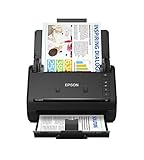
| Epson Workforce ES-400 II | High-volume offices needing reliable speed | $352.95 |
| ScanSnap iX2500 | Wireless convenience with top-tier software | $379.99 |
| ScanSnap iX1300 (White) | Small offices wanting a compact duplex unit | $279.99 |
| Canon imageFORMULA R30 | Plug-and-scan simplicity, no drivers | $259 |
| Epson Workforce ES-580W | Wireless desktop scanning with speed | $354.99 |
| Epson Workforce ES-C220 | Space-constrained desks, travel | $263 |
| Plustek PS188 | Budget buyers with high page counts | $219.99 |
| ScanSnap iX1300 (Black) | Small offices wanting a compact duplex unit | $279.99 |
How We Picked
We weighed four criteria above all others: ADF reliability under mixed paper (thin receipts, coated stock, slightly curled pages), duplex throughput relative to price, software and connectivity options that match how people actually file documents in 2026, and long-term owner satisfaction signals such as recurring complaints about jams or fading scanner lights. A machine that scores well on speed but frustrates owners with finicky feeder alignment did not make the cut over one that is marginally slower but consistently dependable.
The 8 Best Adf Scanner in 2026
Epson Workforce ES-400 II
This is the default recommendation for a busy department that scans hundreds of pages daily. Its duplex speed outpaces every other model here, and the paper path handles mixed media without frequent intervention. Owners consistently note that the feeder grips wrinkled invoices and multi-size batches more reliably than lighter competitors. The trade-off is physical footprint — this unit demands a dedicated section of desk. Skip it if you only scan occasionally or share a tight workspace; the iX2500 or ES-C220 will serve a lighter load without monopolizing your counter.
ScanSnap iX2500
The iX2500 earns its spot for buyers who value software experience as much as hardware speed. Wireless setup across phones and tablets is the smoothest in this group, and the companion app’s auto-cropping and cloud routing keep the filing pipeline short. Duplex scanning is quick enough for most home-office needs. Its one weakness is price — it sits at the top of this list without offering dramatically higher page-per-minute numbers than the Canon or Plustek. Skip it if budget is your binding constraint and you already have a preferred scan-to-folder workflow elsewhere.
ScanSnap iX1300 (White)
A sensible middle choice for two-person offices or solo professionals who scan two-sided documents several times a week. It pairs duplex capability with a compact body and the same wireless ecosystem as its pricier sibling. Owners praise the quiet operation and the straightforward tray loading. The ADF capacity is noticeably smaller than the ES-400 II, so large batches require multiple runs. Skip it if your volume regularly exceeds a few dozen pages per session or if you need the highest possible speed per dollar.
Canon imageFORMULA R30
For users who dread driver installations and prefer a scanner that simply appears as a device, the R30 delivers. Plug it in over USB and scan without installing a single piece of software — a real advantage in locked-down corporate environments or for non-technical staff. Build quality around the feeder feels solid for the price tier. The con is that wireless connectivity is absent, and the bundled software options are thinner than Fujitsu’s. Skip it if you need to scan from a tablet or want cloud integration out of the box.
Epson Workforce ES-580W
This model slots in when you want wireless flexibility but prefer Epson’s hardware pedigree over Fujitsu’s software layer. It covers duplex scanning at a competitive rate and handles mixed paper sizes through a flexible tray. Owners on forums highlight reliable Wi-Fi persistence compared to some peers that drop connections after router changes. Its software is functional but less refined than the ScanSnap suite for automated filing. Skip it if seamless cloud routing matters more to you than scanning speed, or if you already own Epson infrastructure and the ES-400 II’s extra capacity fits your volume.
Epson Workforce ES-C220
The smallest physical unit here, designed for desks where every inch counts. Its 20-page ADF capacity is rated in the product name, and while that limits batch size, the duplex mechanism still processes two-sided pages cleanly. It suits freelancers, realtors, and field agents who carry a bag and scan at a client’s site. The feeder occasionally struggles with heavier cardstock, according to owner threads. Skip it if your typical workload exceeds 20 pages per run or if you need the widest paper-size flexibility; a full-size desktop model serves better.
Plustek PS188
The price-to-throughput ratio is the headline here. At 30 pages per minute with double-sided color scanning, it matches or approaches machines costing more than $130 extra, and Windows 7 through 11 support covers legacy office fleets. Owners who scan insurance claims or student records report good daily reliability. The softening factor is the bundled software and build finishing, which feel a step below the ScanSnap and Epson lines. Skip it if wireless scanning, cloud workflows, or polished mobile apps matter to your routine.
ScanSnap iX1300 (Black)
Identical internally to the white model above — the same duplex mechanism, wireless stack, and compact tray — so it simply answers a color preference question at the same $279.99 price point. Owners of both variants report the same strengths: quiet operation, reliable two-sided feeding for moderate loads, and a short learning curve. The same limitation applies: smaller ADF capacity than the ES-400 II. Skip it for the same reasons as the white version, and choose whichever finish matches your desk aesthetic.
Buying Guide
ADF Capacity and Paper Handling
Page-per-minute ratings describe a best-case scenario with clean, identical sheets. Real offices deal with sticky notes, curled receipts, and mixed cardstock. Look at owner reports specifically about jam frequency under mixed loads, not just the advertised capacity number. A 20-sheet feeder that never jams beats a 50-sheet tray that requires constant resetting.
Duplex Speed vs. Single-Side Speed
If most of your documents are two-sided contracts, invoices, or forms, the duplex rate is the number that determines your actual workflow time. Some models advertise a high single-side rate but drop significantly when feeding both sides simultaneously. Compare the duplex spec explicitly rather than the headline figure.
Software and Connectivity Fit
A scanner without good software is a paper-to-pixel converter with no pipeline. Determine whether your filing workflow depends on cloud destinations, OCR to searchable PDFs, email routing, or network folders. Wireless models reduce desk clutter but add a setup variable that can frustrate owners after firmware updates or router changes. Pick the ecosystem that matches how you already store files.
Our Verdict
Top pick: the ScanSnap iX2500 for its balance of speed, wireless polish, and the most frictionless software experience in the group. Budget pick: the Plustek PS188 — it delivers double-sided color scanning at 30 pages per minute without the premium branding tax. If you operate in a strict no-install environment or need the simplest possible USB experience, the Canon imageFORMULA R30 wins over everything else here despite lacking wireless.
FAQ
What does ADF actually mean for my workflow?
An Automatic Document Feeder lets you stack a batch of pages and scan them sequentially without placing each one on glass manually. If you regularly digitize anything more than three or four pages at a time, an ADF saves meaningful effort and time per session.
Is duplex scanning worth the extra cost over a simplex model?
If any portion of your documents — contracts, statements, forms — arrive with printing on both sides, a duplex ADF saves you from flipping the stack and rescanning. The premium is usually modest and pays back quickly in daily workflow.
Can I connect a wireless ADF scanner to a corporate network?
Most models in this group support standard Wi-Fi and can join a corporate network, but some IT departments restrict or disable wireless scanning for security reasons. Check your policy before buying; a USB-only model like the R30 avoids that negotiation entirely.
How long should an ADF scanner last before I need to replace it?
Owner threads commonly report five or more years of service from the mid-range models here, assuming regular cleaning of the roller assembly. The first failure point is almost always worn feed rollers, which are replaceable on most of these units rather than requiring a new scanner.