
Key takeaways
- Foot traffic: commonly 8–24 hours, depending on temperature and humidity.
- Light items: often after 24–48 hours, if the surface is firm and not tacky.
- Vehicle parking: commonly 2–7 days for epoxy; some polyaspartic systems allow it sooner.
- Maximum chemical and abrasion resistance: may take 5–14 days.
The best epoxy garage floor coatings are 100% solids epoxy for maximum build and chemical resistance, water-based epoxy for easier application and lower cost, and epoxy-polyaspartic systems when fast curing and better UV stability matter most.
Choosing between them is less about the label on the kit and more about seven specifications: solids content, realistic coverage, cure time, slip resistance, UV stability, chemical resistance, and how thoroughly you are prepared to prepare the concrete. A coating that looks inexpensive per gallon can become costly if it requires three coats, covers less than advertised, or fails because moisture was trapped beneath it.
Our top picks
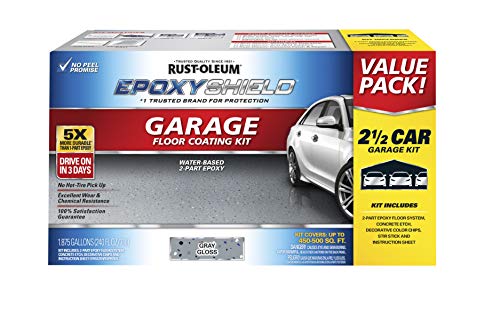
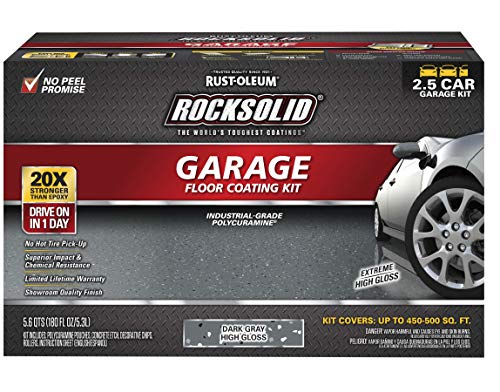
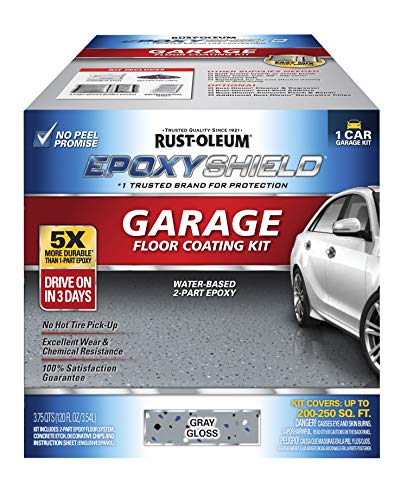
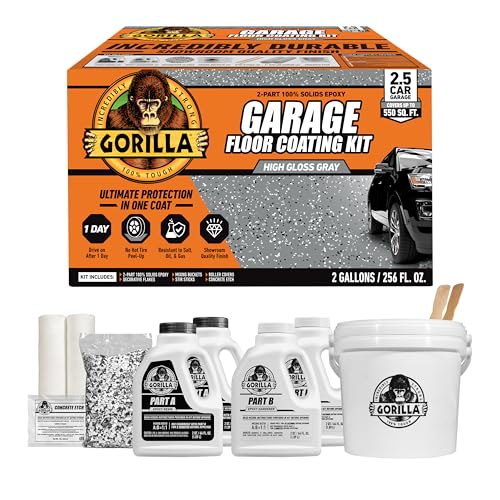
As an Amazon Associate we earn from qualifying purchases at no extra cost to you. Ratings are shown as listed on Amazon.
Quick comparison of epoxy garage floor coatings
| Coating type | Typical solids content | Practical coverage per gallon | Walk-on time | Vehicle-ready time | Best suited to |
|---|---|---|---|---|---|
| Water-based epoxy | Approximately 40–60% | 250–400 sq. ft. per coat | 12–24 hours | 3–7 days | Budget projects, light-duty garages, first-time applicators |
| Solvent-based epoxy | Approximately 50–70% | 200–350 sq. ft. per coat | 12–24 hours | 3–7 days | Moderate use where stronger wetting and build are useful |
| 100% solids epoxy | Approximately 90–100% | 100–250 sq. ft. per coat | 8–24 hours | 2–7 days | Heavy traffic, workshops, impact and chemical exposure |
| Epoxy-polyaspartic system | Often 90–100% solids | 100–250 sq. ft. per coat | 4–12 hours | 1–3 days | Fast return to service and improved sunlight resistance |
Coverage varies with concrete porosity, roller thickness, temperature, and whether the product is intended as a primer, color coat, or build coat. For a 20-by-20-foot garage, calculate 400 square feet of floor area, then add roughly 10% for edges, waste, and the concrete’s texture. A product claiming 400 square feet per gallon may therefore require at least 1.1 gallons for one coat, not one exact gallon.
Which coating is best for your garage?
| Your situation | Best choice | Why | Important compromise |
|---|---|---|---|
| One-car garage with occasional parking | Water-based epoxy or a two-part moderate-solids system | Lower material cost and simpler odor management | Usually less build and shorter long-term durability |
| Daily-driver garage with hot tires | 100% solids epoxy with a compatible topcoat | Thicker film resists abrasion, tire pickup, and impact | More demanding mixing and concrete preparation |
| Garage receiving direct afternoon sun | Epoxy base with a UV-stable polyaspartic or polyurethane topcoat | Reduces yellowing and color change near the open door | Costs more than epoxy alone |
| Workshop exposed to oil, solvents, or road salt | High-solids epoxy with a chemical-resistant topcoat | Provides stronger protection against staining and softening | Spills still need prompt cleanup |
| Cold-weather project with a short application window | Low-temperature-rated system, often polyaspartic-based | Some systems cure faster in cooler conditions | Shorter working time can make application less forgiving |
Solids content: the specification that changes value
Solids content indicates how much of the coating remains on the floor after the liquid carrier evaporates. A 100% solids coating produces considerably more film thickness from the same volume than a water-based product. That thicker film can better absorb abrasion and minor impact, but it also exposes application errors: roller marks, missed areas, and bubbles are harder to hide.
Water-based epoxy is thinner and generally easier to spread. It often suits a clean, lightly used garage, but porous concrete can absorb the liquid quickly, leaving a patchy appearance unless the floor is primed or given a second coat. Solvent-based products wet the concrete more effectively, though ventilation and ignition precautions are essential.
For durability, compare the intended dry-film thickness rather than solids percentage alone. A system specified for approximately 8–12 mils of total build is a different purchase from a decorative coating intended for 3–5 mils, even if both are called epoxy.
Cure time is not the same as dry time
A coating may be dry enough to walk on while still too soft for a vehicle jack, motorcycle stand, or hot tires. Follow the manufacturer’s recoat window: applying the next layer too late may require sanding, while applying it too early can trap solvents or interfere with bonding.
- Foot traffic: commonly 8–24 hours, depending on temperature and humidity.
- Light items: often after 24–48 hours, if the surface is firm and not tacky.
- Vehicle parking: commonly 2–7 days for epoxy; some polyaspartic systems allow it sooner.
- Maximum chemical and abrasion resistance: may take 5–14 days.
Do not judge readiness only by appearance. A cool slab, high humidity, thick application, or poor ventilation can extend curing substantially.
Slip resistance, UV stability, and chemical resistance
Slip resistance
Glossy epoxy becomes slippery when wet unless aggregate is added. Decorative vinyl flakes improve traction somewhat, but they do not automatically create a uniform non-slip surface. For a safer floor, broadcast a fine aluminum oxide, polymer grit, or compatible aggregate into the wet coating, then seal it with a topcoat. Fine grit is easier to clean; coarse grit offers more traction but can hold dirt and make sweeping harder.
UV stability
Most epoxy is not fully UV-stable. Sunlight can cause ambering, fading, or uneven yellowing, especially on the strip of floor just inside an open garage door. This does not necessarily mean the coating has lost all structural performance, but the color may change. A UV-stable polyurethane or polyaspartic topcoat is the better choice where sunlight is significant.
Chemical resistance
Cured epoxy generally resists motor oil, gasoline splashes, antifreeze, and road salt better than bare concrete. Resistance depends on the specific formulation and exposure time. Brake fluid, battery acid, strong solvents, and concentrated cleaners deserve particular caution. A chemical-resistant topcoat can add protection, but no garage coating should be treated as impervious to every spill.
Preparation determines whether the floor lasts
Preparation is often the biggest difference between a durable floor and peeling patches. New concrete should generally be allowed to cure for at least 28 days unless the coating manufacturer specifies otherwise. Existing concrete must be sound, clean, and sufficiently dry.
- Remove contamination. Degrease oil, tire residue, wax, curing compounds, and old coatings. Repeat cleaning until water no longer beads or forms dirty patches.
- Repair defects. Fill cracks and spalled areas with a compatible concrete repair material. Moving structural cracks may telegraph through a rigid coating again.
- Profile the surface. Mechanical diamond grinding is usually the most reliable method. Acid etching can work on suitable bare concrete, but it is less consistent and does not remove every contaminant.
- Vacuum thoroughly. Dust left in pores acts as a bond breaker. Use an industrial vacuum and remove remaining powder from edges and joints.
- Check moisture. Moisture vapor rising through the slab can blister or delaminate epoxy. Use the manufacturer’s recommended moisture test rather than relying on a surface that merely feels dry.
- Control conditions. Apply within the stated slab and air-temperature range. Avoid condensation; the floor temperature should remain above the dew point during application and early cure.
Plan clearances before coating. Remove shelving where possible, and leave enough room to work a roller into the wall edges. A parked car occupies roughly 8 by 16 feet, but coating should extend beneath the tires and ideally beneath removable cabinets; stopping exactly at furniture legs creates visible boundaries and leaves unprotected concrete around them.
What to buy for a durable finish
For most homeowners, the strongest value is a complete system rather than a single can: concrete primer if required, a high-solids color coat, decorative flakes if desired, and a compatible UV- and chemical-resistant topcoat. Confirm that all layers are chemically compatible and that the stated coverage is based on the required film thickness.
Choose water-based epoxy when budget, lower odor, and easier handling outweigh maximum durability. Choose 100% solids epoxy for a workshop or garage that sees frequent vehicles, tools, jacks, and spills. Choose an epoxy-polyaspartic system when rapid curing and sunlight exposure are important, but prepare carefully because its short working time leaves less opportunity to correct mistakes.
The best epoxy garage floor coatings are therefore situation-dependent: prioritize high solids and build for heavy use, coverage and forgiving application for a smaller budget, slip-resistant aggregate for wet conditions, and a UV-stable topcoat wherever the finished floor will receive regular sunlight.


