Key takeaways
- Fluid-flow control: Lets you reduce material output for edges and increase it for broad panels. This is more useful than a simple on/off trigger.
- Fan-width control: A 6–10 inch fan is efficient for doors and tabletops; a 2–4 inch fan gives better control on chair spindles and narrow trim.
- Pattern adjustment: Horizontal, vertical, and round patterns help match the shape of the workpiece.
- Variable air control: Lower air reduces overspray and texture, while higher air helps atomize thicker coatings.
- Long hose: A 15–25 foot hose keeps the turbine away from the wet work and reduces the chance of bumping a freshly coated panel.
The best HVLP paint sprayers for smooth, professional results are turbine-powered models with adjustable air and fluid controls, a 1.3–1.5 mm nozzle for furniture paint, and enough cup capacity to finish a panel or cabinet run without constant refilling.
Our top picks


As an Amazon Associate we earn from qualifying purchases at no extra cost to you. Ratings are shown as listed on Amazon.
Quick picks by project
| Best for | Recommended sprayer type | Useful specifications | Why it fits |
|---|---|---|---|
| Occasional furniture refinishing | Two-stage turbine HVLP | 400–600 W, 1.3–1.5 mm nozzle, 800–1,000 ml cup | Good finish quality without the size and cost of a professional system |
| Several cabinets or built-ins | Three-stage turbine HVLP | 700–1,200 W, 1.3 mm nozzle, 1,000 ml cup | More air pressure helps maintain atomization through longer sessions |
| Large furniture and doors | Four-stage turbine HVLP | 1,000–1,400 W, multiple nozzle sizes, 1,000–1,400 ml cup | Handles thicker coatings and wider fan patterns with less thinning |
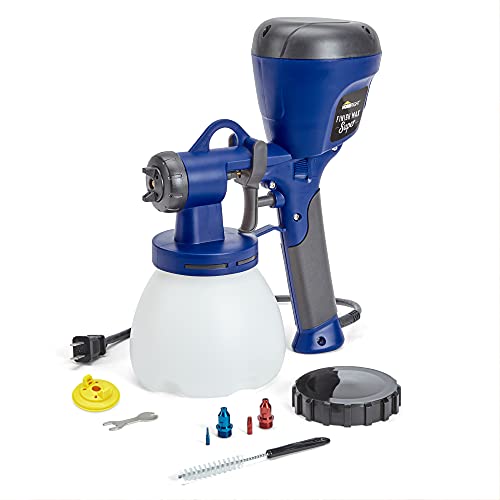
| Small apartment or occasional touch-ups | Compact handheld HVLP | 350–600 W, 600–800 ml cup, adjustable fan | Easy to store, but better suited to small surfaces than whole kitchens |
What separates the best HVLP paint sprayers?
Turbine power
Turbine stages matter more than a large wattage number printed on the box. A single-stage unit can apply thin stains and diluted paint, but it may struggle with cabinet enamel or unthinned water-based coatings. Two-stage systems offer a useful step up for chairs, dressers, tables, and occasional doors. Three- and four-stage turbines produce a steadier stream of air, making them more suitable for thick finishes, long hoses, and repeated cabinet work.
Higher power is not automatically better. A powerful turbine can create more overspray if the fluid control is opened too far or the fan is too wide. It also tends to be louder. For most home furniture, a well-adjusted two-stage system is sufficient; frequent refinishing justifies a three-stage model such as the Fuji Semi-PRO 2 or a comparable turbine package. Fuji Q-series systems sit further toward the professional end, with stronger airflow and better suitability for extended use.
Nozzle size and coating compatibility
The nozzle, needle, and fluid tip determine how well the sprayer atomizes a coating. A 1.3 or 1.4 mm setup is a versatile starting point for water-based furniture enamel, lacquer, shellac, and many clear finishes. A 1.5–1.8 mm tip is more forgiving with thicker primers and latex paint, while a 1.0–1.2 mm tip gives finer control for stains and thin clear coats.
| Coating | Typical nozzle range | Thinning expectation | Practical note |
|---|---|---|---|
| Wood stain | 1.0–1.3 mm | Usually none | Use a narrow fan and keep the gun moving quickly |
| Water-based clear coat | 1.2–1.4 mm | Often none or minimal | Filter the finish to prevent tip blockage |
| Furniture enamel | 1.3–1.5 mm | May need 5–15% water or manufacturer-approved thinner | Test viscosity before committing to the visible surface |
| Latex primer or wall paint | 1.8–2.5 mm | Frequently required | Not every compact HVLP can atomize it reliably |
Always follow the coating manufacturer’s thinning instructions. Unthinned paint can work in a high-powered turbine with a larger tip, but forcing thick paint through a small nozzle produces spitting, rough texture, and excessive strain on the motor. Over-thinning creates weak coverage, runs, and a finish that may not build properly.
Cup capacity and working time
A 600 ml cup keeps a handheld sprayer light, but it may cover only one or two chair components before refilling. An 800–1,000 ml cup is a better balance for dressers, tables, and cabinet doors. A 1,200–1,400 ml cup reduces interruptions on large panels, though the added liquid weight makes the gun tiring.
As a practical estimate, one litre of usable coating may cover roughly 80–120 square feet in a controlled furniture-spraying application, depending on transfer efficiency, fan overlap, and the coating’s solids content. A dresser with six drawers and a cabinet body can therefore consume much more material than its front-facing dimensions suggest.
Controls that improve the finish
- Fluid-flow control: Lets you reduce material output for edges and increase it for broad panels. This is more useful than a simple on/off trigger.
- Fan-width control: A 6–10 inch fan is efficient for doors and tabletops; a 2–4 inch fan gives better control on chair spindles and narrow trim.
- Pattern adjustment: Horizontal, vertical, and round patterns help match the shape of the workpiece.
- Variable air control: Lower air reduces overspray and texture, while higher air helps atomize thicker coatings.
- Long hose: A 15–25 foot hose keeps the turbine away from the wet work and reduces the chance of bumping a freshly coated panel.
Systems from Fuji and Earlex are particularly worth considering when independent air and fluid controls are important. Wagner and HomeRight offer more compact consumer-oriented HVLP options that can be convenient for smaller projects, although their handheld formats generally have less reserve power for thick, unthinned coatings.
Overspray, workspace, and furniture clearance
HVLP means high volume, low pressure—not zero overspray. Fine droplets still travel beyond the workpiece, especially at the ends of a spray pass. For a dining chair, allow at least 3 feet of clear space on every side. For a cabinet door or tabletop, a temporary spray area about 10 feet wide by 12 feet deep gives room to stand, turn, and keep the hose from touching wet paint.
Cover floors and nearby walls with plastic, but use paper or breathable fabric under the workpiece so airborne paint does not remain suspended as long. A box fan should not blow directly across wet paint; it can deposit dust and cause uneven drying. Wear a properly rated respirator, eye protection, and gloves, and follow the coating’s ventilation requirements.
Decision matrix for home users
| Your situation | Best choice | Avoid |
|---|---|---|
| Small apartment with limited storage | Compact handheld HVLP with a 600–800 ml cup and narrow fan | Large four-stage turbine unless you can ventilate and store it safely |
| Children or pets at home | Transfer-efficient turbine, enclosed spray area, and low-odor water-based coating | Spraying in occupied rooms or relying on ventilation alone |
| Renter refinishing removable furniture | Two-stage unit with quick-clean parts and a detachable cup | Permanent spray booths or equipment requiring workshop wiring |
| Back, hand, or shoulder discomfort | Floor-mounted turbine with a lightweight gun and 1,000 ml cup | Heavy handheld units held above shoulder height |
| Regular cabinet projects | Three-stage turbine, 1.3 mm tip, 25-foot hose, and spare fluid set | Single-stage sprayers with no replacement nozzle options |
How to choose between popular HVLP formats
Handheld HVLP sprayers
These combine the motor, gun, and cup in one unit. They are affordable, quick to set up, and practical for a small bookcase, a few chairs, or occasional touch-ups. Their drawbacks are hand fatigue, smaller cups, and a greater tendency for the spray pattern to change as the paint level falls.
Separate-turbine systems
A floor turbine connected to a lightweight spray gun is usually the better choice for professional-looking furniture. The gun is easier to control, the hose keeps warm air away from the coating, and replacement nozzle sets are commonly available. The trade-offs are higher cost, more storage space, and turbine noise.
Market pricing varies by configuration: compact handheld HVLP sprayers usually cost about $60–$180, capable two-stage turbine systems about $250–$600, and more powerful three- or four-stage packages about $600–$1,500 or more. The nozzle set, hose length, filters, and cleaning tools can matter as much as the advertised motor rating.
Setup and maintenance that protect the result
- Strain the coating through a paint filter before filling the cup.
- Spray a test board and adjust viscosity, air, fluid, and fan width together.
- Hold the gun 6–8 inches from the surface and move at a steady speed.
- Overlap each pass by about 50 percent, but do not linger at edges.
- Empty and clean the cup, needle, nozzle, and air cap immediately after spraying.
The parts that wear first are usually the needle and nozzle seals, cup gasket, air-cap openings, and flexible hose connections. Dried paint in the air cap causes lopsided fans; a damaged needle or nozzle causes spitting. Choosing a sprayer with readily available replacement fluid sets can save more frustration than choosing one with a slightly larger motor.
Bottom line
For most furniture owners, the best HVLP paint sprayers are two-stage turbine systems with a 1.3–1.5 mm nozzle, independent air and fluid controls, an 800–1,000 ml cup, and a hose long enough to keep the turbine away from the work. Choose a compact handheld model for occasional small pieces, step up to three stages for cabinets and unthinned coatings, and prioritize replacement parts and controllable overspray over headline wattage.