Our Top Picks
 Franklin Sensors ProSensor MAX 13-Sensor Stud FinderExtra Large9 x 4.5 x 3.1 inches1.1 poundsCheck on Amazon
The best stud finder for plaster walls is a deep-scanning electronic model with many sensors, and on paper the Franklin Sensors ProSensor MAX is the strongest fit because its listing calls out 2.5-in deep detection for thick walls, plaster and OSB. That said, plaster-and-lath is the hardest surface a stud finder can face, and no handheld tool reads it the way it reads modern drywall. A wall that was built by hand a century ago can hide wood lath, wire mesh, horsehair plaster, patched cracks and cavities packed with old insulation, all within a few inches of each other.
So this guide does two jobs. It compares eight electronic and magnetic stud finders from the listings, and it tells you plainly where each one is likely to struggle. We rank them by how well their published features suit plaster, then show you a cheap confirmation step, a small test hole or a magnet pass over lath nails, that turns a maybe into a yes before you drill. If you only need a quick refresher on technique first, our guide on how to use a stud finder and locate stud centers more safely covers the basics.
Top picks at a glance

Franklin Sensors ProSensor M210 13-Sensor Stud Finder, Live Wire Detection | High-Accuracy Stud Finder Wall Scanner, Wood and Metal Stud Detector, Made in the USA, Shows Full Width of Studs


As an Amazon Associate we earn from qualifying purchases. Product prices and availability are accurate as of the date/time indicated.

Original StudPoP Moving Magnet Stud Finder, for Any Construction, 1" Magnet


As an Amazon Associate we earn from qualifying purchases. Product prices and availability are accurate as of the date/time indicated.

Stud Finder, Upgranded Wood and Metal Stud Detector, Live Wire Detection | Fast & Accurate Stud Finder Wall Scanner, Smart Chip, HD LCD Display, Easy to Use, for Drywalls, Floors, Ceilings



As an Amazon Associate we earn from qualifying purchases. Product prices and availability are accurate as of the date/time indicated.

Stud Finder, Upgranded Wood and Metal Stud Detector, Live Wire Detection | Fast & Accurate Stud Finder Wall Scanner, Smart Chip, HD LCD Display, Easy to Use, for Drywalls, Floors, Ceilings


As an Amazon Associate we earn from qualifying purchases. Product prices and availability are accurate as of the date/time indicated.

Franklin Sensors ProSensor M150/X990 9-Sensor Stud Finder, AC Wire Warning | Accurate Stud Finder Wall Scanner With Electric Wire Finder, Wood and Metal Stud Detector, Made in the USA


As an Amazon Associate we earn from qualifying purchases. Product prices and availability are accurate as of the date/time indicated.
Franklin Sensors ProSensor MAX 13-Sensor Stud Finder, 2.5-in Deep Detection | High Accuracy Wood and Metal Stud Finder Wall Scanner For Thick Walls, Plaster, and OSB, Made in the USA, Built-in Level


As an Amazon Associate we earn from qualifying purchases. Product prices and availability are accurate as of the date/time indicated.

CH Hanson Magnetic Stud Finder | Battery-Free Stud Locator with Rare Earth Magnets | Finds Nails & Screws Behind Drywall | Built-In Level for TV Mounting, Shelves & Home Projects







As an Amazon Associate we earn from qualifying purchases. Product prices and availability are accurate as of the date/time indicated.

Franklin Sensors ProSensor M210 13-Sensor Stud Finder, Wire Warning, Green | High-Accuracy Stud Finder Wall Scanner With Electric Wire Finder, Wood and Metal Stud Detector With Level, Made in the USA


As an Amazon Associate we earn from qualifying purchases. Product prices and availability are accurate as of the date/time indicated.
| Model | Key spec | Price tier | Best for |
|---|---|---|---|
| Franklin Sensors ProSensor MAX 13-Sensor | 13 sensors, 2.5-in deep detection, built-in level | Premium | Thick plaster and the best odds of a usable scan |
| Franklin Sensors ProSensor M210 13-Sensor (standard) | 13 sensors, live wire detection, shows full stud width | Mid-range | Thinner plaster over lath, mixed-wall homes |
| Franklin Sensors ProSensor M210 13-Sensor (green, with level) | 13 sensors, wire warning, level | Mid-range | Shelf and picture jobs where the level saves a tool |
| Franklin Sensors ProSensor M150/X990 9-Sensor | 9 sensors, AC wire warning | Mid-range | Lighter jobs on modest plaster |
| CH Hanson Magnetic Stud Finder | Rare earth magnets, built-in level, no battery | Budget | Finding lath nails as a cross-check |
| StudPoP Moving Magnet Stud Finder | 1-in moving magnet, battery-free | Budget | Quick nail and screw locating on any construction |
| JAXWQ Wood and Metal Stud Detector (smart chip, HD LCD) | LCD display, live wire detection | Budget | Light use on drywall-like patches |
| JAXWQ Wood and Metal Stud Detector (basic listing) | Wood and metal detection, live wire detection | Budget | Occasional, low-stakes marking |
Franklin Sensors ProSensor MAX 13-Sensor Stud Finder
This is the one model in the group whose listing speaks directly to plaster. The title advertises 2.5-in deep detection, a 13-sensor array, a built-in level, and use on thick walls, plaster and OSB, with US manufacturing noted. Franklin’s ProSensor design works differently from older single-sensor scanners: instead of sweeping across the wall and waiting for a peak, you press the tool flat and the sensor row lights up to show where denser material sits. That layout suits plaster-and-lath because you are comparing many neighbouring readings at once rather than trusting one swing.
Our estimate, based on the listed depth and the sensor count rather than any measurement of our own, is that this tool will read through typical 3/4-inch to 1-inch plaster-and-lath better than the lower-priced siblings, but it can still show ghosts where lath ends, where a patch was feathered, or where metal lath sits behind the surface. Expect to scan each target area three or four times, recalibrate between attempts, and treat any single reading as provisional. If your walls are over an inch thick overall, check the listing for the exact depth conditions, since depth ratings are normally quoted for ideal materials.
For shelves, mirrors and mid-weight cabinets, the built-in level is a small bonus because it lets you mark a plumb or level reference while you are already holding the tool. Battery type and exact dimensions are not stated in the title, so check the listing.
Pros
- Longest advertised detection depth of the eight, aimed at plaster and thick walls
- 13-sensor array shows stud width rather than only a centre beep
- Built-in level reduces tool juggling during layout
Cons
- Highest cost of the group, hard to justify for one small project
- Still not immune to metal lath, thick patches or inconsistent plaster density
- Depth claims are for ideal conditions, so confirm with a test hole before heavy loads
Who it’s for: owners of older homes with genuinely thick plaster who will scan many walls and want the best published chance of a usable reading.
Franklin Sensors ProSensor M210 13-Sensor Stud Finder
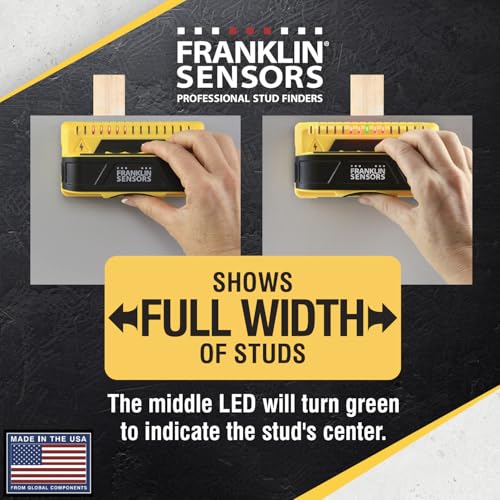
The M210 is the standard-listing version of Franklin’s 13-sensor mid-range model. Its title lists live wire detection, high accuracy for wood and metal studs, US manufacture, and the ability to show the full width of studs. It does not mention a deep-scan rating or plaster use, which is the key difference from the MAX. On a plaster wall that is closer to half an inch to three quarters of an inch of material over the lath, this unit has a reasonable shot; on thicker builds, expect weaker or inconsistent responses.
The practical reason to consider it is the display style. A wide row of sensors lets you see the left and right edges of a stud and spot when the pattern looks implausible, such as a block that is far wider or narrower than a typical 1.5-inch framing member. In plaster this plausibility check matters more than the beep, because lath can produce a broad dense band. In our spec-based estimate, a plausible stud edge should be roughly 1.5 inches wide with another about 14.5 inches over for 16-inch centres, and anything that departs from that deserves a magnet check.
The wire warning is useful in old houses, where cloth-sheathed or retrofitted wiring runs through odd places. Treat it as a caution light only, not a guarantee that a spot is safe to drill, and shut off power to the circuit if you are unsure.
Pros
- 13 sensors give a wider, easier-to-read picture than typical single-sensor tools
- Live wire detection adds a margin of caution in older wiring
- Noticeably cheaper than the MAX while sharing the sensor count
Cons
- No stated deep-scan rating, so thick plaster may defeat it
- Standard listing does not mention a level, so check the listing before you buy
- Readings still need a hand-check on lath walls
Who it’s for: homeowners with moderate plaster who want a wide-sensor display without paying the premium for the deepest model.
Franklin Sensors ProSensor M210 13-Sensor Stud Finder, Wire Warning, Green
This is a second listing of the M210 line, described as green, with a wire warning and a level. The core capabilities in the title match the standard M210: 13 sensors, wood and metal stud detection, an electric wire finder, and US manufacture. The extra detail is the level, which turns it into a two-in-one tool for hanging shelves or a row of frames when you want your stud mark and your level mark from the same device.
For plaster walls specifically, nothing in the title promises deeper reading than the standard M210, so we would expect similar behaviour: decent on thinner plaster, increasingly uncertain as thickness grows. The sensor count is the main advantage over the cheaper tools, since the display lets you judge whether a result looks like a stud, a lath-edge artefact, or a wide dense patch.
A practical workflow with this model is to scan horizontally at three heights, say chest height, knee height and just under the ceiling, and mark where the edges line up vertically. Studs run vertically, so true edges should stack. If the edges wander more than a half inch between heights, the wall is probably confusing the tool, and you should confirm with a magnet or test hole. Compare the listing details against the standard M210 before purchase, because the two listings differ in colour and in the level.
Pros
- Built-in level makes it a good all-round shelf-hanging partner
- Wire warning and wide sensor array for a cautious scan
- Sits in the same price tier as the standard M210 listing
Cons
- No advertised deep-scan range for thick plaster
- Two near-identical listings can confuse buyers, so match the details carefully
- A level does not help with the accuracy problem on lath
Who it’s for: DIYers who want one tool for finding studs and levelling a shelf layout, on walls with plaster that is not unusually thick.
Franklin Sensors ProSensor M150/X990 9-Sensor Stud Finder
The M150/X990 sits one step below the M210 line, with a 9-sensor array, an AC wire warning, wood and metal stud detection and US manufacture. The lower sensor count means a narrower picture of the wall in a single placement, so you will do more repositioning to establish where a stud begins and ends. On drywall that is a minor inconvenience. On plaster it is more significant, because each extra reading helps you decide whether a signal is a stud or just a dense stretch of plaster.
Because the title does not mention deep detection or plaster, we would put this tool in the lighter-duty category: worth considering if your walls are thin plaster skim over rock lath or plasterboard (a 1950s-era hybrid), and less convincing for thick, original, hand-troweled walls. Rock lath, sometimes called gypsum lath, is a gypsum board base that takes plaster much like drywall, and electronic finders generally handle it better than wood lath.
Our spec-based estimate is that this model is a decent lower-cost option within the Franklin range if your goal is to find the approximate stud location, and then confirm it with a magnet or a pilot hole. It is not the model we would choose if you expect to rely on the screen alone for hanging heavy items.
Pros
- Lower cost than the 13-sensor models with the same brand design approach
- AC wire warning included
- Reasonable for thin plaster over rock lath or hybrid walls
Cons
- Fewer sensors, so a less detailed picture of the wall
- No deep-scan claim in the title
- A weaker choice for thick wood-lath plaster
Who it’s for: owners of 1940s to 1960s homes with thinner plaster who want a name-brand electronic tool without stepping up to the 13-sensor line.
CH Hanson Magnetic Stud Finder
This battery-free finder uses rare earth magnets to locate nails and screws behind the wall surface, and the title also lists a built-in level for TV mounts, shelves and home projects. It is the least glamorous tool here and, for plaster-and-lath, quite possibly the most useful second opinion. The logic is simple: in lath construction, the lath strips are nailed to every stud they cross, so a line of nail heads running vertically often reveals where the stud is, regardless of how thick the plaster is.
The catch is that magnets work only if the pull is strong enough to reach through the plaster, and the thickness limit depends on the magnet and the wall; the listing should say more, and we are not quoting a figure. You also learn only where a metal fastener is, not where the stud ends, so you will need to find several nails and judge the line they form. Cut nails in old lath can be rusty and weakly magnetic, which affects sensitivity.
We like pairing this with an electronic unit: scan electronically, mark what the screen says, then run the magnet over your marks. If the magnet finds a vertical row of nails where the electronic tool says stud, your confidence jumps. If it finds nothing at all, drill a hidden pilot hole before trusting either tool.
Pros
- No batteries to fail and no calibration needed
- Finds lath nails, which line up with studs in many old walls
- Low cost and handy as a cross-check
Cons
- Detects fasteners only, not wood, wire or pipe
- Reach through very thick plaster is limited by magnet strength
- Can mislead near metal lath, corner bead or plumbing
Who it’s for: anyone with a plaster wall who wants a cheap confirmation tool, whether or not they own an electronic scanner.
Original StudPoP Moving Magnet Stud Finder, 1-Inch Magnet
StudPoP takes a different approach from fixed magnets: the title describes a moving magnet that is meant to work on any construction, with a 1-inch magnet at its heart. The moving element is designed to be pulled toward fasteners so you get a visible cue when it finds metal, often a distinct motion or snap. That feedback can be easier to spot than a quiet drag on a stationary magnet, especially on textured or painted plaster.
For plaster-and-lath, the same principle applies as with the other magnet: you are finding nails, not studs. Take your time, move slowly in a grid, and note the points where it reacts. A true stud typically produces a repeating vertical line of reactions at roughly the lath spacing, while a single reaction is more likely a stray nail, anchor or repair. Because the finder is described as working on any construction, it is also a sensible tool to keep around for the drywall rooms of the house.
The listing does not publish a maximum plaster depth, so we would not claim one; thick walls may reduce the response. Treat the tool as a way to build a pattern, then verify the pattern with a pilot hole.
Pros
- Battery-free, simple to use, and cheap
- Moving magnet gives a visible reaction when it finds metal
- Works regardless of plaster density or electronic noise
Cons
- Only finds metal fasteners, and rusted nails may react weakly
- No stated depth limit, so thick plaster may hide fasteners
- No level, wire detection or stud-width readout
Who it’s for: budget-minded owners who want a low-cost way to hunt lath nails before drilling.
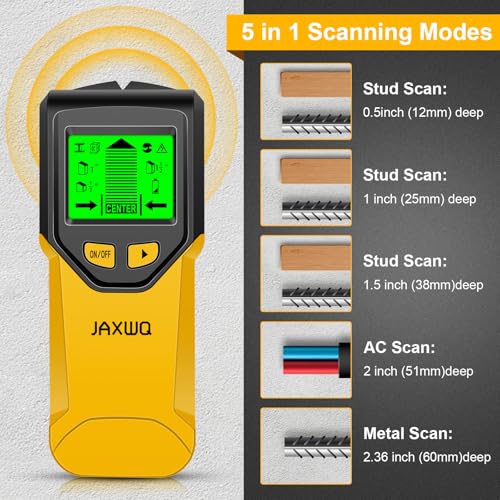
JAXWQ Wood and Metal Stud Detector with Smart Chip and HD LCD
This is an inexpensive electronic detector whose title promises wood and metal stud detection, live wire detection, a smart chip, an HD LCD display, and use on drywalls, floors and ceilings. Note what is missing: the listing speaks to drywall rather than plaster, and does not state a depth. Low-cost single-sensor scanners usually rely on measuring changes in the wall’s dielectric properties as you slide across it, and that method becomes unreliable on plaster, where thickness and density change from patch to patch.
In our spec-based estimate, a tool at this tier may work on a smooth, thin plaster skim over plasterboard and may produce erratic results over wood lath. The LCD display is helpful for seeing signal strength rather than guessing at a beep, and a wire warning is a sensible safety add-on in any house. But if you are shopping specifically for plaster, you should treat this as a light-duty marker and not a primary guide.
If you buy it anyway, calibrate with the tool held flat on a spot you believe is empty, scan slowly in both directions, and compare at multiple heights. Do not drill straight into the centre point; test first. The listing details on battery type and the exact sensing depth are worth reading before purchase.
Pros
- Low cost and a readable LCD display
- Includes live wire detection in the listing
- Useful on modern drywall elsewhere in the house
Cons
- Listing targets drywall, not plaster, and gives no depth figure
- Single-sweep technique is easily confused by lath and patches
- Brand has less documentation than the established names
Who it’s for: occasional users who need a basic detector for drywall rooms and are prepared to verify any plaster result by hand.
JAXWQ Wood and Metal Stud Detector, Live Wire Detection (Basic Listing)
The second JAXWQ listing carries a much shorter title, naming wood and metal stud detection and live wire detection and little else. It appears to be a sibling of the smart-chip listing above, but the title does not confirm the display, the chip or the drywall, floor and ceiling use, so compare the product pages carefully and look at the images before deciding between them. We are not going to assume features the title does not state.
For plaster walls, our assessment mirrors the other JAXWQ: it may give a rough indication on thin, even plaster, and it is not designed to cope with thick or lath-backed material. Because it costs about the same as the other listing, the sensible approach is to pick whichever page gives clearer specifications on sensing depth and battery type. If neither page gives a depth figure, that is a signal to look elsewhere or to treat the tool as a rough pre-scan only.
The wire detection feature is the best argument for owning a tool like this: in plaster walls, the cable that powers a light switch can run in unexpected places, and a warning is better than no warning. Use it to rule areas out, not to declare them safe.
Pros
- Very low cost and simple concept
- Wire detection listed in the title
- Fine as a backup or garage tool
Cons
- Sparse listing information, so check the product page for details
- No plaster or depth claim
- Likely to give inconsistent readings over wood lath
Who it’s for: shoppers on a tight budget who only need a rough indicator and will confirm every mark with a magnet or test hole.
How we picked these
The Editorial team did not run in-person tests for this guide, and we will not pretend otherwise. Our testbench for this article is published specifications, manufacturer documentation and buyer reviews, read side by side. We pulled the eight listings from the retailer, compared what each title and bullet actually claims about detection depth, sensor count, wire warnings, levels and power source, and then weighted those claims against the particular problem of plaster-and-lath walls.
Three questions drove the ranking. First, does the listing mention thick walls or plaster, or only drywall? Only the ProSensor MAX does. Second, how much information does the display give you? A 13-sensor array that shows stud width helps you spot a bad reading, while a single beep gives you nothing to cross-check. Third, how well does the tool handle its own failure? A magnet cannot be miscalibrated, so it is a good partner for any electronic unit.
We also read common themes in buyer feedback on tools of this type, such as calibration issues, false positives near corners and difficulty on textured or old walls, and treated them as risks to flag rather than as measurements. Where a listing was silent, for example on battery type or exact depth, we said so and told you to check the listing. We did not invent specifications, and any performance expectation in this article is an estimate based on published features. Price tiers (budget, mid-range, premium) are judged from the listing price, and the live price cards on the page will always be the final word.
If you want to pair a stud finder with a layout tool for shelves, our look at self-leveling laser levels is a useful next read, and our main roundup of the best stud finders for wall studs and hanging jobs covers general-purpose picks beyond plaster.
What to look for in a stud finder for plaster walls
Understand what you are scanning
Plaster walls come in three broad types, and your tool choice depends on which you have. Traditional plaster over wood lath is the oldest: thin wood strips, usually about 1/4 inch thick and an inch or so wide, are nailed horizontally across the studs with small gaps between them, and wet plaster is pressed through the gaps to form keys. Plaster over metal lath uses an expanded metal mesh, which fools nearly every electronic scanner because the metal reflects the sensing field everywhere. Plaster over rock lath or gypsum lath, common in mid-century homes, is the friendliest to electronic tools because the base is board-like.
To work out which you have, look at an unobtrusive spot such as the back of a closet, an outlet opening with the cover plate removed (power off), or an old hole. Wood lath shows narrow wooden strips; metal lath looks like rusted mesh; rock lath is a grey-white board. Total thickness is usually somewhere between 3/4 and 1 inch for wood-lath walls, though old, uneven walls can be thicker. That thickness is the first number to compare against any tool’s depth rating.
Deep scan mode and published depth
Standard scan modes are tuned for drywall, which is typically a half inch thick. Plaster walls can be double that or more, so a deep mode or a clearly stated detection depth matters more here than it does elsewhere. Among the eight picks, the ProSensor MAX is the only one that states a depth in its title, 2.5 inches. For the others, the listing may or may not provide one, and a missing figure is a reason to be cautious.
Remember that depth ratings are normally best-case. They assume a uniform material and a stud that sits directly behind it, which plaster-and-lath seldom provides. A tool rated for 2.5 inches may deliver a clean reading through 1 inch of plaster and lath in some places and an uncertain one in others.
Sensor count and what the display shows
Multi-sensor arrays, like the 9- and 13-sensor Franklin tools, let you see the shape of the dense region rather than a single peak. That is useful on plaster because the shape tells you if the reading is plausible. A real stud should appear as a band about 1.5 inches wide (a 2×4 on its narrow face) with repeating bands about 14.5 inches apart on 16-inch centres, or 22.5 inches apart on 24-inch centres. If you see a 4-inch dense band, you are probably looking at lath, a patch, or a pipe.
Single-sensor tools can still help, but they ask more of you. You will need to scan from both directions, mark the left edge and the right edge, and take the midpoint, and you must ensure the tool is calibrated on a spot that is not itself dense.
Metal and live wire detection
Metal detection helps you avoid nails, screws and pipes, but in plaster walls it can also trigger on lath nails, which is exactly what you are looking for with a magnet. Live wire detection is a safety aid for old homes, where wiring paths are less predictable than in new construction. It is not a replacement for turning off the breaker or using a dedicated non-contact voltage tester before any deep drilling.
Magnets as a backup, not a replacement
A magnetic finder costs little, never needs a battery and works on every wall type that has metal fasteners. Their weakness is that they find nails, not wood. In old lath-and-plaster walls, that is often enough, because lath is nailed to each stud with several nails, producing a line you can follow. Combine two or three magnet hits along a vertical line with an electronic reading that agrees, and you have strong evidence.
Features that matter less on plaster
Backlit screens, audio beeps, colours and body shape matter little compared with sensing quality. A built-in level is a pleasant extra, and the ones in the CH Hanson and Franklin MAX listings can save a step during layout, but they will not improve accuracy. Do not pay a premium for features that do not address the underlying problem, which is how well the tool reads through plaster.
The test hole
Whatever tool you buy, keep a thin drill bit and a pack of spackle in your kit. A pilot hole about the size of a finishing nail, placed where the object you are hanging will cover it, lets you feel for wood with a straight wire. Probe at the centre, then a half inch left and right, and you know the stud’s edges within a small margin. This single step turns a stud finder from a guessing device into a navigation aid, and it matters most when you hang something heavy like a TV, a wall cabinet or a loaded shelf. Our guide on mounting shelving with a stud finder walks through weight and fastener choices after you have found the studs.
Plaster-wall mistakes that cost you extra holes
Trusting a single scan. Plaster is inconsistent, so one pass is a coin flip. Scan at three heights, in two directions, and check that the stud edges stack vertically. If they wander more than a half inch, the tool is confused and you should stop and confirm another way.
Calibrating on a bad spot. Most electronic tools set their baseline when you power them on or press a button. If you do that over a stud, a patch or a thick plaster build-up, every reading afterward is off. Start in an area you expect to be empty, then recalibrate somewhere else if the results look odd.
Ignoring the wall type. Metal lath will defeat most electronic units, and no setting fixes that. If a scanner lights up everywhere, you may have mesh behind the plaster. Switch to a magnet to find fasteners or use a test hole.
Skipping wire checks. In older homes, wiring routes are less predictable, and some cable was added later through existing walls. A wire warning can help, but it is not infallible. Shut off the breaker if you plan to drill deeper than a pilot hole near switches or outlets.
Using drywall anchors without understanding the wall. Plaster crumbles around hollow-wall anchors designed for drywall. If you cannot hit a stud, use anchors rated for plaster and drill a pilot hole first to avoid blowing out the face. For heavy items, always aim for studs.
Paying for features that do not help. A louder beep or a colourful LCD does not make the sensing better. Compare detection depth, sensor count and cross-check options before looking at extras.
Verdict
If your walls are genuinely thick plaster and you want the best published chance of a clean reading, the Franklin Sensors ProSensor MAX is our top pick, mainly because it is the only listing that states 2.5-in deep detection and names plaster. For a better balance of price and capability, the ProSensor M210 line (especially the green listing with the level) is the mid-range option, with the M150/X990 as the lighter-duty alternative for thinner walls.
The budget pick is a magnet. The CH Hanson or the StudPoP will not tell you where a stud is, but they can locate the lath nails that point to it, and they work with no batteries. Buy one even if you also buy an electronic unit. The two JAXWQ detectors are for light use on drywall rooms, and we would not rely on them for plaster. Whichever you choose, finish with a small test hole before you hang anything heavy.
Frequently asked questions
Can any stud finder work reliably on plaster and lath walls?
None works reliably on its own. Plaster-and-lath walls vary in thickness, density and hidden metal, so electronic scanners can drift, flicker or miss edges. Deep-scan models with many sensors give you the best chance of a usable reading, and a magnet can find lath nails. Treat every result as a hypothesis, then confirm with a small test hole or a magnet pass before you commit to hanging anything heavy such as a TV or a loaded bookcase.
Why does my stud finder beep or light up across the whole wall?
Plaster is dense and uneven, and the lath strips behind it, the metal mesh in some walls and even thick paint layers can make the density change look constant. The scanner may calibrate on a thick patch and then read everything as a stud. Recalibrate on a fresh area, try deep mode, scan in several directions, and compare readings at a few heights. If the pattern still looks random, switch to a magnet or a test hole.
Is a magnetic stud finder a good choice for plaster walls?
It is a useful second opinion. A rare-earth magnet locates the nails or screws that hold lath to the studs, and those fasteners usually line up vertically at stud locations. It needs no battery and ignores plaster density, but it only finds metal fasteners, can be fooled by pipes or metal lath, and gives you a spot rather than the full stud width. Pair it with an electronic unit for best results.
How can I confirm a stud before hanging something heavy?
Drill a small pilot hole, about the size of a thin finishing nail, in a spot that will be hidden by the item you are hanging. Push a straight wire or thin bit through and feel for solid wood versus a hollow gap. Then probe a half inch to each side to find the edges. Fill the extra holes with spackle. This takes a few minutes and is far more trustworthy than a beep.
Do I need a deep scan mode for plaster walls?
Usually yes. Plaster plus lath can be well over three quarters of an inch thick, and some old walls are thicker where plaster was built up to hide waviness. Standard modes are meant for typical drywall depth and may stop reading through that much material. A deep or thick-wall mode, or a model that lists a deeper detection depth, widens your odds, though it still will not guarantee a clean reading.