Key takeaways
- Compact walk-behind: Lowest purchase cost and easiest storage. It suits homeowners who can accept slower cutting and manual repositioning. Some models weigh less than 300 pounds; others exceed 500 pounds.
- Self-propelled wheeled grinder: A practical middle ground for several stumps. Drive controls reduce lifting and make slopes easier, but the machine may weigh 900 pounds or more.
- Tracked grinder: Best for muddy ground, slopes, and repeated repositioning. Tracks distribute weight better than narrow tires, although they cost more and can damage soft lawns during tight turns.
- Towable grinder: Efficient for contractors with a suitable vehicle and trailer. It is not automatically the easiest option: loading, tie-downs, ramps, registration requirements, and storage all become part of the job.
Best Stump Grinders for Fast, Effective Yard Clearing
The best stump grinder for most homeowners is a compact walk-behind machine with a 13–15 hp engine, a cutting wheel of about 14–16 inches, and a grinding depth of at least 12 inches below grade; frequent land-clearing work usually justifies a towable or self-propelled grinder with 25–40 hp and a wider cutting arc.
Choosing between those categories matters more than simply buying the machine with the largest engine. Cutting-wheel diameter, cutter-tooth design, operating clearance, transport weight, and control layout determine how quickly a grinder clears a stump and whether it is practical for your property.
Our top picks


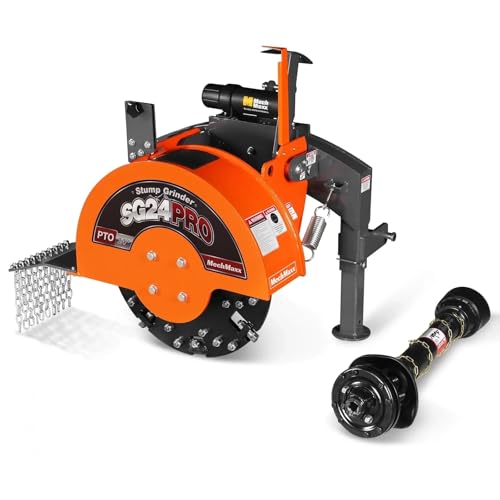

As an Amazon Associate we earn from qualifying purchases at no extra cost to you. Ratings are shown as listed on Amazon.
Best stump grinders by job type
| Situation | Best machine type | Useful specifications | Typical market range |
|---|---|---|---|
| One or two small residential stumps | Compact handlebar walk-behind | 13–15 hp, 14–16 in. wheel, 8–12 in. below-grade depth, 250–500 lb | $2,000–$4,500 |
| Several backyard stumps behind a gate | Self-propelled compact grinder | 25–35 hp, 20–26 in. wheel, 12–16 in. depth, 900–1,600 lb | $8,000–$18,000 |
| Regular contractor or land-clearing work | Tracked or towable commercial grinder | 35–75 hp, 26–40 in. wheel, 16–24 in. depth, 1,500–4,000 lb | $18,000–$60,000 or more |
| Stumps beside fences, walls, or buildings | Narrow compact grinder | 24–30 in. overall width, offset cutting head, 8–14 in. depth | $3,000–$15,000 |
What separates the leading choices
1. Cutting-wheel size and tooth design
A larger wheel can sweep through a wider section of stump and reach deeper below grade, but it also adds weight and requires more engine power. A 14–16-inch wheel is adequate for typical ornamental and small hardwood stumps. A 20–26-inch wheel is more productive on large trunks, while commercial machines may use wheels 30 inches or larger.
Count and inspect the cutting teeth rather than focusing only on wheel diameter. Replaceable carbide-tipped teeth generally tolerate soil contact better than inexpensive fixed cutters. Teeth wear fastest when the operator repeatedly bites into dirt, stones, concrete edging, or buried metal. A grinder with easy-access tooth pockets reduces maintenance downtime.
2. Grinding depth and side-to-side reach
For replanting or installing turf, aim for at least 8–12 inches below surrounding soil. If the area will receive a patio, retaining wall, or footing, confirm the required excavation depth separately; a stump grinder is not a substitute for removing all contaminated soil and roots.
Vertical depth is only part of the calculation. Measure the wheel’s lateral sweep and the machine’s offset. A narrow grinder may reach a stump between a fence and a house, while a wider model may clear the stump faster but fail to fit through the access route. Allow additional clearance for the operator, controls, and machine movement—not just the published body width.
3. Engine power and hydraulic performance
Engine horsepower affects how aggressively the wheel can cut without bogging down. Around 13–15 hp works for small, accessible stumps when the operator takes shallow passes. Engines in the 25–35 hp range provide a better balance for multiple hardwood stumps. Machines above 40 hp are sensible when daily production, large diameters, or deeply embedded roots are involved.
On self-propelled and tracked grinders, hydraulic flow influences travel speed and cutter response. A powerful engine paired with weak hydraulics can still feel slow when repositioning or swinging the cutting head. For frequent work, compare both engine output and the manufacturer’s rated cutting or hydraulic specifications.
Walk-behind, self-propelled, or towable?
- Compact walk-behind: Lowest purchase cost and easiest storage. It suits homeowners who can accept slower cutting and manual repositioning. Some models weigh less than 300 pounds; others exceed 500 pounds.
- Self-propelled wheeled grinder: A practical middle ground for several stumps. Drive controls reduce lifting and make slopes easier, but the machine may weigh 900 pounds or more.
- Tracked grinder: Best for muddy ground, slopes, and repeated repositioning. Tracks distribute weight better than narrow tires, although they cost more and can damage soft lawns during tight turns.
- Towable grinder: Efficient for contractors with a suitable vehicle and trailer. It is not automatically the easiest option: loading, tie-downs, ramps, registration requirements, and storage all become part of the job.
Transport and access requirements that listings often omit
Before buying, measure the narrowest point from the driveway to the stump. Include gates, fence posts, downspouts, retaining walls, and turning space. A machine advertised as 30 inches wide may still need several more inches of practical clearance if its handles, guards, or controls extend outward.
| Transport question | Homeowner benchmark | Why it matters |
|---|---|---|
| Gate or side-yard width | Measure at least 4–6 inches wider than the machine | Leaves room for uneven ground and avoids scraping controls or siding |
| Trailer payload | Rated capacity should exceed machine weight by at least 20% | Allows for fuel, ramps, chains, tools, and other equipment |
| Loading method | Use ramps rated above the grinder’s gross weight | A small utility trailer may not safely handle a 1,000-pound machine without suitable ramps |
| Storage footprint | Plan roughly 3 by 6 feet for a compact unit, more for tracked models | Handles and guards need space, and fuel equipment requires appropriate ventilation |
Never rely on a pickup tailgate or improvised boards for loading a heavy grinder. Use manufacturer-approved loading points, secure the cutter head, chock the wheels or tracks, and tie the machine down at multiple structural points.
Safety features worth paying for
Look for a cutter-wheel guard that limits thrown chips, a clearly accessible operator-presence control, an emergency-stop switch, parking brakes, and a neutral or interlock system that prevents cutting during transport. A remote control can improve visibility around large machines, but it does not remove the need to keep people, pets, and bystanders outside the exclusion zone.
Automatic clutch engagement, wheel braking, and protected hydraulic hoses are useful additions. Check whether the guard remains effective at the maximum swing angle and whether routine tooth changes can be completed without reaching near the cutting wheel. Eye, hearing, foot, and leg protection remain necessary even with good machine guarding.
Cost of ownership: what wears first
Cutting teeth are the routine consumable. Keep a spare set and the correct torque tools available, because dull or damaged teeth increase vibration, fuel use, and cutting time. Belts, bearings, wheel pockets, hydraulic hoses, and track components are the next likely maintenance costs on frequently used machines.
For occasional residential work, renting a commercial grinder usually costs less than owning, storing, transporting, and maintaining one. Purchase becomes easier to justify when you clear multiple properties each month, already own the towing equipment, and can perform basic servicing. General rental pricing often falls around $150–$400 per day for compact equipment and $400–$1,000 or more for larger tracked machines, varying by region and delivery.
A practical buying decision
- Choose a compact walk-behind if access is narrow, stumps are under about 20 inches across, and you expect only occasional use.
- Choose a self-propelled machine if you have several stumps, slopes, or heavy hardwoods and want less manual pushing.
- Choose a tracked grinder if ground conditions are soft or uneven and productivity matters more than a small storage footprint.
- Choose a towable commercial unit if you regularly clear large stumps and have a properly rated tow vehicle, trailer, and loading setup.
- Rent instead of buying when the job is limited to one project or your access measurements are uncertain.
Final recommendation
For most homeowners, prioritize access width, manageable weight, carbide-tipped replaceable teeth, a 13–15 hp engine, and at least 8–12 inches of below-grade grinding depth. Frequent land-clearing operators should move up to a self-propelled or tracked grinder with 25 hp or more, a larger cutting wheel, hydraulic travel, and serviceable commercial components. The fastest machine on paper is not the best choice if it cannot pass through the gate, be transported safely, or be maintained when its first set of teeth wears out.