Key takeaways
- Best TIG Welders for Precise, Clean Welding For the best TIG welders, choose an AC/DC machine with adjustable pulse and a foot pedal if you need one welder for steel, stainless steel, and aluminum; choose a DC-only unit if you’ll…
Best TIG Welders for Precise, Clean Welding
For the best TIG welders, choose an AC/DC machine with adjustable pulse and a foot pedal if you need one welder for steel, stainless steel, and aluminum; choose a DC-only unit if you’ll weld steel and stainless steel and want a simpler, less expensive setup. Match the machine’s output and duty cycle to your material thickness and work schedule, then check torch comfort and gas controls before buying.
Choose by the work you’ll actually do
| Situation | What to look for | Why it matters |
|---|---|---|
| Mostly steel or stainless, up to about 1/8 in. (3 mm) | DC TIG, roughly 150–200 A output, foot-pedal compatibility | DC TIG is effective on these metals; extra AC functions add little if aluminum is off the list. |
| Aluminum repairs or fabrication, up to about 1/4 in. (6 mm) | AC/DC TIG, adjustable AC balance, at least about 200 A | Aluminum needs AC TIG to manage its oxide layer. Thick parts and long welds need more output and cooling capacity. |
| Fine work on thin sheet or small components | Stable low-amp start, adjustable downslope, pulse, and a small torch | Good low-end control helps prevent burn-through and makes it easier to finish a weld without leaving a crater. |
| Frequent production or long welds | A high duty cycle at the amperage you use, plus a water-cooled torch if needed | A machine’s maximum amperage is less useful if it must cool down after short welding periods. |
AC/DC capability: the first major decision
DC TIG is the usual choice for mild steel and stainless steel. It produces a controlled arc and clean welds when the joint is prepared well and shielding gas coverage is steady. A DC-only welder is often the better value if aluminum is not part of the job.
Our top picks


As an Amazon Associate we earn from qualifying purchases at no extra cost to you. Ratings are shown as listed on Amazon.
For aluminum, look for AC TIG. Alternating current helps break up the oxide layer that forms on aluminum’s surface, while allowing the weld pool to form in the metal beneath it. Useful AC controls include adjustable balance, which changes the cleaning action relative to penetration, and adjustable frequency, which can help focus the arc. These settings are valuable, but they don’t replace clean metal, correct filler, or careful fit-up.
Some AC/DC machines also offer stick welding, pulse settings, and memory programs. Treat these as useful extras, not substitutes for a stable TIG arc, a suitable torch, and controls you can operate comfortably.
Amperage and duty cycle: compare the working range
Amperage affects how quickly a welder can heat a joint, but the best machine is not simply the one with the highest maximum output. For thin sheet, stable operation at low amperage matters more than a large top-end number. For thicker aluminum or steel, higher output can help, provided the machine can sustain it.
Duty cycle tells you how long a welder can operate within a 10-minute period at a stated output before it needs to cool. For example, a 40% duty cycle at 200 A means four minutes of welding at that output followed by six minutes of cooling under the manufacturer’s stated conditions. Compare duty-cycle figures at the amperage you expect to use; the rating at maximum output may differ sharply from the rating at a lower setting.
| Work pattern | Practical target | Buying implication |
|---|---|---|
| Short hobby welds with pauses | About 20–40% duty cycle at your typical amperage | A compact air-cooled setup may be adequate. |
| Longer fabrication sessions | About 40–60% or more at your typical amperage | Check the published rating carefully; consider torch cooling and workshop ventilation. |
| Frequent, sustained welding | High duty cycle at the output you need | Prioritize thermal capacity and serviceability over extra preset features. |
These are comparison targets, not guarantees of the thickness a machine can weld. Joint design, metal type, preparation, and welding position all affect the result.
Torch comfort and gas setup affect weld quality
A TIG torch is held close to the work, often at an awkward angle. A flexible cable, a comfortable handle, and a torch head sized for the task can make precise work easier. A small air-cooled torch is convenient for light jobs but can become uncomfortable during higher-amperage welding. For sustained high-output work, a water-cooled torch can reduce heat in the handle, though it adds a cooler, hoses, and more setup.
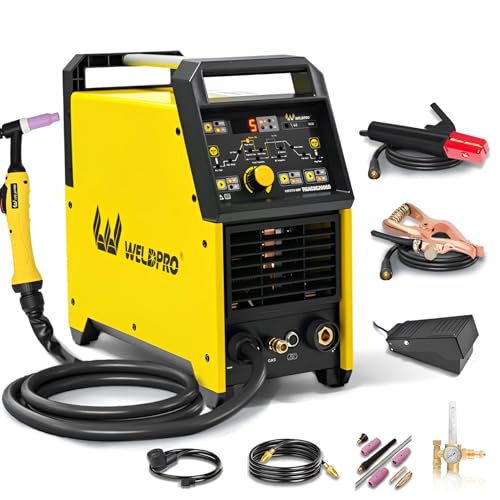
Check what the welder includes and what it requires: torch, foot pedal or fingertip control, regulator or flowmeter, gas hose, and consumables may be sold separately. TIG typically uses argon shielding gas. You’ll need a cylinder, regulator or flowmeter, and a secure way to store the cylinder upright. Set gas flow according to the torch, cup, and working conditions; excessive flow can cause turbulence and draw air into the shielding zone rather than improve coverage.
A foot pedal is especially useful when you need to adjust heat as the part warms up. If you weld in tight spaces or must keep both hands positioned carefully, check whether the machine supports fingertip amperage control instead. Confirm compatibility before ordering a control accessory.
Material performance: steel, stainless, and aluminum
| Material | Process and setup | Common trade-off |
|---|---|---|
| Mild steel | DC TIG, usually argon shielding gas | Forgiving compared with aluminum, but rust, mill scale, oil, and poor fit-up can still contaminate a precise weld. |
| Stainless steel | DC TIG, suitable stainless filler, careful heat control | Too much heat can discolor or distort thin material; shielding the back of a joint may be necessary for corrosion-sensitive work. |
| Aluminum | AC TIG, clean surface, compatible aluminum filler | Conducts heat quickly and has a tenacious oxide layer; clean immediately before welding and use AC controls suited to the part. |
For all three materials, TIG’s precise control comes with a slower pace and a greater need for clean surfaces than many other welding processes. A welder cannot compensate for a contaminated joint or incorrect filler rod.
Which type is the best fit?
Best value for steel and stainless: DC TIG inverter
If aluminum is not on your project list, a DC-only inverter with a usable low-amp range, foot-pedal support, and a clear duty-cycle rating is a sensible choice. It avoids paying for AC controls you may never use. This category suits repairs, brackets, exhaust components, and small fabrication work, subject to the machine’s rated output.
Best one-machine choice across metals: AC/DC TIG inverter
For a home workshop handling steel, stainless, and aluminum, an AC/DC model is the most versatile option. Prioritize adjustable AC balance, stable starts, pulse if you work on thin material, and compatible pedal control. A higher amperage rating is useful only if your electrical supply and duty-cycle needs support it.
Best for extended high-output work: AC/DC unit with cooling provisions
If you regularly weld thick sections or make long runs, consider a machine with a stronger duty cycle at your working amperage and support for a water-cooled torch. The added equipment takes space and costs more, so it is unnecessary for occasional short welds.
Check power and included equipment before buying
Confirm the machine’s input-voltage requirements against your workshop circuit, especially if you plan to use its highest output. Verify whether the advertised package includes the torch, pedal, regulator, and gas hose; budget for missing essentials and consumables. Also check connector compatibility, available service support, and the manufacturer’s stated duty cycle rather than relying on the maximum-amperage figure alone.
For most home fabricators, the decision is simple: buy DC TIG for steel and stainless only, or AC/DC TIG if aluminum matters. Within either category, prioritize a stable low-amperage arc, adequate duty cycle for your actual sessions, and a torch and control setup you can use comfortably.