
Key takeaways
- Choose a 14-inch abrasive model if you need affordable capacity for tube, angle iron, and flat bar.
- Choose the Evolution S355MCS if angled and compound cuts are central to the project.
- Choose the Makita LW1401 if the saw must be carried and stored frequently.
- Choose the Bosch GCO14-24 or DeWalt D28730 for a stable, general-purpose fabrication station.
- Choose a cold-cut saw when low heat, minimal sparks, and cleaner finished edges matter more than the lowest operating cost.
The best chop saws for fast, precise metal cuts are the Evolution S355MCS for versatile miter work, the DeWalt D28730 for dependable everyday fabrication, the Makita LW1401 for a lighter 14-inch setup, and the Bosch GCO14-24 for a strong combination of power, capacity, and controlled cutting.
Abrasive chop saws remain the practical choice for cutting steel tube, angle iron, rebar, threaded rod, and other ferrous metal quickly. Cold-cut metal saws generally produce less heat and fewer sparks, but they cost more and use specialized blades. When comparing the best chop saws, look beyond motor wattage: blade diameter, vise rigidity, miter adjustment, spark direction, and the effort required to move the saw often matter more in real workshop use.
Our top picks



As an Amazon Associate we earn from qualifying purchases at no extra cost to you. Ratings are shown as listed on Amazon.
Best chop saws by cutting situation
| Situation | Best fit | Why it stands out | Typical market range |
|---|---|---|---|
| General steel fabrication | DeWalt D28730 | 14-inch blade, strong motor, practical quick-adjust vise | Usually $250–$400 |
| Frequent angled cuts | Evolution S355MCS | More flexible miter setup and compound-cut capability | Usually $500–$750 |
| Portable jobsite work | Makita LW1401 | Compact 14-inch design with a manageable carrying weight | Usually $250–$400 |
| High-volume straight cutting | Bosch GCO14-24 | Powerful motor, large abrasive wheel, substantial base | Usually $300–$500 |
| Budget workshop use | Metabo CS 23-355 | Large blade and useful capacity without premium features | Usually $200–$350 |
Head-to-head: what separates the leading models
Evolution S355MCS: best for accurate angled cuts
The Evolution S355MCS is the most adaptable choice when a project involves more than repeated 90-degree cuts. Its 14-inch blade platform supports a broad range of steel, aluminum, and other metal-cutting work, while its miter arrangement is designed for more flexible angle cutting than a basic abrasive saw.
Its major advantage is control over compound and miter work. That is useful when building steel furniture frames, brackets, gates, or shelving where several pieces must meet cleanly. The trade-off is size, price, and complexity. A saw with more adjustments takes longer to set accurately, and its larger body needs a dedicated bench area. It is best for a stationary fabrication corner rather than someone who carries a saw from room to room.
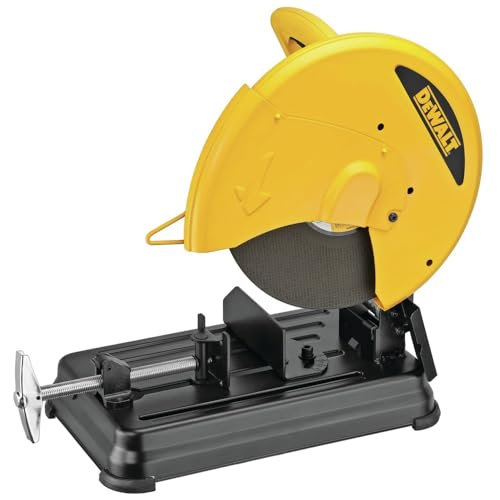
DeWalt D28730: best all-around abrasive chop saw
The DeWalt D28730 is a sensible middle ground for users who want a conventional 14-inch chop saw with a powerful motor and a sturdy work base. Its quick-adjust vise makes repeated cuts faster than a basic threaded clamp, while the miter adjustment handles common angled cuts without turning the saw into a specialist machine.
This is the type of saw that suits square tube, angle stock, flat bar, and rebar. Its limitations are typical of abrasive models: the cut becomes hot, the kerf is wider than a cold-cut saw, and the abrasive wheel gradually becomes smaller as it wears. For occasional household metalwork, a 14-inch abrasive saw offers a useful balance of capacity and purchase cost.
Makita LW1401: best when portability matters
The Makita LW1401 is a practical option for a workshop that must be packed away after use. Its 14-inch wheel gives it the capacity expected from a full-size chop saw, but the overall design is easier to move than especially heavy industrial-style models.
Portability does not mean lightweight operation. A chop saw still needs a stable surface, room for long stock, and a clear spark path. The Makita is most useful when you can carry it to a driveway, garage workbench, or temporary fabrication table, then store it vertically or on a lower shelf. Check the exact model’s included vise and angle range before buying, because some versions prioritize straightforward 90-degree work over elaborate miter adjustment.
Bosch GCO14-24: best for demanding straight cuts
The Bosch GCO14-24 is aimed at users who value a substantial base and strong cutting performance over minimum weight. Its 14-inch abrasive wheel is appropriate for larger steel sections, and the vise is designed for holding common stock securely during repeated cuts.
The heavier construction can reduce movement when cutting thick material, which helps keep the blade tracking consistently. The downside appears when the saw must be carried up stairs or loaded into a vehicle. Treat it as a workshop machine unless you already have a reliable transport setup.
Metabo CS 23-355: best value for occasional fabrication
The Metabo CS 23-355 uses a large 355 mm, approximately 14-inch, abrasive disc and is suited to users who need substantial capacity without paying for advanced miter features. It is a good match for straightforward steel cutting in a home garage, especially when the main requirement is speed rather than a fine, cool finish.
The vise and angle fence deserve careful inspection before purchase. On an inexpensive chop saw, the first frustration is often not motor power but a clamp that flexes, slips, or takes too many turns to tighten. If you make many repeated cuts, a faster quick-release vise may save more time than a modest increase in motor rating.
Specifications that matter in practice
Motor power
Most corded 14-inch abrasive chop saws use motors in roughly the 2,000–2,500-watt class, or around 15 amps in North American models. More power helps the blade maintain speed in thick steel, but it does not compensate for a dull wheel, excessive downward pressure, or poorly supported stock. A robust motor is most valuable when you cut thick-wall tube repeatedly.
Blade diameter and cutting capacity
A 14-inch wheel is the common choice for general metal fabrication. It can typically handle round stock around 4 to 5 inches in diameter, depending on the saw, and rectangular sections around 4 by 6 inches or similar dimensions. A 12-inch saw is easier to store but gives up useful clearance.
Always compare the manufacturer’s capacity chart for 90-degree and miter cuts. Angled cuts reduce effective capacity because the material presents a wider diagonal face to the wheel. A saw rated for a large square tube at 90 degrees may accept a noticeably smaller piece at 45 degrees.
Miter range and repeatability
A basic saw may offer a limited range around 45 degrees, while more versatile designs provide wider adjustment or compound-cut capability. For furniture frames, accuracy of the angle stop matters as much as the advertised range. A positive, readable detent is preferable to a loose fence that must be measured and rechecked for every piece.
Vise quality
The vise should close squarely, resist twisting, and hold both round and rectangular stock without crushing thin-wall tubing. A quick-release mechanism is valuable for repetitive work; a threaded tightening screw provides better fine control for unusual shapes. Look for a movable jaw with a broad contact area and a fence that locks firmly at the selected angle.
Spark control
Sparks are unavoidable with abrasive cutting, but their direction is manageable. A useful spark deflector directs the stream toward the floor instead of the operator or nearby furniture. Place the saw on a noncombustible surface, remove sawdust and fabric from the area, and keep at least 10 feet of clear space in the spark direction when possible. Do not use a chop saw near solvents, cardboard, upholstery foam, curtains, or stored lumber.
Size, weight, and workspace requirements
| Planning item | Useful minimum | Why it matters |
|---|---|---|
| Clear space in front of saw | 30 inches | Allows the operator to lower the handle without hitting a wall or bench edge |
| Clear space on each side | 24 inches | Helps support long stock and keeps hands away from the wheel |
| Support for long material | At least 2 feet beyond the base | Prevents tube or angle iron from tipping during the cut |
| Dedicated bench depth | 30–36 inches | Provides room for the saw, clamps, and stable material support |
| Common saw weight | 35–60 pounds | Determines whether storage and setup will be realistic |
In a 10-by-12-foot garage, a chop saw can fit comfortably on a 36-inch-deep bench if the spark path is aimed away from vehicles, doors, and stored materials. In a smaller workshop, a folding stand or removable mounting board is more practical than permanently occupying the main workbench. Do not cut directly on a finished furniture surface: sparks can burn wood, laminate, paint, and fabric within seconds.
Abrasive versus cold-cut metal saws
Abrasive chop saws are usually the better value for occasional steel work. They cut quickly, accept inexpensive wheels, and handle mixed shapes well. They also create heat, burrs, noise, and a large spark stream.
Cold-cut saws use toothed blades and generally leave a cleaner, cooler edge with fewer sparks. They are attractive for precise furniture fabrication and indoor-adjacent workshops, but replacement blades cost more and the saws can be less forgiving of hardened or contaminated material. For clean miters in visible steel furniture, a cold-cut option may justify its higher purchase and blade cost.
How to choose your saw
- Choose a 14-inch abrasive model if you need affordable capacity for tube, angle iron, and flat bar.
- Choose the Evolution S355MCS if angled and compound cuts are central to the project.
- Choose the Makita LW1401 if the saw must be carried and stored frequently.
- Choose the Bosch GCO14-24 or DeWalt D28730 for a stable, general-purpose fabrication station.
- Choose a cold-cut saw when low heat, minimal sparks, and cleaner finished edges matter more than the lowest operating cost.
Before ordering, confirm the wheel size, actual cutting-capacity chart, vise adjustment, replacement-wheel availability, and electrical requirements for your workshop. The best chop saw is not simply the one with the largest motor; it is the model whose capacity, clamping system, spark control, and weight match the material and workspace you will use every week.


