Key takeaways
- For most two-car garages: Choose a 4 ft × 8 ft adjustable steel rack rated for at least 600 lb, provided the ceiling joists and mounting hardware support that load.
- For a single-car or compact garage: A 2 ft × 6 ft or 3 ft × 6 ft platform is easier to position around the opener, side walls, and parked vehicle.
- For bulky seasonal storage: Select a rack with 22–33 inches of vertical drop and a high weight rating, but keep heavy bins shallow enough to lift safely.
- For low ceilings: Use a short-drop rack, typically 12–18 inches, and measure the raised garage door before buying.
- For renters: A freestanding shelving unit or wall-mounted system is usually more practical. Most overhead racks require permanent attachment to ceiling joists.
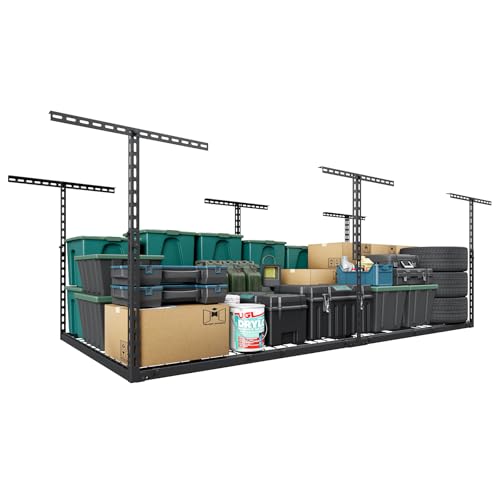
The best overhead garage storage racks are ceiling-mounted steel platforms sized to your joist spacing, with enough clearance for the garage door and enough load capacity for the items you actually plan to store.
Our top picks



As an Amazon Associate we earn from qualifying purchases at no extra cost to you. Ratings are shown as listed on Amazon.
Quick picks by garage situation
- For most two-car garages: Choose a 4 ft × 8 ft adjustable steel rack rated for at least 600 lb, provided the ceiling joists and mounting hardware support that load.
- For a single-car or compact garage: A 2 ft × 6 ft or 3 ft × 6 ft platform is easier to position around the opener, side walls, and parked vehicle.
- For bulky seasonal storage: Select a rack with 22–33 inches of vertical drop and a high weight rating, but keep heavy bins shallow enough to lift safely.
- For low ceilings: Use a short-drop rack, typically 12–18 inches, and measure the raised garage door before buying.
- For renters: A freestanding shelving unit or wall-mounted system is usually more practical. Most overhead racks require permanent attachment to ceiling joists.
Head-to-head: which overhead rack type fits best?
| Rack type | Common platform sizes | Typical load rating | Best use | Main limitation |
|---|---|---|---|---|
| Short-drop fixed rack | 2 ft × 6 ft to 4 ft × 8 ft | 250–600 lb | Low ceilings and light-to-medium storage | Less room for tall totes or camping gear |
| Adjustable ceiling rack | 3 ft × 6 ft to 4 ft × 8 ft | 400–1,000 lb | Flexible placement in standard garages | Longer posts can interfere with vehicles or doors |
| Heavy-duty steel rack | 4 ft × 8 ft and larger | 600–1,200 lb | Multiple full storage bins and bulky equipment | Needs sound joists and careful load distribution |
| Motorized lift platform | Usually 3 ft × 6 ft to 4 ft × 8 ft | 200–600 lb | People who cannot safely lift bins overhead | Higher cost, power requirements, and more moving parts |
These are market-standard ranges rather than guarantees for every model. A rack’s advertised capacity may assume installation into solid wood joists, evenly distributed weight, and correctly tightened hardware. It does not mean a single anchor point can carry the entire rating.
Dimensions that matter before you order
Platform size and walking clearance
A 4 ft × 8 ft rack offers excellent storage, but it can overwhelm a narrow one-car garage. Leave approximately 24–30 inches between the rack’s edge and the side walls where you need to walk, open a car door, or reach a wall control. If the rack sits above the hood or roof of a parked vehicle, check that its corners will not obstruct entry and exit.
For a 10 ft-wide garage, a 4 ft-wide platform leaves about 3 ft on each side if centered. That is workable for storage access but tight if the rack hangs over a vehicle. A 2 ft × 6 ft rack placed along one side often leaves a more useful central parking path.
Ceiling height and vertical drop
Measure from the garage floor to the lowest obstruction—not just to the ceiling. Include the raised door, door tracks, opener rail, lights, ductwork, and sprinkler piping. A rack with a 22-inch drop needs at least 22 inches of unobstructed space below the ceiling, plus the height of the storage bins.
As a practical guide, a rack with a 12–18-inch drop suits many garages with 8-foot ceilings when storing low-profile totes. A 22–33-inch drop is more useful with 18-gallon or larger bins, but it may reduce vehicle clearance. The bottom of the loaded rack should remain comfortably above the tallest vehicle, with extra allowance for roof racks, hatch movement, and walking under it.
Garage-door interference
Open the garage door fully and mark the highest point of the door or its hardware. A rack should not occupy the door’s travel path. On sectional doors, the horizontal tracks commonly run several feet into the garage, so a ceiling rack is often placed behind the tracks rather than directly above the car’s front position. Never assume the visible ceiling area is available until the door is open.
Load ratings: choose for real weight, not the headline number
Estimate the contents before choosing capacity. A plastic storage tote may weigh 10–20 lb empty and 30–60 lb when filled with household items. A box of books can exceed 50 lb, while a folded artificial tree or empty luggage may weigh less than 25 lb. Add the contents of every bin, then keep a safety margin of at least 20–25 percent below the rack’s stated capacity.
For example, eight 45-lb bins total 360 lb. A rack rated at 500 lb provides a more sensible margin than a 400-lb rack, especially if the load will not be perfectly centered. Distribute heavy containers over the rack’s frame and keep lighter items near the outer edges. Do not place a concentrated load such as an engine, safe, or stack of concrete blocks on a residential overhead platform unless the manufacturer and a qualified professional specifically approve it.
Mounting hardware and ceiling construction
The safest overhead rack installations attach to structural framing, not drywall, plaster, or a thin ceiling finish. Many systems include lag screws, washers, brackets, and vertical support posts. The included hardware may be suitable for wood joists but unsuitable for concrete ceilings or engineered I-joists.
- Solid wood joists: Use the specified structural lag screws or structural-rated screws, with pilot holes drilled to the manufacturer’s dimensions. Confirm that each fastener enters the center of the joist.
- Concrete: Use anchors specifically rated for overhead loading in concrete, installed to the required embedment depth. Ordinary plastic wall plugs are not appropriate.
- Engineered I-joists or trusses: Do not drill or attach to the flange or web without approval from the manufacturer, builder, or a qualified contractor.
- Metal framing: Treat it as a specialized installation. Thin-gauge framing may not support the rack’s published rating without reinforcement.
Check the joist spacing as well. Common spacing is 16 or 24 inches on center, while rack mounting holes may assume one pattern. Adjustable brackets help, but they do not eliminate the need to hit structural members. If the supplied screws are not long enough to achieve the required structural embedment, replace them only with hardware approved for that application—not simply longer generic screws.
Best choices for common garage layouts
One-car garage
Choose a 2 ft × 6 ft or 3 ft × 6 ft rack and place it toward the rear or along the side, away from the door tracks. A 4 ft × 8 ft platform may leave too little room to open the driver’s door or walk around the vehicle. Shorter 12–18-inch posts are usually preferable unless the ceiling is unusually high.
Two-car garage
A 4 ft × 8 ft rack can work well in the rear third of the garage or above one parking bay. Two smaller racks can be easier to configure than one large platform, particularly when the garage door opener is centered or the joists run in an inconvenient direction. Separate racks also let you keep heavy items over a less-used area.
Garage with an attic or storage loft
Compare the rack with the existing structure rather than assuming both can share the same ceiling area. Leave enough clearance to use the loft ladder, attic hatch, or pull-down stairs. A narrow rack may be better than a high-capacity platform that blocks access to electrical equipment or roof framing.
Garage used as a workshop
Keep the rack above the perimeter or parked vehicle rather than above a workbench. A 24–30-inch access gap below the platform makes it easier to move long boards and use ladders, while a rack directly above a bench can limit lighting and overhead work. Avoid storing flammable liquids or heat-sensitive materials above electrical equipment.
Features worth paying for—and those that are less important
- Worth prioritizing: height-adjustable posts, a welded or bolted steel frame, a visible load rating, safety lips or wire decking, included ceiling brackets, and hardware instructions specific to the ceiling type.
- Useful for access: a crank or lift mechanism, though motorized systems add cost and require inspection of cables, pulleys, or locking mechanisms.
- Useful for organization: a grid or wire deck that prevents small bins from slipping through. Add a separate strap or retaining barrier if earthquake movement or vibration is a concern.
- Less important than fit: decorative coatings, extra hooks, and maximum platform area. A smaller rack installed correctly is safer than a larger rack overloaded or mounted around obstructions.
Installation and long-term durability
Most steel racks require two adults for positioning, and a large platform may be awkward even before it is loaded. Measure the package and assembled frame against the garage entry door, especially if the garage is detached or reached through a narrow side door. Assemble the frame on the floor, identify joist locations, and lift it only after confirming the mounting layout.
The parts most likely to wear first are adjustment bolts, lift cables or pulleys on moving models, and plastic bin lids—not the powder-coated steel frame. Inspect fasteners after the first month and periodically thereafter. Look for sagging, bent corners, rust around scratched coating, loose hardware, or cracked storage containers. Remove some weight immediately if any of these appear.
Final buying checklist
- Measure the ceiling, raised garage door, opener rail, lights, and ductwork.
- Confirm the platform will not block vehicle doors, walking routes, attic access, or work areas.
- Identify the joist direction, spacing, and construction before choosing mounting hardware.
- Add the weight of the actual bins and contents, then maintain at least a 20–25 percent capacity margin.
- Choose the smallest platform that holds your planned items with room to access them safely.
- Use a professional installer when the ceiling is concrete, engineered framing, damaged, or difficult to inspect.
For most households, the best overhead garage storage racks are not the largest or highest-rated models. They are the racks whose dimensions fit the door and vehicle layout, whose posts leave usable clearance, and whose mounting system matches the structure above the ceiling.