Key takeaways
- Inspect the connectors: Cam locks, metal brackets, and through-bolts generally tolerate expansion better than small wooden pins alone.
- Assemble on a level surface: A rack that is slightly twisted can place uneven pressure on bottles and make doors or modules difficult to align.
- Move it empty: Even a 12-bottle section can weigh 35–45 pounds when loaded. Remove bottles before shifting or carrying the rack.
- Measure the route: For a tall assembled unit, check stair turns and doorway openings. A 30-inch-wide doorway may not accommodate a deep cabinet carried flat.
- Watch the wear points: Particleboard edges can swell from spills, screw holes can loosen after repeated disassembly, and metal finishes can chip where modules rub together.
- Anchor tall configurations: Any unit taller than it is deep should be secured against tipping, especially in homes with children, pets, or seismic risk.
The best modular wine racks are stackable solid-wood or powder-coated-metal systems with a stable base, at least 3.5 inches of bottle clearance, and connectors that let you expand without rebuilding the entire rack.
The right choice depends less on the largest advertised bottle count than on where the rack will live, how often you move bottles, and whether your collection may grow. A compact countertop unit can suit a small apartment, while a floor-to-ceiling modular system makes better use of a dedicated dining or cellar wall.
Our top picks


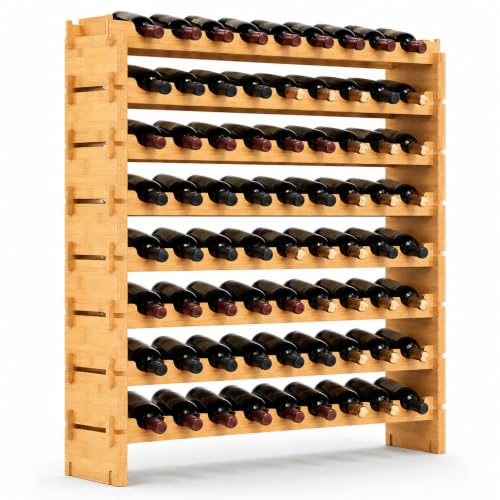
As an Amazon Associate we earn from qualifying purchases at no extra cost to you. Ratings are shown as listed on Amazon.
Best modular wine racks by situation
| Situation | Best rack type | Useful target specification | Main caution |
|---|---|---|---|
| Small apartment or 10 × 12 ft dining room | Stackable countertop or low floor rack | 12–24 bottles; depth of 10–14 inches | Leave 3 inches around sides for cleaning and ventilation |
| Growing collection | Interlocking modular cubes or column system | Expandable in 6–12 bottle increments | Check whether matching modules remain available |
| Children or pets | Low-center-of-gravity floor rack or anchored wall system | Wide base; anti-tip hardware; 40–60 lb minimum load rating | Do not rely on bottle weight alone to stabilize a tall rack |
| Renter | Freestanding modular rack with a weighted base | 12–36 bottles; no permanent wall attachment | Use furniture straps only where the lease and wall surface allow |
| Back pain or limited mobility | Waist-height rack or pull-out cabinet insert | Bottle centers roughly 30–42 inches above the floor | Avoid floor-level modules that require repeated bending |
Head-to-head: the main modular wine rack designs
Stackable cubbies: the easiest way to expand
Stackable cubbies are individual boxes or open compartments that sit side by side or one above another. They are usually the most flexible option for a collection that may grow from 12 bottles to 36 or more. A single cubby can fit standard 750 ml bottles, while additional units can create a horizontal row, a low cabinet-like arrangement, or a taller column.
Choose cubbies with positive connectors, dowels, or locking brackets rather than relying on friction between stacked boxes. A fully loaded 12-bottle module can weigh about 35–45 pounds, depending on construction, so a three-high stack needs a broad footprint or wall anchoring. Keep the top of an unanchored rack below about 42 inches whenever possible.
Modular lattice racks: attractive and space-efficient
Lattice designs use X-shaped, diamond, or wave-shaped openings to support bottles at an angle. They offer more visual openness than cubbies and can fit beneath a counter or along a dining-room wall. Their capacity is often listed in bottle count, but the practical limit depends on bottle shape: wide Burgundy bottles, sparkling-wine bottles, and heavy punted bottles may occupy adjacent spaces or fail to fit securely.
Look for openings at least 4 inches wide and a support depth of 10–12 inches. A lattice rack is a poor choice if every bottle position is identical but your collection includes many oversized bottles.
Modular metal grids: strong, slim, and adjustable
Powder-coated steel grids are suitable for utility rooms, contemporary kitchens, and narrow wall sections. They are generally slimmer than wood racks and can offer excellent vertical expansion. Wall-mounted versions can hold substantial weight when attached to studs or suitable masonry, but drywall anchors must be rated for the combined rack and bottle load.
Metal transfers vibration and temperature changes more readily than a thick wood rack. That is not usually a problem for short-term storage, but a metal rack placed beside a refrigerator, radiator, dishwasher, or sunny window is not ideal for wine intended for long aging.
Modular wine cabinets: better protection, less flexibility
Cabinet-style modules protect bottles from dust and light and may provide a more finished appearance in a living or dining room. They are useful when the rack must double as furniture, but they take more floor depth—often 16–24 inches—and are harder to reconfigure after assembly.
Cabinet modules are also substantially heavier. A 24-bottle cabinet may weigh 50–90 pounds before loading, which affects stair moves, doorway clearance, and the strength of the floor beneath it. Choose this format when appearance and protection matter more than frequent rearrangement.
Material comparison: what you gain and give up
| Material | Strengths | Weaknesses | Best use |
|---|---|---|---|
| Solid wood | Good rigidity, repairable surfaces, warm appearance, effective vibration damping | Heavier; can expand or contract with humidity; usually costs more | Dining rooms and long-term freestanding storage |
| Engineered wood | Consistent dimensions, lower cost, lighter than many hardwood racks | Edges can swell after water exposure; fasteners may loosen after repeated moves | Budget modular cubes and low racks |
| Powder-coated steel | High load capacity, slim profiles, easy cleaning, suitable for wall systems | Can transmit vibration; chipped coating may rust; requires careful anchoring | Modern kitchens, utility areas, and vertical expansion |
| Bamboo or laminated wood | Light, renewable-looking finish, often affordable and easy to assemble | Quality varies; thin laminations can split around screws | Small countertop and renter-friendly racks |
Capacity is not the same as usable capacity
For standard Bordeaux-style bottles, allow about 3.5 inches of width per bottle and at least 12 inches of insertion depth. Add 1–2 inches of front clearance if the rack sits beside a wall, cabinet, or appliance so you can grip the bottle without scraping labels.
Plan on reducing the stated capacity by 10–20 percent if you store mixed bottle shapes. Champagne and sparkling-wine bottles are wider; Burgundy-style bottles have broader shoulders; large-format bottles may not fit at all. If a rack claims 24 bottles but has 24 tightly sized openings, its practical mixed-bottle capacity may be closer to 19–21.
For a countertop unit, measure the full footprint rather than just the rack body. A 24-bottle rack can occupy approximately 24–30 inches of width and 12–15 inches of depth. Keep it at least 2 inches from a backsplash or side wall, and do not place it where an open cabinet door or refrigerator door will strike the bottles.
Wall-mounted or countertop: which placement is safer?
Wall mounting preserves floor space and works well in a narrow kitchen or dining area, but the wall structure determines the real capacity. A 36-bottle rack with bottles can weigh 120 pounds or more. Attach the mounting rail to studs, masonry, or a manufacturer-approved structural system—not just a decorative panel or a single drywall anchor.
Countertop racks are easier to install and move, but the counter must remain stable. A loaded rack should not overhang the front edge, block a work area, or sit next to a cooktop. Place the heaviest bottles in the lowest positions and use non-slip feet. On a kitchen island, leave roughly 36 inches of working clearance around the rack; 42 inches is more comfortable where two people pass each other.
Assembly, moving, and durability realities
- Inspect the connectors: Cam locks, metal brackets, and through-bolts generally tolerate expansion better than small wooden pins alone.
- Assemble on a level surface: A rack that is slightly twisted can place uneven pressure on bottles and make doors or modules difficult to align.
- Move it empty: Even a 12-bottle section can weigh 35–45 pounds when loaded. Remove bottles before shifting or carrying the rack.
- Measure the route: For a tall assembled unit, check stair turns and doorway openings. A 30-inch-wide doorway may not accommodate a deep cabinet carried flat.
- Watch the wear points: Particleboard edges can swell from spills, screw holes can loosen after repeated disassembly, and metal finishes can chip where modules rub together.
- Anchor tall configurations: Any unit taller than it is deep should be secured against tipping, especially in homes with children, pets, or seismic risk.
How to choose the best modular wine rack
- Count your current bottles and add 25 percent. A 16-bottle collection usually justifies at least a 20-bottle configuration if you expect to buy regularly.
- Measure the location in three dimensions. Record width, depth, height, nearby door swings, outlet positions, and the clearance needed to remove bottles.
- Identify your bottle mix. If you buy sparkling or Burgundy-style wine, choose adjustable shelves, oversized openings, or a design that leaves spare spaces.
- Check the load path. Confirm the capacity of each module, connector, shelf, wall rail, and floor—not only the headline bottle count.
- Choose an expansion method. Side-by-side growth is easiest to reconfigure; vertical growth saves floor space but increases tip risk and usually needs anchoring.
- Set a realistic budget. Small modular racks commonly cost about $40–$150, larger solid-wood or metal systems about $150–$600, and furniture-grade cabinets or extensive wall systems often cost $600 or more.
Bottom line
For most homes, the best modular wine racks are low, stackable cubbies made from solid wood, well-sealed engineered wood, or powder-coated steel, with secure connectors and room for at least 25 percent future expansion. Choose a countertop rack for 12–24 bottles, a low freestanding system for flexible mixed storage, and a wall-mounted grid when floor space is limited and proper anchoring is available. Prioritize stable construction, usable bottle clearance, and easy reconfiguration over the largest number printed on the package.