Key takeaways
- Measure your dog and compare the usable interior, not the exterior size.
- Confirm the door opens fully without hitting a wall, sofa, or table.
- Allow 30–36 inches of operating clearance in front of the crate.
- Check ventilation on multiple sides and keep vents unobstructed.
- Choose steel or protected edges for puppies and persistent chewers.
- Verify the top’s weight capacity before using it as a seat or desk.
- Look for a removable tray, washable bedding, and accessible interior corners.
- Measure doorways and check the shipping-box weight before committing to a large cabinet.
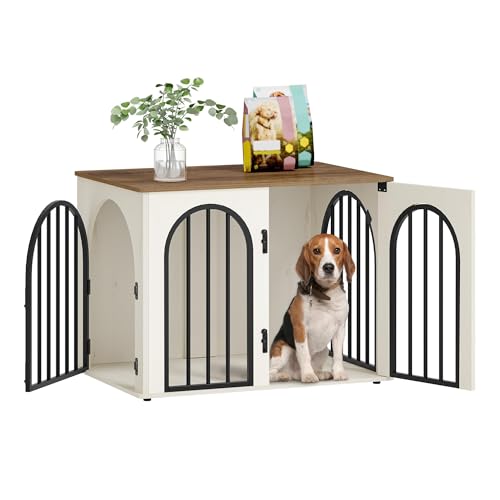
The best dog crate furniture is a properly sized crate disguised as a cabinet, console, end table, or bench—not a decorative box that restricts movement or traps heat.
Best Dog Crate Furniture for Stylish Homes
A good furniture-style crate must solve two problems at once: it should give your dog a secure, comfortable retreat while looking intentional in your living space. Before choosing a finish or silhouette, compare the crate’s usable interior dimensions, ventilation, door placement, chew resistance, cleaning access, and the weight of anything placed on top.
Our top picks


As an Amazon Associate we earn from qualifying purchases at no extra cost to you. Ratings are shown as listed on Amazon.
Quick picks by living situation
| Situation | Best crate-furniture type | Specifications to prioritize | Typical price range |
|---|---|---|---|
| Small apartment | End-table crate or narrow console crate | Interior width under 30 inches, front or side access, open ventilation panels | Usually $180–$450 |
| Large dog | Reinforced cabinet crate or metal-frame furniture enclosure | Interior length 42–48 inches, steel frame, reinforced hinges, 150-pound-plus capacity | Usually $350–$800 |
| Kids and other pets | Heavy console-style crate with secure latch | Tip-resistant base, two-point latch, rounded corners, no reachable gaps | Usually $300–$700 |
| Renters | Freestanding metal crate with removable furniture panels | No wall anchoring, manageable box weight, replaceable tray and panels | Usually $150–$500 |
| Back pain or frequent cleaning | Raised bench or cabinet crate | 18–24-inch access height, slide-out tray, wide-opening door | Usually $250–$650 |
How to choose the correct crate size
Your dog should be able to stand without ducking, turn around comfortably, lie fully on their side, and stretch out. Measure from the floor to the top of the head or ears while standing, then add approximately 3–6 inches. Measure from the nose to the base of the tail, then add approximately 3–6 inches for interior length.
Do not use the furniture’s outside dimensions as the sizing guide. A cabinet may be 36 inches wide but offer only 31 inches of interior space after accounting for sidewalls, trim, and a central divider. Check the manufacturer’s usable interior measurements, especially if the crate has a thick cushion or a removable divider.
| Approximate dog size | Common minimum interior size | Furniture footprint to expect |
|---|---|---|
| Small dogs up to about 20 pounds | 24 L × 18 W × 20 H inches | About 27–32 L × 21–25 W inches |
| Medium dogs about 20–50 pounds | 30 L × 21 W × 24 H inches | About 34–39 L × 24–28 W inches |
| Large dogs about 50–80 pounds | 36 L × 24 W × 27 H inches | About 40–46 L × 27–31 W inches |
| Extra-large dogs about 80–110 pounds | 42–48 L × 28–30 W × 30–34 H inches | About 46–54 L × 32–37 W inches |
These are starting points, not substitutes for measuring your dog. A long-bodied dog may need a longer crate, while a tall dog may need more height. The crate should also leave enough room for a flat bed without forcing the door to remain open.
Head-to-head: the main furniture crate designs
End-table crates
An end-table crate is the easiest option for a small dog or compact room. Most fit beside a sofa and use the top as a lamp table, plant stand, or charging station. Look for a usable top height of roughly 22–26 inches, which works beside many sofas and chairs. Measure your sofa arm first; some modern sofas have arms 24–28 inches high, while low-profile seating may be closer to 20 inches.
The drawback is limited interior volume. End-table crates often have a single front door, making it harder to retrieve bedding or clean the back corners. They are best for calm dogs that do not chew wood trim or push against doors.
Console crates
Console-style crates suit entryways, dining rooms, and the back of a sofa. A 48–60-inch-wide console can visually anchor a wall while housing one large crate or two smaller compartments. Leave at least 30–36 inches of walking clearance in front of the doors; 42 inches is more comfortable in a busy hallway.
Console crates are usually the most attractive choice for larger dogs, but their long cabinets can be difficult to move. Confirm whether the center divider is removable and whether each compartment has independent ventilation and doors.
Bench crates
A bench crate can provide seating in a mudroom or window area, but the top must be structurally rated for people if it is intended as a seat. A practical bench height is about 17–20 inches, and a seat depth of 15–18 inches accommodates most adults without becoming an awkwardly deep cabinet.
Do not assume every crate cabinet is safe to sit on. A top designed only for decor may sag, loosen at the fasteners, or transfer excessive vibration into the crate. Look for a reinforced frame, a stated weight capacity, and legs that spread the load beyond the cabinet’s thin side panels.
Desk or sideboard crates
These designs use a crate as a low cabinet beneath a work surface or sideboard. They can save floor space, but check knee clearance and airflow before combining them with a desk. A typical desk surface is about 28–30 inches high; a crate beneath it should not block your legs or force the dog’s enclosure into a cramped recess.
Materials: attractive versus chew-resistant
| Material or construction | Advantages | Trade-offs | Best for |
|---|---|---|---|
| Solid wood frame | Strong joinery, repairable edges, substantial appearance | Heavy; exposed corners can be chewed; can absorb accidents | Calm dogs and long-term furniture use |
| Engineered wood panels | Lower cost, consistent finish, lighter than thick hardwood | Swollen edges and stripped fasteners are difficult to repair after moisture damage | Dry indoor rooms and moderate use |
| Powder-coated steel frame | Strong, chew-resistant, good airflow, suitable for escape-prone dogs | Can rattle; less warm-looking without an outer cabinet | Puppies, powerful chewers, and large dogs |
| Tempered glass or acrylic panels | Easy visibility and a modern appearance | Shows nose marks; acrylic can scratch; must not reduce ventilation | Homes where visibility is important |
| Polyester or canvas cover | Lightweight, washable, and inexpensive | Can be shredded; retains odors if not washed promptly | Non-chewing dogs and temporary setups |
For dogs that chew, prioritize a metal interior frame with furniture panels mounted outside the dog’s reach. Avoid exposed particleboard edges, decorative slats that can be pulled loose, and hardware gaps wide enough for a jaw or paw. A furniture finish does not make a wooden crate chew-proof.
Ventilation and interior comfort
A stylish cabinet still needs cross-ventilation. Look for openings on at least two sides, ideally three, with enough free area that curtains, cushions, or the wall cannot block them. A crate pushed tightly against a wall may look tidy but can become warm and stale. Leave approximately 2–4 inches behind the cabinet when the design requires rear airflow, and keep at least 6 inches clear of heaters, radiators, and direct heat sources.
Use a washable, low-profile bed that fits without curling up the door area. Waterproof liners help with accidents, but fully sealed plastic interiors can hold moisture and odors if there is insufficient airflow. For a nervous dog, a partial cover may create privacy; covering every ventilation panel is not an appropriate substitute for a well-ventilated design.
Assembly, moving, and durability realities
Furniture crates commonly arrive in boxes weighing roughly 40–100 pounds, with large reinforced models exceeding that range. Before ordering, measure the narrowest doorway, stair turn, elevator opening, and the final space. A 50-inch cabinet may fit through a 32-inch doorway only if it can be carried vertically and its legs or doors are removable.
Assembly quality matters more than decorative hardware. Tighten fasteners after the first week because vibration from a dog entering, exiting, or leaning on the door can loosen cam locks and hinges. The parts most likely to wear first are door latches, hinges, removable trays, veneer edges near the floor, and felt pads under the feet.
For a heavy crate, use non-slip furniture pads rather than small casters unless the wheels have reliable locks. A crate that rolls when a dog enters can create anxiety and may damage flooring. If the cabinet is tall or placed in a home with children, an anti-tip strap is a sensible safety upgrade—even for renters, provided it can be attached without damaging the wall or replaced with a freestanding tip-resistant design.
Final buying checklist
- Measure your dog and compare the usable interior, not the exterior size.
- Confirm the door opens fully without hitting a wall, sofa, or table.
- Allow 30–36 inches of operating clearance in front of the crate.
- Check ventilation on multiple sides and keep vents unobstructed.
- Choose steel or protected edges for puppies and persistent chewers.
- Verify the top’s weight capacity before using it as a seat or desk.
- Look for a removable tray, washable bedding, and accessible interior corners.
- Measure doorways and check the shipping-box weight before committing to a large cabinet.
For most stylish homes, the best balance is a reinforced metal crate enclosed by well-ventilated furniture panels, sized with several inches of spare room and positioned where its door can open completely. Choose the silhouette—end table, console, bench, or sideboard—only after the dog’s safety, comfort, and daily cleaning access are settled.