Key takeaways
- Two included probes can follow separate roasts with different finishing targets.
- Maker claims food accuracy within 0.5 degree F across its rated use.
- The 2.4-inch base display allows temperature checks without opening the app.
Keeping track of a turkey in the oven or a brisket in a smoker should not require opening the lid every few minutes. A wireless meat thermometer can follow internal food temperature while you prepare side dishes, but the details matter: some use Bluetooth alone, others relay through Wi-Fi, and a high advertised heat rating may apply only to the exposed end of the probe.
Quick Verdict: The Typhur Sync Gold Dual is our Best Overall for cooks who regularly track more than one piece of meat. Its included two probes, visible base display, and Sub-1G link create more flexibility than a single Bluetooth-only probe. This is an editorial selection from published maker specifications as of October 2026, not an in-house test; check the current price and available bundle before ordering.
As an Amazon Associate we earn from qualifying purchases.
By DIY Ideas 4 Home Editorial Team
The Best Wireless Meat Thermometers Reviewed
We checked US manufacturer product pages, support guides, and model-specific specifications for seven currently listed kits. The principal comparison is internal temperature accuracy and rated limits, followed by the number of included probes, connection architecture, and the way each system charges. Manufacturer prices ranged from about $60 to $150 as listed in October 2026, with some figures reflecting temporary offers. Wireless distances below are advertised best-case ranges, not a prediction of performance through a metal grill lid or several walls. USDA FSIS guidance still calls for checking whole poultry at 165 degrees F in multiple places.
| Product | Best For | Key Spec | Listed Price (as of October 2026) | Watch Out For |
|---|---|---|---|---|
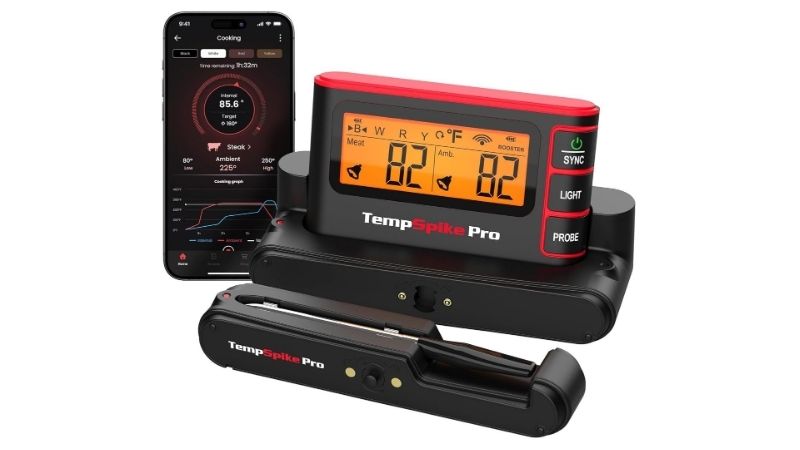
| Typhur Sync Gold Dual | Best Overall | 2 probes; food to 221 F; accuracy within 0.5 F | $149.99 manufacturer | Large display base; Wi-Fi requires 2.4 GHz |
| ThermoWorks RFX Starter Kit TX-5600-01 | Best for Smokehouse Air Readings | 1 RF probe; food to 212 F; accuracy within 0.9 F | $125.30 manufacturer sale | Ambient sensor uses a separate wired probe |
| MEATER Pro | Best for High-Heat Searing | 1 probe; food to 221 F; ambient up to 1,000 F | $74.99 US manufacturer sale | Bluetooth-only dock requires phone proximity |
| CHEF iQ iQ Sense CQ60-1C-Z1-E | Best for Audible Hub Alerts | 1 probe; food to 212 F; accuracy within 1 F | $129.99 manufacturer | Phone app needed for detailed guidance |
| Combustion Predictive Thermometer Gen 2 | Best for Shorter Insertions | 8 sensors; 1.97-in minimum insertion; food to 220 F | $149.00 manufacturer | Wi-Fi booster or display costs extra |
| TempPro TempSpike Plus TP970 | Best for Long Bluetooth Sessions | 1 probe; food to 212 F; accuracy within 1.8 F | $89.99 manufacturer sale | 572 F is ambient measurement ceiling |
| INKBIRD INT-11P-B | Best Budget | 1 probe; food to 212 F; accuracy within 1.8 F | $59.99 manufacturer sale | No Wi-Fi relay or stand-alone temperature screen |
Typhur Sync Gold Dual: Best Overall
Best For: Backyard hosts tracking two cuts at once who want a readable monitor without opening the phone app.
The practical advantage here is the complete two-probe setup. A brisket and a pork shoulder can each have a dedicated sensor, and the separate base display avoids making every temperature check a smartphone task. Typhur also uses a sub-gigahertz probe connection before the data reaches its display or Wi-Fi connection, which is a more adaptable layout for outdoor cooking than a basic phone-to-probe Bluetooth link. The investment is harder to justify for someone who normally cooks one steak.
Typhur’s product page for the Sync Gold Dual lists five internal sensors and one ambient sensor in each probe, internal readings from 32 to 221 degrees F, and manufacturer-stated accuracy within 0.5 degree F. The exposed section is rated up to 932 degrees F. Typhur advertises up to 3,000 feet in open space, with a shorter 700-foot closed-space estimate; real reach still depends on the structure. The US manufacturer listed the two-probe kit at $149.99 in October 2026, putting it in the premium tier of this comparison.
Each probe measures 5.08 inches long and 0.22 inch in diameter, so verify that your usual cut is thick enough for the manufacturer’s insertion mark. The base measures 6.0 inches wide, 3.3 inches deep, and 1.0 inch thick, taking a little more room on a grill cart than a slim charging sleeve. Its 2.4 GHz Wi-Fi requirement matters with routers configured only for another band. Typhur lists IPX8 protection for the probes and an 18-month US warranty, but the base has a lower IPX2 rating and should stay sheltered.
Pros:
- Two included probes can follow separate roasts with different finishing targets.
- Maker claims food accuracy within 0.5 degree F across its rated use.
- The 2.4-inch base display allows temperature checks without opening the app.
Cons:
- The larger base and $149.99 price are excessive for occasional single-cut dinners.
- Its Wi-Fi relay depends on a compatible 2.4 GHz home network.
Who Should Buy It: Choose this for simultaneous holiday roasts; select the MEATER Pro if you want one slimmer, less expensive probe.
ThermoWorks RFX Kit: Best for Smokehouse Air Readings
Best For: Serious smokers who want food and grate-air temperatures measured at independent locations during extended cooks.
Instead of estimating cooker air temperature from a sensor immediately beside cold meat, ThermoWorks includes a separate Pro-Series air probe with its RFX starter system. That difference matters around a brisket or pork butt, where the surface of the food can cool the air directly beside an embedded probe. The RFX food probe reports over a sub-gigahertz wireless link to the gateway; the additional air lead is deliberately wired, so this is not a completely cord-free grill setup.
Its product page for the RFX Starter Kit identifies the one-probe package as SKU TX-5600-01 and lists the complete kit at $125.30 on a manufacturer promotion, versus $179 regular price. Its RFX MEAT specification page gives an internal range up to 212 degrees F, accuracy within 0.9 degree F between 14 and 212 degrees F, and a 1,000-degree-F exposed-heat rating. ThermoWorks states up to 1,500 feet line of sight between probe and gateway. Unlike buying the RFX MEAT accessory alone, the starter package contains the gateway needed to read it.
The RFX MEAT probe is 4.7 inches long and 0.21 inch across its wider section. The manufacturer states at least 65 hours of probe use after a full charge and rates the probe IP69K for cleaning. Its charging block uses a replaceable AAA battery, while the included gateway needs powered placement near the cooker and a Wi-Fi or Bluetooth link onward to your device. You also need a safe route for the separate air-probe wire through the lid; it should not be crushed by a sharp door edge.
Pros:
- Independent air probe can measure the smoker environment away from chilled meat.
- RFX MEAT supports a maker-rated 1,500-foot unobstructed probe-to-gateway link.
- The $125.30 starter offer includes the required gateway and food probe.
Cons:
- Separate wired air lead complicates lid routing on tightly sealed smokers.
- A one-probe starter kit needs extra purchases to track multiple meats.
Who Should Buy It: Buy RFX for deliberate grate-air measurement on long smokes; pick the Typhur Sync Gold Dual for two fully untethered food probes.
MEATER Pro: Best for High-Heat Searing
Best For: Cooks finishing steaks over fierce heat who prefer a narrow probe and an uncomplicated charging dock.
MEATER Pro is a better match for searing than many low-cost probes because the manufacturer explicitly rates its exposed end for very high cooking temperatures. Its multiple internal sensors aim to locate the coldest part of a thick cut, rather than depending on one exact tip position. That makes it an appealing purchase for steaks and smaller roasts, provided you insert it to the required depth. It is not the right solution when you need cloud monitoring from across town without additional compatible hardware.
MEATER’s product page for the Pro describes five internal sensors and one ambient sensor, internal tolerance up to 221 degrees F, exposed heat up to 1,000 degrees F, and stated accuracy within 0.5 degree F. A US manufacturer storefront listed the single probe for $74.99 on promotion against its $99.99 regular price in October 2026. The MEATER Pro Support Guide says the Bluetooth system can reach up to 250 feet in favorable conditions; the number falls with grills, walls, and interference. The dock itself does not supply built-in Wi-Fi.
MEATER’s support guide records a 5.12-inch probe length and 0.2-inch diameter, with a 6.22-inch-tall bamboo charging dock. The probe is dishwasher safe; the dock is not and should be kept dry. The charger runs on one replaceable AAA cell, while the probe has its own rechargeable battery. Manufacturer documentation claims more than 24 hours from a full charge, which is ample for many roasts, but it is sensible to top it up before longer cooks. App access is essential to see live temperatures.
Pros:
- Exposed probe area has a manufacturer-rated 1,000-degree-F heat limit.
- Five internal sensors reduce dependence on positioning one single tip exactly.
- A 0.2-inch diameter limits the hole in smaller roasts or steaks.
Cons:
- Bluetooth-only monitoring lacks the built-in Wi-Fi base of some rivals.
- The tall bamboo dock cannot share the probe’s dishwasher-safe cleaning routine.
Who Should Buy It: Choose MEATER Pro for hot finishing and one main cut; choose ThermoWorks RFX Kit for a remotely placed air sensor.
CHEF iQ iQ Sense: Best for Audible Hub Alerts
Best For: Home cooks who want a kitchen-side audible cue while their phone provides the detailed cook timeline.
CHEF iQ takes a slightly different approach to checking dinner: its charging hub also has a speaker. That gives someone concentrating on other kitchen tasks an audible reminder without having to watch a phone screen. The app supplies food presets, live temperature updates, and estimates for cooking and resting. Compared with the MEATER Pro, this system is more connected out of the box, but the single-probe package costs noticeably more and depends on keeping its rechargeable hub powered.
CHEF iQ’s product page for the iQ Sense identifies the one-probe SKU CQ60-1C-Z1-E at $129.99 in the US. Its published specification lists four food sensors and one ambient sensor, with internal readings from 32 to 212 degrees F and exposed ambient measurement up to 1,000 degrees F. The brand describes food accuracy within 1 degree F. The Smart Hub uses Wi-Fi and Bluetooth to relay readings to the CHEF iQ app, so the phone is not restricted to a short direct connection with the probe when the hub has internet access.
The food probe measures 4.75 inches in length and 0.19 inch across, a narrow shape that can be easier to seat in medium roasts than Typhur’s longer probe. The manufacturer’s FAQ explains that both the hub and the probe have built-in rechargeable batteries and that the package includes a USB-C cable but not a wall charging brick. CHEF iQ says the probe is dishwasher safe, but it does not extend that protection claim to the hub. Plan a charging spot away from splashes and hot burners.
Pros:
- The Smart Hub speaker gives local audible warnings independent of phone vibration.
- Its 0.19-inch-diameter probe suits moderately thick cuts without an oversized opening.
- Wi-Fi relay lets the app report cooking progress beyond Bluetooth-only distance.
Cons:
- The $129.99 one-probe package costs more than two competing single-probe options.
- USB-C power is supplied by cable only, without a wall adapter.
Who Should Buy It: Buy iQ Sense when kitchen audio prompts matter; choose INKBIRD INT-11P-B if low upfront cost matters more than Wi-Fi.
Combustion Gen 2: Best for Shorter Insertions
Best For: Precision-minded cooks preparing smaller cuts who want detailed sensor data and advanced cooking-time predictions.
Combustion’s eight-sensor layout makes a useful point about the meaning of accuracy: a precise sensor is of limited use if it is nowhere near the coolest part of the food. The second-generation Predictive Thermometer uses several sensing positions to locate cooler regions and estimate finishing time. Its short minimum insertion requirement is especially meaningful for cooks whose usual portions cannot accommodate long, thick probes. It is a technical product, however, and some of its more ambitious remote-monitoring abilities require additional hardware rather than coming in the $149 basic kit.
Combustion’s product page for the Predictive Thermometer lists the second-generation single probe at $149 and describes eight temperature sensors. Its technical specifications permit up to 220 degrees F in the embedded lower half and up to 900 degrees F at the exposed upper end, with a lower 750-degree-F continuous heat limit for upper sensors. Accuracy changes with temperature: the maker specifies within 0.4 degree F from 14 to 149 degrees F for the lower sensors and within 0.5 degree F from 149 to 185 degrees F. Treat those as stated operating bands, not a whole-range guarantee.
The probe is just 3.8 inches long and 0.19 inch in diameter; Combustion lists a minimum food insertion depth of 1.97 inches. A hermetic seal and IP69K rating support more demanding cleaning and wet cooking, according to its specifications. Battery life is claimed at more than 90 hours in cooking mode with five-second updates, while the included case needs an external USB power supply to recharge. The base thermometer uses Bluetooth; the manufacturer’s Wi-Fi Booster starter kit, listed at $199, adds the accessory for internet-based access. The basic $149 price does not include it.
Pros:
- Minimum insertion of 1.97 inches broadens the usable range of food thicknesses.
- Eight distributed sensors feed the maker’s core-temperature and time-estimation software.
- Second-generation sealing supports water exposure and a 900-degree-F upper-end limit.
Cons:
- Full remote internet access requires an optional Wi-Fi accessory or upgraded bundle.
- Its software detail is more involved than a simple target-temperature alarm.
Who Should Buy It: Choose Combustion for thinner roasts and temperature profiling; select CHEF iQ iQ Sense for a ready-made Wi-Fi hub with audible prompts.
TempPro TP970: Best for Long Bluetooth Sessions
Best For: Patio grillers who prefer a single rechargeable Bluetooth probe over a router-dependent Wi-Fi system.
The TempSpike Plus TP970 is attractive when the task is simply following one long roast from around the house. It uses a rechargeable booster that stores the probe between cooks, with maker-stated battery endurance aimed at extended smoking sessions. Its advertised Bluetooth reach is larger than many basic budget probes. Still, its headline heat-resistance wording deserves care: the very high rating of the ceramic tip is not the same as the environmental temperature span that its ambient sensor can actually measure.
TempPro’s TempSpike Plus TP970 product page lists the kit for $89.99 on sale, with $129.99 as the comparison price. The published internal sensing range is 14 to 212 degrees F and the ambient measurement range is 14 to 572 degrees F. The brand claims accuracy within 1.8 degrees F and Bluetooth 5.2 range as far as 600 feet with minimal obstructions. It separately rates its ceramic probe tip for heat as high as 1,050 degrees F. These figures describe different components and must not be substituted for one another when picking a cooking method.
For placement, the TP970 probe is 4.17 inches long and 0.21 inch in diameter. Its booster is 6.69 inches long, 1.85 inches wide, and 1.34 inches high, so it is not a tiny sleeve. TempPro’s specification claims more than 40 hours on a charged probe and IP67 water protection, with dishwasher cleaning permitted for the probe. Bluetooth interference from a closed metal smoker will narrow the advertised 600-foot figure, and this kit is not the Wi-Fi-enabled TP980. Check that you are buying the TP970 variant rather than the similar-looking newer system.
Pros:
- A charged probe is rated for over 40 hours of cooking use.
- Its booster supports a maker-stated 600-foot unobstructed Bluetooth connection.
- IP67-rated probe can be cleaned in the dishwasher under manufacturer guidance.
Cons:
- No built-in Wi-Fi option for checking temperatures beyond local Bluetooth reach.
- Ambient readings stop at 572 degrees F despite the hotter ceramic tip.
Who Should Buy It: Pick TP970 for longer local smoking sessions; choose ThermoWorks RFX Kit if you need independent grate-air measurements.
INKBIRD INT-11P-B: Best Budget
Best For: First-time wireless-probe buyers cooking one roast who accept phone-based alerts and a shorter local signal.
INKBIRD is the most economical complete system in this selection based on the listed US offers. The INT-11P-B includes its probe and charging case without a required gateway add-on, making it a reasonable introduction to leave-in monitoring. Unlike the more expensive Typhur Sync Gold Dual, there is no stand-alone numeric screen to glance at, and there is no Wi-Fi bridge built into this model. Those are real compromises, not missing precision claims that a marketing badge can fix.
INKBIRD’s INT-11P-B product page lists a $59.99 US sale price against $99.99 regular, lower than the $74.99 promotional MEATER Pro price on the same research date. Its manufacturer’s specification gives one internal and one ambient sensor, internal readings from 14 to 212 degrees F and ambient readings from 32 to 572 degrees F. INKBIRD states food accuracy within 1.8 degrees F and Bluetooth 5.1 range of up to 300 feet unobstructed. The product’s specifications clearly identify the exact model, preventing confusion with the brand’s Wi-Fi-enabled multi-probe INT-14-BW.
The probe is 4.78 inches long and 6 millimeters in diameter, slightly thicker than several premium picks here. INKBIRD’s documentation quotes a 25-hour charged probe run time, a 25-minute full-charge period, IP67 water resistance, and a one-year warranty. The included case carries a rechargeable lithium battery and needs its own charging schedule. For someone whose cooker sits far behind masonry walls, the 300-foot promotional range should not be mistaken for a reliable household radius. Choose this to try the workflow at modest cost, not to solve a difficult signal path.
Pros:
- The $59.99 sale price includes a wireless probe and charging case.
- Maker rates the probe for 25 hours from a full charge.
- Separate food and ambient sensors support basic two-temperature app tracking.
Cons:
- No independent display for viewing current food temperature without a phone.
- The 6-millimeter shaft is relatively thick for delicate, narrow cuts.
Who Should Buy It: Start with INT-11P-B for affordable one-probe monitoring; choose the MEATER Pro when searing heat tolerance is essential.
How to Choose a Wireless Meat Thermometer
The primary purchase decision is not how far the box says the thermometer transmits. It is whether the system can safely remain inside your food during the planned cooking method and report a trustworthy internal reading from where you will actually be. Once that is clear, compare how much hardware the listed price includes. The seven systems above cover Bluetooth-only use, Wi-Fi hubs, separate radio gateways, and multi-sensor probes, but none substitutes for checking temperatures in more than one part of a large bird.
Separate Food Limits From Cooking Heat Limits
Every probe has at least two temperature zones: the section inserted into food and the exposed area near the ceramic handle. Most of these models have embedded sensor limits around 212 to 221 degrees F. Several tolerate a much hotter cooking environment, but the numbers are not interchangeable. For example, TempPro specifies 572 degrees F for ambient sensing while describing a higher ceramic-tip heat-resistance figure. Combustion distinguishes a 900-degree-F upper-half peak rating from a lower continuous limit. Keep each zone within the exact model’s manual.
For food safety, the USDA Food Safety and Inspection Service’s Food Thermometers guidance calls for 165 degrees F in poultry and measurements in the breast, inner thigh, and inner wing of a whole bird. Ground meat should reach 160 degrees F, while whole cuts of beef or pork generally require 145 degrees F and at least a three-minute rest under the USDA’s safe-temperature chart. A notification about predicted finishing time is not proof that every part of the roast has reached the required temperature; verify multiple spots with an instant-read thermometer before serving.
Compare Accuracy at Actual Cooking Temperatures
Manufacturer accuracy specifications need their stated temperature bands. MEATER Pro and Typhur Sync Gold Dual claim food readings within 0.5 degree F under specified operating conditions. ThermoWorks RFX gives within 0.9 degree F across 14 to 212 degrees F, while INKBIRD INT-11P-B and TempPro TP970 state within 1.8 degrees F. Combustion provides separate accuracy limits over narrower temperature intervals, rather than one simple figure for every condition. Those values are published claims, not independently measured results by this site.
Sensor count changes how easily a product finds the center of an irregular piece of meat, but it does not automatically mean the thermometer is better calibrated. A probe inserted too shallowly can expose a section designed to be cooled by food; an improperly placed sensor near bone or a fat pocket can also mislead. Check minimum insertion markers and compare the displayed internal reading with a separate instant-read thermometer whenever the result seems surprising. This is particularly important before serving poultry.
Match the Signal to Your Grill and Home
Bluetooth range is often measured in open space, so a metal smoker or brick wall can reduce it sharply. INKBIRD advertises up to 300 feet unobstructed, TempPro quotes 600 feet, and the MEATER support guide describes up to 250 feet in favorable conditions. ThermoWorks RFX and Typhur’s Sync Gold use longer-range sub-gigahertz probe links to their receivers, but the receiver still needs a route to your screen or internet. A long-range probe does not guarantee that the app will stay online if the gateway loses power or your router goes offline.
If you leave the yard frequently during a cook, a proper Wi-Fi hub is more useful than a larger Bluetooth number alone. CHEF iQ includes one with its iQ Sense, and Typhur includes Wi-Fi in the Gold Dual base. The standard Combustion Gen 2 probe does not come with a Wi-Fi accessory, while ThermoWorks includes its RFX Gateway in the starter package. For any internet-connected system, confirm that the network and app are configured before lighting the smoker. Temperature monitoring is a convenience, not a reason to ignore fire-safe appliance supervision.
Price the Whole System, Not Just the Probe
Start by checking what the advertised purchase includes. The $125.30 promotional ThermoWorks RFX starter kit contains its gateway and ambient probe, while a separately listed RFX MEAT accessory does not. Combustion’s $149 stand-alone thermometer becomes a different purchase if you need its $199 Wi-Fi Booster kit. By contrast, the basic $59.99 INKBIRD includes a charging case and can operate through local Bluetooth without an extra receiver. Sale prices are snapshots from October 2026, not promises for future checkout.
Think through batteries and cleanup over a year of use. MEATER’s dock relies on an AAA cell; CHEF iQ’s hub and Combustion’s case recharge through USB; TempPro’s booster has its own rechargeable battery. The waterproof ratings on probes should never be assumed to cover matching displays, charging blocks, or hubs. Carefully read the manufacturer’s dishwasher instructions for your exact model, dry the contact points when required, and budget for replacement probes or support if a small battery-powered sensor eventually stops holding charge.
Frequently Asked Questions
Many questions arise after someone starts using a leave-in probe rather than an instant-read tool. The practical answers below focus on connectivity, placement, safety, and the meaning of the numbers on screen, so you can troubleshoot a cook without mistaking an app estimate for a temperature measurement.
Do Wireless Thermometers Work With the Oven Door Closed?
Yes, models designed for enclosed ovens are intended to send readings during cooking with the door shut. However, the metal enclosure can reduce the signal, and some brands rely on a receiver near the door to repeat it. Place the compatible hub outside the hot zone, following the owner’s manual, then confirm that readings arrive after closing the door. If the connection disappears, move the receiver rather than opening the door repeatedly or leaving it partly ajar.
Can I Use a Wireless Probe in a Rotisserie?
Only if the exact model’s maker authorizes that arrangement and its probe can stay properly inserted throughout the rotation. A truly wire-free food probe avoids the twisting problem of a cable, but the exposed section must still stay inside its heat rating and away from mechanical obstructions. Use the guidance for the selected rotisserie, clear any moving parts, and confirm that your signal remains available while the spit turns. A wireless label by itself does not establish compatibility.
Why Does the Ambient Reading Differ From the Grill Display?
Because the sensors may be in different places and measuring different air conditions. A probe-end ambient sensor sits close to cool, moist food, while a built-in grill thermometer may be near the lid or well above the grate. ThermoWorks explains this effect in its RFX MEAT product documentation and provides a separate grate-air probe with the starter kit. Different readings do not automatically mean either instrument is faulty. Put the sensors at comparable locations before treating a difference as an accuracy defect.
Can I Leave the Wireless Probe in Food After Cooking?
Yes, during a recommended resting period if the model supports that use and the food is handled safely. But a temperature history screen is not a food holding device. USDA FSIS’s food-safety guidance says hot food should be held at 140 degrees F or warmer and perishable leftovers refrigerated within two hours of cooking, sooner in very hot conditions. Remove, clean, and recharge the probe using its own instructions before putting it back in storage.
Final Thoughts
The Typhur Sync Gold Dual remains our Best Overall because its two ready-to-use probes, visible monitor, and multiple connection paths solve more real hosting problems than a single-probe Bluetooth gadget. If your oven-to-phone path is easy and dinner is usually one cut, however, the smaller MEATER Pro can be the more sensible purchase at its listed US promotional price. Before checking out, decide whether the receiver will sit beside a metal smoker, inside a house, or on a kitchen counter; that location can change which kit works better for you more than another advertised few hundred feet of range. Confirm the current model, included accessories, and price, and keep a separate instant-read thermometer handy for final food-safety checks.