Key takeaways
- Published 12.7-by-9.4-inch interior is genuinely suitable for broad casserole layers.
- Interior reaches 2.7 inches deep for saucy, multilayer recipes.
- Manufacturer lists 500°F oven suitability and a 10-year warranty.
A rectangular ceramic baking dish can go from a weeknight lasagna to a holiday table, but the measurements on the box rarely tell the whole story. A dish advertised as 9 by 13 inches might describe its outer rim while offering a noticeably smaller flat cooking surface. Depth, hot-handling clearance and the maker’s actual oven-temperature limit are more useful comparison points than glaze color alone. This guide compares six identifiable ceramic or stoneware pieces sold in the United States rather than ceramic-coated metal pans.
Quick Verdict: The Le Creuset Heritage Rectangular Dish, white 4-quart SKU 71102032010002, is our Best Overall choice. Its published 12.7-by-9.4-inch interior, 2.7-inch depth and 500°F oven rating make it a practical family casserole pan at a stated $95. Our selections use manufacturer and named retailer documentation as of October 2026, not in-house testing. Check the current price and selected color before purchasing.
As an Amazon Associate we earn from qualifying purchases.
By DIY Ideas 4 Home Editorial Team
6 Ceramic Baking Dishes Reviewed
We selected six specific pieces made of stoneware, porcelain or ceramic, with separate evidence for cooking dimensions, heat limits and cleaning guidance. Listed US prices run from $49.99 for a smaller Staub baker to $119.95 for an Emile Henry large ruffled baker as of October 2026; these are posted prices rather than a promise of checkout totals. Product sizes can describe inside, outside or handle-to-handle measurements, so we identify that distinction whenever a maker publishes it. Food safety matters as much as bakeware: the USDA Food Safety and Inspection Service’s Safe Minimum Internal Temperature Chart identifies 165°F as the safe temperature for casseroles, measured with a food thermometer.
| Product | Best For | Key Spec | Listed Price (as of October 2026) | Watch Out For |
|---|---|---|---|---|
| Le Creuset Heritage, white 4 qt, 71102032010002 | Best Overall | 12.7 x 9.4 in interior, 2.7 in deep; 500°F | $95.00 | Wide outside footprint; avoid stovetop heat |
| Fiesta Rectangular Baker 963100 | Best Value for Family Baking | 9 x 13 in stated dimensions; 3 qt | $69.99 | Maker does not state a numeric max oven temperature |
| Made In White 9×13 Porcelain | Best for High Heat | 11.625 x 7.75 in flat baking surface; 650°F | $99.00 | Actual flat base smaller than 9 x 13 in name |
| Emile Henry Large Ruffled Baker | Best for Deep Lasagna | 13 x 9 x 3.25 in; 4.75 qt; 500°F | $119.95 | Decorative rim requires care when storing |
| Staub 40511-886 Rustic Turquoise | Best for Small Batches | 10.47 x 7.87 in top opening; 2.54 qt; 572°F | $49.99 | Not a full-size family 9 x 13 baker |
| Great Jones Hot Dish Blueberry | Best for Oven to Table | 4 qt; 16.5 in with handles; 500°F | $105.00 | Large handles; lid is sold separately |
Le Creuset 71102032010002: Best Overall
Best For: Families making layered pasta, baked breakfasts and vegetables who need a genuinely roomy, deep rectangular oven dish.
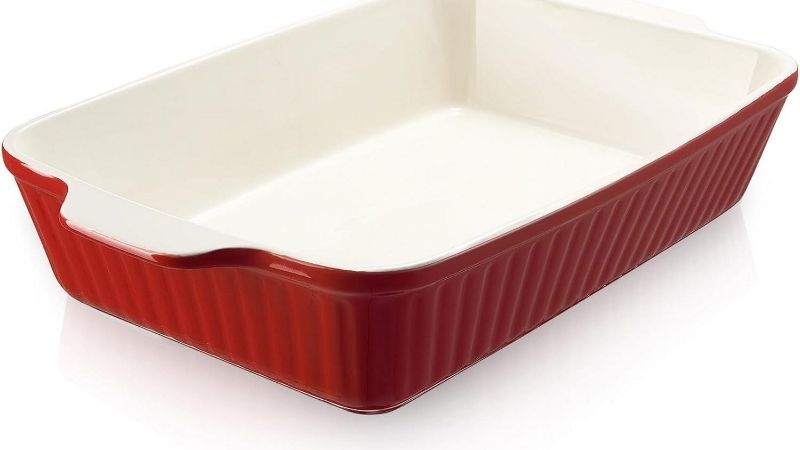
Le Creuset earns the lead because the company specifies both the cooking cavity and the exterior rather than leaving shoppers to guess what 9 by 13 inches means. Unlike Made In’s white 9×13 porcelain baker, whose flat base is notably narrower, this Heritage dish offers a 12.7-by-9.4-inch interior and a 2.7-inch interior height. That combination makes it easier to distribute a broad layer of pasta without reaching the rim too soon. The trade-off is a substantial footprint and a higher price than Fiesta’s family-size option.
Le Creuset’s product page for the white 4-quart Heritage Rectangular Dish, SKU 71102032010002, lists a $95 suggested retail price as of October 2026. Its listed maximum oven temperature is 500°F, and the page allows oven, broiler and microwave use. The brand’s care information calls the glaze dishwasher-safe while recommending hand washing to preserve appearance. A 10-year warranty is listed; that is a manufacturing-coverage statement, not a guarantee against impact damage.
Its exterior measures 15.1 inches long, 9.8 inches wide and 3.7 inches high, including the sculpted form around the cooking well. Those extra inches matter in narrow ovens and when placing the dish next to a roasting pan. The manufacturer explicitly prohibits stovetop use and advises bringing refrigerated or frozen stoneware toward room temperature before reheating to reduce thermal stress. If you expect to alternate between an oven and a burner for gravy, a metal roasting pan belongs in that workflow instead.
Pros:
- Published 12.7-by-9.4-inch interior is genuinely suitable for broad casserole layers.
- Interior reaches 2.7 inches deep for saucy, multilayer recipes.
- Manufacturer lists 500°F oven suitability and a 10-year warranty.
Cons:
- At $95, it costs more than the Fiesta 963100.
- Stoneware cannot be heated directly on an oven burner or stovetop.
Who Should Buy It: Choose this dish when interior room matters most; select the Fiesta 963100 when a lower purchase price and simpler everyday casserole duty matter more.
Fiesta 963100: Best Value for Family Baking
Best For: Frequent family casserole cooks who want an American-made ceramic pan below the premium price tier.
Fiesta is the sensible purchase when the main requirement is a durable-looking, full-size ceramic baker rather than a specialty high-heat glaze or elaborate table presentation. Its 3-quart capacity is smaller than Le Creuset’s 4-quart listing, yet its familiar rectangular shape suits cornbread, enchiladas and moderate-depth casseroles. The brand also makes replacement and color coordination part of its kitchenware offering, although a broad color catalog is not the same as every color being in stock today.
Fiesta Factory Direct’s product page names SKU 963100 and lists the white 9×13-inch rectangular baker at $69.99 as of October 2026. The stated capacity is 96 fluid ounces, or 3 quarts; the maker describes the body as fully vitrified china with a color glaze, made in the United States. It is labeled oven, microwave and dishwasher safe, but the page does not provide a numeric maximum baking temperature. Buyers preparing unusually high-temperature recipes should ask Fiesta for the operating limit rather than assume its rating matches Staub or Made In.
The same Fiesta 963100 product page gives length and width as 9 inches and 13 inches, with a height of 2 3/8 inches. The dimension labels do not say whether those numbers exclude the rim, so a recipe that depends on a flat 9-by-13-inch cake base needs an interior measurement before purchase. Fiesta advertises a 5-year chip-replacement program, subject to its terms; it should not be treated as protection against dropping a fully loaded ceramic dish. The lighter total spend leaves room in a kitchen budget for a good food thermometer.
Pros:
- Factory-listed $69.99 price undercuts most full-size premium bakers here.
- Made-in-USA vitrified ceramic has a stated 3-quart capacity.
- Maker offers a 5-year chip-replacement program under stated terms.
Cons:
- No precise maximum oven-temperature figure appears on Fiesta’s product page.
- Three-quart capacity gives less headroom than the Emile Henry ruffled model.
Who Should Buy It: Pick Fiesta for ordinary baked dinners at a moderate price; buy the Made In White 9×13 Porcelain when a documented 650°F limit is essential.
Made In 9×13 Porcelain: Best for High Heat
Best For: Home cooks who need a documented high-heat porcelain baker and prioritize thermal ratings over maximum surface area.
Made In offers a different proposition from the classic stoneware pans here: its white porcelain version is rated for a notably higher oven temperature. That makes it the relevant option for recipes and finishing methods that exceed the 500°F ceiling published for Le Creuset and Great Jones. However, the branding is a trap for anyone expecting a full 9-by-13-inch flat bottom. Made In’s own dimensions show that the cooking surface is smaller than those words suggest, so this is not the automatic winner for a precise brownie-pan footprint.
Made In’s product page for its white 9×13-inch Rectangular Baking Dish lists $99 as of October 2026 and specifies porcelain made in France. The maker rates it up to 650°F in the oven and allows microwave and dishwasher use; its care page recommends hand washing despite dishwasher compatibility. The stated lifetime warranty applies under the manufacturer’s written terms. The manufacturer’s claim of thermal-shock resistance does not mean a cook should put a piping-hot pan on a wet countertop or ignore ovenware handling precautions.
The white 9×13 version measures 15.312 inches long with handles, 9.375 inches across and 2.5 inches high. Made In identifies an 11.625-by-7.75-inch baking surface, 2.25-inch depth and a 4.2-pound empty weight. That published difference between outer measurements and internal floor gives shoppers unusually useful information for fitted lasagna sheets and recipe yields. Confirm the white porcelain listing, not Made In’s differently formulated colored French Ceramic variants, which the company lists with a 480°F rating.
Pros:
- White porcelain version carries a manufacturer-stated 650°F oven limit.
- Listed 4.2-pound empty weight helps estimate handling before adding food.
- Maker discloses an exact 11.625-by-7.75-inch flat baking surface.
Cons:
- The 9×13 name overstates the width of its level interior base.
- High heat performance does not increase capacity for broad-layer recipes.
Who Should Buy It: Use Made In for documented high-temperature porcelain baking; choose Le Creuset 71102032010002 when a broad casserole interior is the priority.
Emile Henry Ruffled Large: Best for Deep Lasagna
Best For: Hosts baking generous layered meals who need a deeper ceramic vessel with a decorative serving edge.
The Large Ruffled Rectangular Baker stands out not by claiming the hottest oven but by holding a higher, wetter stack of ingredients. Williams Sonoma lists 4.75 quarts, more than Fiesta’s 3 quarts and Great Jones’s 4 quarts. Its ruffled silhouette makes it an attractive serving piece for family-style lasagna or cobbler, while the deeper profile can be less convenient when the desired result is a thin, crisp baked layer. That mismatch is worth considering before paying for additional volume you will rarely fill.
Williams Sonoma’s product listing for the Emile Henry French Ceramic Ruffled Rectangular Baker, Large, posts a $119.95 price as of October 2026. The description gives oven and broiler use up to 500°F, plus microwave and freezer compatibility, and identifies French manufacture. It also specifies a 10-year limited warranty. Williams Sonoma describes the clay as retaining heat well; that benefits table service but also means an apparently stationary dish remains hot when guests reach for a second helping.
For the Large size, the retailer gives physical dimensions of 13 inches long, 9 inches wide and 3 1/4 inches high. These are item measurements, not a guarantee that every inch of the base is flat and available for food; the decorative sides taper the effective shape. Because the edge rises above a substantial filling, check oven-shelf clearance as well as oven width. The retailer recommends avoiding abrasive scouring and washing the glazed ceramic carefully even though the dish is dishwasher safe.
Pros:
- Large-size 4.75-quart capacity exceeds every other listed capacity here.
- Ruffled 3.25-inch-high form suits generously layered main dishes.
- Retailer specifies 500°F oven use and a 10-year warranty.
Cons:
- Posted $119.95 price makes this the most expensive un-lidded pick.
- Textured rim makes stacking and fitting tight storage less convenient.
Who Should Buy It: Choose the large Emile Henry for deep holiday bakes; switch to Staub 40511-886 for smaller meals and easier cabinet storage.
Staub 40511-886: Best for Small Batches
Best For: One- and two-person households cooking compact gratins or side dishes without filling a family-size casserole pan.
Staub solves a portion-size problem that the larger bakers cannot solve efficiently. A smaller vessel lets potatoes, vegetables or a fruit crisp occupy a useful depth without stretching a modest serving across a wide 9-by-13-inch base. It is also the lowest posted price in this comparison, but that does not make it the value winner for shoppers who need six generous servings. With a 2.54-quart capacity, the rustic turquoise 40511-886 is purposely a compact option rather than a substitute for Fiesta’s family baker.
Staub’s product page for model 40511-886, sold through Zwilling US, names the 10.5-by-8-inch rectangular baking dish and shows $49.99 as of October 2026. Its published temperature ceiling is 572°F for oven or broiler use, and the seller also lists microwave, freezer and dishwasher compatibility. The ceramic body has a glazed finish. This is a stated temperature limit, not evidence that every rapid freezer-to-hot-oven transition is risk-free, so follow Zwilling’s ceramic safety instructions when moving between temperature extremes.
Zwilling’s 40511-886 specification section lists a 3.68-pound empty weight and overall dimensions of 12.60 inches long, 8.07 inches wide and 2.44 inches high. Its top opening is approximately 10.47 by 7.87 inches, narrowing to a smaller lower footprint; that taper matters for an even layer of gratin. The side handles project beyond the baking space, but remain relatively manageable when transferred with dry oven mitts. This dish makes more sense for two separate smaller recipes than one crowded lasagna intended for a group.
Pros:
- Manufacturer lists a 572°F maximum for oven and broiler use.
- At 3.68 pounds empty, it is lighter than Great Jones Hot Dish.
- Compact 2.54-quart volume suits a side dish without excessive spread.
Cons:
- The tapered 10.47-inch opening cannot hold a full 9×13 recipe.
- A $49.99 small baker is not necessarily cheaper per serving.
Who Should Buy It: Choose Staub for compact gratins; use Great Jones Hot Dish when four-quart capacity and large serving handles are more useful.
Great Jones Hot Dish: Best for Oven to Table
Best For: Entertainers bringing a colorful four-quart casserole directly from the oven to a buffet or dining table.
Great Jones makes its case at serving time. The Hot Dish has unusually expressive colors and broad, visible handles that make a hot casserole easy to identify among serving dishes at a gathering. Its 4-quart capacity is appropriate for common baked pasta dishes and assembled desserts, while the form looks less like a utilitarian baking pan than Fiesta’s plain rectangular baker. This advantage has a cost: the bare ceramic dish is not a sealed transport kit, and the optional lid is a separate purchase.
Great Jones’s product page for the Blueberry Hot Dish lists the ceramic casserole at $105 as of October 2026. The manufacturer’s Details and Care sections specify 4 quarts, oven safety to 500°F, microwave and freezer compatibility, and dishwasher cleaning. They describe short broiler exposure rather than unrestricted use under a heating element. The site also advertises a 30-day trial and return conditions. Check inventory and lid bundle pricing before ordering, particularly if the dish is needed for a dated family event.
The Hot Dish weighs about 5 pounds empty and measures 16.5 inches long with handles, 9.25 inches wide and 3 inches high, according to Great Jones’s product page. Without handles, the listed length is 13 inches. Those protruding grips consume cabinet and oven space even when the advertised cooking surface appears familiar. When serving, use a trivet that supports the ceramic base, not just the handle ends; its colorful glazed surface is not a reason to place it directly over stovetop heat.
Pros:
- Four-quart volume makes it practical for substantial shared casseroles.
- Wide 16.5-inch handled profile eases positioning on a serving table.
- Maker permits dishwasher cleaning and oven temperatures up to 500°F.
Cons:
- The separately purchased lid adds to the $105 starting price.
- Sixteen-and-a-half-inch overall length complicates compact oven or cabinet fit.
Who Should Buy It: Buy Hot Dish when serving appearance is part of the meal; choose Emile Henry Ruffled Large for a greater 4.75-quart published volume.
How to Choose a Ceramic Baking Dish
Shopping starts with the recipe and the interior floor rather than a fashionable color. The six pans above range from 2.54 to 4.75 quarts in stated capacity, and the makers do not use the phrase 9×13 in a completely consistent way. The buying decisions below prioritize usable flat area, headroom, oven suitability and ownership costs. Solid ceramic and stoneware should not be confused with a thin ceramic nonstick coating on metal, which follows different heating and durability rules.
Measure the Inside, Not Just the Rim
If a cake recipe assumes a rectangular 9-by-13-inch pan, a tapered ceramic baker can yield a different layer thickness and browning pattern even though the exterior label appears correct. Made In publishes a white porcelain flat baking surface of 11.625 by 7.75 inches while calling the product a 9×13 baking dish. Le Creuset specifies 12.7 by 9.4 inches inside its 4-quart Heritage. These numbers are more helpful for a precise recipe than handle-to-handle length. A broad pasta bake tolerates some variation; a sheet cake intended for neat portions may not.
Before buying, compare the recipe’s expected fill depth with the interior wall profile. An inclined wall narrows a dish toward the floor, leaving less usable area for the first layer and often changing how much sauce settles around the edges. If a brand omits the interior base, ask for that measurement or choose a baker whose maker discloses it. This is especially important when replacing a metal pan with ceramic because the material and geometry change together.
Match Quart Capacity to Food Depth
Volume is not a serving guarantee. Fiesta lists 3 quarts, Great Jones lists 4 quarts, and the Emile Henry ruffled Large lists 4.75 quarts; these capacities describe what the vessel can hold rather than a universal number of dinner portions. A soupy vegetable gratin benefits from generous headroom, while brownies and coffee cakes typically demand a predictable layer thickness. More depth also adds weight once food, sauce and a cover are involved.
Check the stated height as a separate number. Emile Henry’s Large is 3.25 inches high, while the Fiesta is listed at 2 3/8 inches. Neither measurement confirms the height of an absolutely vertical interior wall, but it indicates whether the dish is fundamentally a deeper casserole or a shallower baker. Leave room under the next oven rack for a bubbling filling, and do not stack ceramic vessels directly against each other where sharp rim-to-rim contact can chip glaze.
Choose a Documented Heat Limit
Ordinary baking often stays within 350 to 450°F, but broiling and high-heat finishing deserve closer attention. Made In specifically lists 650°F for its white porcelain variant, Staub specifies 572°F for the 40511-886, and Le Creuset and Great Jones both publish 500°F limits for the models compared. Fiesta calls the 963100 oven-safe without stating a maximum on the product page we reviewed. Do not transfer a temperature limit from a different brand, color, material or cookware line.
Thermal-shock language is particularly easy to misread. Le Creuset advises allowing cold stoneware to approach room temperature before reheating, while Emile Henry’s seller says not to put its hot baker on a cold surface. Use a dry heatproof surface and dry potholders, and do not pour cold liquid into a very hot dish unless its specific manual permits the procedure. For food safety, USDA FSIS guidance requires casseroles to reach 165°F in their center; the oven setting alone does not establish food doneness.
Balance Cleaning, Storage and Total Cost
All six makers or their official US sellers identify dishwasher suitability, but a dishwasher-safe label does not eliminate the risk of a heavy pan knocking against another item. Wide handles increase grip but also create storage demands: Great Jones lists 16.5 inches overall, whereas the small Staub is only 12.60 inches long. In a narrow cabinet, test shelf depth and whether an upright slot is available before choosing the largest dish.
Prices in this comparison occupy approximately three practical ranges: around $50 to $70 for a smaller piece or no-frills baker, near $95 to $105 for a substantial branded 4-quart dish, and about $120 for the deeper Emile Henry. Those ranges are descriptions of six October 2026 listings, not universal market price tiers. A bundled lid, replacement after chipping or shipping surcharge can matter more than a modest initial difference, so compare the full checkout price and warranty exclusions. Decorative glaze is a nice bonus, but it cannot replace measurements and handling rules.
Frequently Asked Questions
Beyond dimensions and oven ratings, a home cook still needs to know what the ceramic body can tolerate during everyday preparation and after serving. The answers below separate a manufacturer’s stated capability from safer routine habits, particularly when a dish has been chilled or has held perishable food.
Are porcelain and stoneware both ceramic bakeware?
Yes. Porcelain and stoneware are both ceramic materials, but they are produced using different clay bodies and firing methods. Made In identifies its white baker as porcelain, while Le Creuset calls the Heritage a stoneware dish. Neither name by itself guarantees a higher safe temperature or a larger usable baking surface; compare the exact product documentation instead of assuming porcelain always outperforms stoneware.
Can I slice brownies in the baking dish?
Yes, if the specific maker permits the utensil you plan to use, but a plastic or silicone server is usually the more cautious choice for keeping a glossy interior looking new. Le Creuset describes its Heritage glaze as safe for metal utensils, while Made In’s care guidance recommends plastic or silicone because stainless steel can scratch the finish. Ceramic can also chip if struck by a hard metal edge, so do not treat a utensil-safe statement as impact resistance.
How should I clean burnt cheese from glazed ceramic?
Allow the hot dish to cool safely, then soak it with warm soapy water before using a soft sponge or nonabrasive brush. The Williams Sonoma care directions for the Emile Henry ruffled baker warn against abrasive cleaners and scouring pads. Aggressive scraping can damage the glaze and is especially awkward around a fluted rim. If the ceramic has cracked or developed sharp chips in food-contact areas, retire the damaged piece rather than concealing the defect with seasoning or glue.
When should I refrigerate leftover casserole?
Within 2 hours of serving is the general USDA FSIS recommendation for perishable leftovers, or within 1 hour when ambient temperatures are above 90°F. Transfer thick portions to shallow food-storage containers rather than relying on a large ceramic baker to cool the center quickly. USDA guidance also says to reheat leftovers to 165°F measured with a food thermometer. Use the manufacturer’s advice if reheating in the original refrigerated ceramic dish to avoid exposing a cold vessel to a sudden temperature change.
Final Thoughts
For most households shopping for a ceramic baking dish, our Best Overall remains the Le Creuset Heritage Rectangular Dish 71102032010002, because its disclosed interior is closer to the familiar casserole footprint than several products bearing a 9×13 label. Before checkout, compare your most-used recipe’s required flat base with the maker’s actual cavity measurement, then confirm the selected color and price. A cook regularly making thin cakes in a precisely sized metal pan may be better served by retaining that metal pan and using ceramic for meals where heat retention and table presentation matter.