Key takeaways
- Manufacturer specifies two heat-pump compressor stages and two auxiliary heating stages.
- Included Power Extender Kit serves many approved installations without an existing C wire.
- Included SmartSensor adds a second occupied-room temperature reference.
A heat pump thermostat must coordinate a reversing valve, compressor stages and, when present, backup heating. A fashionable screen is irrelevant if the thermostat cannot distinguish your O/B wire from the auxiliary or emergency heat terminals. For a supported, low-voltage two-stage heat pump with backup heat, ecobee Smart Thermostat Premium is our best overall choice: the manufacturer documents two compressor stages and two auxiliary stages, and its included Power Extender Kit can solve many missing-C-wire installations. Owners of dual-fuel systems, older battery-powered thermostats and higher-stage equipment may have better options below.
Quick Verdict: Choose ecobee Smart Thermostat Premium for compatible 2H/2C heat pumps with up to two auxiliary heat stages and well-documented control terminals. This is an editorial comparison of published manufacturer specifications as of October 2026, not a hands-on test. Verify every wire and the heat pump’s installation instructions before purchase.
As an Amazon Associate we earn from qualifying purchases.
By DIY Ideas 4 Home Editorial Team
6 Best Heat Pump Thermostats Reviewed
We selected specific models by published heat-pump staging, backup-heat connections, power needs and documented installation limits. Ecobee, Bosch, Resideo, Google and Amazon manuals provide the source material; they do not replace a terminal-by-terminal compatibility check. Regular published device prices stretch from the $79.99 Amazon model to Google’s $279.99 Nest, while several professional-control models have no direct official list price. A professionally installed wired controller may cost more overall than its shelf price suggests.
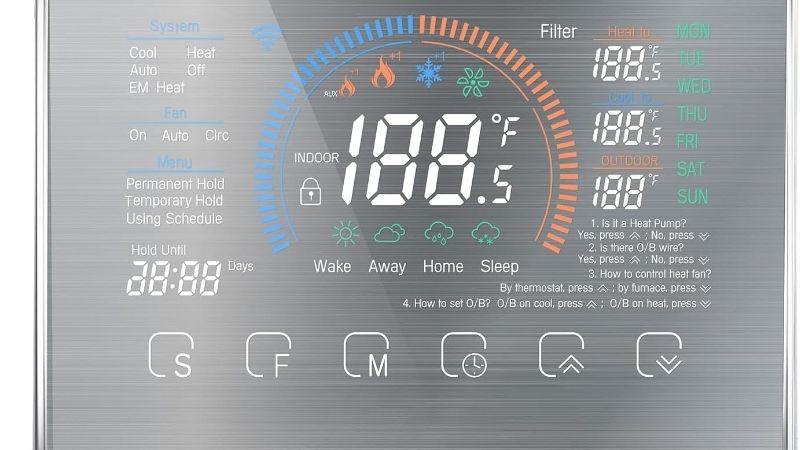
| Product | Best For | Key Spec | Listed Price (as of October 2026) | Watch Out For |
|---|---|---|---|---|
| ecobee Smart Thermostat Premium | Best Overall | 24VAC heat pumps: 2H/2C + 2 AUX stages | $259.99 | Terminal-specific dual-fuel and accessory checks |
| Bosch Connected Control BCC110 | Four-Heat-Stage Systems | Heat pump up to 4H/2C; C wire required | No official list price | Only 2.4GHz Wi-Fi; staging configured by installer |
| Honeywell Home T10+ Pro THX321WFS3001W | Dual Fuel With Room Sensing | 3H/2C heat pump; room sensor included | No official list price | 4H/2C needs separate EIM kit |
| Google Nest Learning Thermostat (4th gen) | Adaptive Auxiliary Controls | Up to 2 compressor stages, 2 alternate heat stages | $279.99 | Complex dual-fuel setups merit professional help |
| Honeywell Home T6 Pro TH6320U2008 | Offline Scheduling | Up to 3H/2C heat pump; AA battery option | No official list price | No built-in app/Wi-Fi access |
| Amazon Smart Thermostat S6ED3R | Basic Alexa Homes | 24V heat-pump support; C wire required | $79.99 at APS marketplace | Check stage and AUX wiring in Alexa setup |
ecobee Premium: Best Overall
Best For: A conventional low-voltage heat pump with two compressor stages and multiple supported backup heat calls.
Ecobee Premium leads for the particular problem this comparison addresses: it documents two compressor heat/cool stages plus two auxiliary stages without treating a remote sensor or a glossy screen as proof of heat-pump competence. The included Power Extender Kit also gives homeowners with older four-wire thermostat cables a manufacturer-supported avenue to investigate. That makes it a more rounded selection than Amazon S6ED3R for sophisticated equipment, although a dual-fuel furnace still deserves an installer review.
The ecobee Smart Thermostat Premium product and compatibility page lists the device at $259.99 as of October 2026, specifying 24VAC operation and heat-pump compatibility up to 2H/2C plus two AUX stages. Its terminals include O/B, Y1, Y2, W1, W2 and C, while the package includes a Power Extender Kit and a SmartSensor. The published stage limit is equipment compatibility, not a promise that every combination of dual fuel, heat strips and accessories can be configured simultaneously.
Ecobee’s product specifications give a housing roughly 4.09 inches wide and 4.09 inches tall, with a roughly 1.02-inch depth. The wall trim plate can conceal some paint marks left by older rectangular thermostats. The sensor is for temperature prioritization, not independent duct zoning; thermostat logic should be commissioned so auxiliary resistance strips do not energize merely because a large schedule change was requested. The manufacturer’s limited warranty is three years.
Pros:
- Manufacturer specifies two heat-pump compressor stages and two auxiliary heating stages.
- Included Power Extender Kit serves many approved installations without an existing C wire.
- Included SmartSensor adds a second occupied-room temperature reference.
Cons:
- $259.99 regular price exceeds Amazon S6ED3R by $180.
- Complex fossil-fuel backup and accessory terminals need tailored configuration.
Who Should Buy It: Choose Premium for compatible multistage electric-backup equipment; choose Bosch BCC110 if the documented four-heat-stage arrangement is the priority.
Bosch BCC110: Four-Heat-Stage Systems
Best For: Owners whose documented heat-pump configuration needs up to four heating stages and a sizable local display.
Bosch BCC110 deserves consideration when heat-pump staging is more demanding than an entry smart controller supports. Its professional engineering sheet explicitly states up to 4H/2C heat-pump control, plus emergency heating mode, and it provides equipment fault-message functions for supported Bosch water-source heat pumps. The compromise is that it needs continuous power and local setup details; unlike Honeywell Home T6 Pro, its design does not offer a simple battery-only substitute for a missing common conductor.
Bosch’s Connected Control BCC110 Engineering Submittal Sheet, document BTC 469908301 A dated May 2024, specifies 24VAC operation (18 to 30VAC), seven output relays, up to four heat and two cooling stages for heat pumps, and a five-inch touchscreen. A single humidification or dehumidification accessory is supported where compatible. Bosch does not display an official direct list price on its BCC110 product page; request an exact-model dealer quote, including any wiring labor.
The same engineering sheet illustrates the thermostat at approximately 5.20 inches wide, 3.07 inches high and 0.98 inch deep. Bosch states a five-year limited warranty and 2.4GHz-only wireless networking. Bosch’s Thermostats and Controls FAQ explains that supported external micro-USB powering may be used by a technician where wiring cannot provide a C wire, but this is not an invitation to jury-rig a wall cable. Confirm whether proprietary communicating equipment is actually supported before purchasing.
Pros:
- Official engineering submittal identifies heat-pump compatibility up to 4H/2C.
- Five-inch color screen exposes modes without opening a phone app.
- Bosch documents a five-year limited product warranty.
Cons:
- No official list price makes installed-cost comparison harder.
- Only 2.4GHz Wi-Fi works; the unit is not compatible with every zoned system.
Who Should Buy It: Choose BCC110 for a Bosch-compatible complex heat pump; prefer Honeywell Home T6 Pro for basic controls without Wi-Fi.
Honeywell T10+ Pro: Dual Fuel With Room Sensing
Best For: Homes with a heat pump plus fossil-fuel backup that also want a supplied wireless room sensor.
For dual-fuel installations, the T10+ Pro is a more natural comparison point than a generic consumer thermostat because Resideo documents outdoor temperature lockouts and backup-fuel operation. The THX321WFS3001W bundle supplies a wireless indoor sensor, which can change which occupied space influences a single-zone system. Resideo also sells a distinct equipment interface module configuration for additional stages. Those two packages must not be conflated when calculating price or choosing a wiring diagram.
Resideo’s T10+ Pro Smart Thermostat product page for SKU THX321WFS3001W/U and its 50-1194 T10+ accessories sheet specify 24VAC operation, up to 3H/2C heat-pump control without the separate equipment interface module and dual-fuel capability. The company identifies 4H/2C only with a compatible T10+ EIM kit; it is not a capability of the loose wall thermostat alone. The standard sensor-included package does not have a manufacturer-direct listed price in the pages checked in October 2026.
Resideo’s product specifications measure the controller at 4.9 inches tall, 3.7 inches wide and 0.93 inch deep. Its thermostat selection guide identifies C-wire power, a five-year limited warranty and room sensor support. A separate outdoor probe or internet weather source can be relevant to lockouts, but the actual changeover temperature depends on equipment sizing and the contractor’s heat-loss calculation, not a universal 35°F rule. Owners should ask the installer to explain which source is prioritized during a network interruption.
Pros:
- THX321WFS3001W includes a RedLINK 3.0 indoor temperature sensor.
- Documented dual-fuel logic supports equipment-dependent outdoor lockout decisions.
- Distinct EIM bundles offer a verified expansion path to 4H/2C.
Cons:
- More complex pro-only equipment integration can increase installation labor.
- Purchasing the sensor bundle alone does not provide the EIM expansion.
Who Should Buy It: Select T10+ for professionally managed dual fuel; ecobee Premium better suits a simpler compatible all-electric heat pump.
Google Nest 4th Gen: Adaptive Auxiliary Controls
Best For: A compatible heat pump where automatic temperature routines and adjustable AUX thresholds matter.
The fourth-generation Nest adds practical heat-pump controls that can matter more than its attractive dial. Google’s Heat Pump Balance documentation describes how its supported systems coordinate compressor heating with auxiliary backup and allow adjustments around auxiliary staging. The box also contains a room sensor. Compared with Honeywell’s conventional T6 Pro, it offers a more automated ownership experience, but a dual-fuel gas furnace requires careful identification as alternate heat rather than electric auxiliary heat.
Google Store lists the Nest Learning Thermostat (4th gen) at a $279.99 regular price in October 2026. Google’s Nest thermostat compatibility guide describes heat-pump equipment using up to two compressor stages plus two alternate or auxiliary heat stages, depending on connection layout. The Google fourth-generation professional information sheet names O/B, AUX and E support and explains that certain wiring still needs a C wire or Nest Power Connector. Nest Heat Pump Balance is not available for every dual-fuel arrangement.
Google’s technical specifications give a 3.9-inch diameter, 1.1-inch depth and 5.7-ounce weight, and its standard US retail limited warranty is two years. The room sensor changes the temperature point considered by the thermostat rather than creating independent zones. The product’s power-sharing design may work without a C wire on many compatible installations, but heating-only, zoned or complex equipment can require extra hardware. A professional is strongly recommended where a furnace and heat pump share control.
Pros:
- Google documents Heat Pump Balance for supported AUX-equipped heat pumps.
- One second-generation Nest Temperature Sensor ships with the thermostat.
- Its regular $279.99 price is published on the Google Store.
Cons:
- Two-year retail warranty is shorter than several competing professional controllers.
- Automated AUX logic does not apply unchanged to dual-fuel alternate heat.
Who Should Buy It: Pick Nest for guided backup-heat control and a Google Home setup; pick Resideo T10+ for contractor-managed dual fuel.
Honeywell T6 Pro TH6320U2008: Offline Scheduling
Best For: Owners who favor local programmable heat-pump operation without app accounts, voice control or Wi-Fi dependencies.
Not every heat-pump thermostat needs to be smart. The T6 Pro’s value lies in clearly documented terminal connections, day-to-day scheduling and battery-powered operation. That is a meaningful alternative for an older home where adding a C wire would require new wall work. Resideo offers models with fewer stages in the same family, but this selection deliberately uses TH6320U2008, the precise higher-stage SKU; the lower-staged TH6210 must not be assumed equivalent.
Resideo’s T6 Pro Submittal Sheet 33-00263-03 and product page for TH6320U2008/U specify up to 3H/2C heat-pump control, including a two-compressor-stage installation, auxiliary heat, emergency heat and optional dual fuel. The thermostat offers seven-day, 5-2 and 5-1-1 programming. Its 20 to 30VAC control terminals and optional AA-battery power differ from Bosch’s always-powered connected thermostat. Resideo does not post a direct official list price for this exact professional SKU, so compare local HVAC supplier prices.
The submittal sheet lists a body around 4.06 inches high, 4.06 inches wide and about 1.16 inches deep. Resideo’s product information identifies an included UWP mounting system, cover plate and two AA batteries, plus a five-year limited warranty. Wired sensor-assisted outdoor lockouts are optional, so buyers should ask their technician whether the proposed backup-heat strategy uses an outdoor sensor or another approved arrangement. Do not mistake the offline T6 Pro for the Wi-Fi version in online product listings.
Pros:
- TH6320U2008 documents 3H/2C heat-pump operation with E and AUX terminals.
- Two AA batteries allow supported installations without continuous C-wire power.
- Seven-day and split-week programs operate without a cloud account.
Cons:
- Absence of Wi-Fi rules out checking temperature remotely.
- Outdoor-sensor lockout capability may require extra professional-supplied parts.
Who Should Buy It: Choose the TH6320U2008 for reliable local schedules; choose Google Nest fourth-generation for online optimization controls.
Amazon S6ED3R: Basic Alexa Homes
Best For: Owners of simple compatible 24-volt heat pumps who already use Alexa and want a low upfront price.
Amazon’s thermostat brings the entry price down without promising the sophisticated stage management of BCC110 or T10+. The Alexa app leads initial configuration, making it attractive where the existing heat-pump wiring is standard and well labeled. Amazon’s own support documentation includes emergency heat operation for supported installations, but that should not be confused with guaranteed compatibility for multiple compressors, dual fuel or proprietary control boards. Buyers with extra AUX wires should verify the exact wiring scheme before checkout.
Amazon’s Getting to Know Amazon Smart Thermostat guide states the S6ED3R class is intended for 24V heating, cooling and heat pump systems and requires a common wire, explicitly excluding 120 to 240V line-voltage baseboards. Amazon’s Safety and Compliance Information for Model S6ED3R specifies 24VAC, 60Hz and 0.2A power for a Class 2 circuit. The utility-run APS marketplace lists the device at $79.99 as of October 2026; this is a current retailer listing, not an Amazon-published permanent MSRP.
The device measures about 3.56 by 3.56 by 0.84 inches according to the published S6ED3R device specification reproduced with its model number. A one-year limited warranty is confirmed by Amazon’s compliance notice. Unlike the battery-capable T6 Pro, it needs a proper 24V common supply; buying a separate compatible power adapter can erode the low sticker price. Alexa schedules and remote controls depend on software and network access, but the heating equipment must still be commissioned to operate safely if internet service fails.
Pros:
- APS marketplace shows an identifiable $79.99 listing for the device.
- Amazon’s official guide explicitly includes compatible 24V heat pump systems.
- Alexa provides phone-based schedules for compatible installed equipment.
Cons:
- One-year limited warranty trails Honeywell Home T6 Pro’s five years.
- Advanced multi-stage or dual-fuel compatibility needs a particularly careful check.
Who Should Buy It: Choose S6ED3R for a simple supported Alexa installation; upgrade to ecobee Premium when two auxiliary stages are documented necessities.
How to Choose a Heat Pump Thermostat
Start with the heat pump model and the existing terminal diagram, not a home’s square footage or the thermostat’s touchscreen. A standard air-source heat pump may need one compressor stage, two compressor stages or coordinated electric strips, and a dual-fuel unit substitutes furnace heat according to a distinct changeover strategy. No amount of app automation compensates for an unsupported Y2, O/B or E terminal. The following checks separate safe compatibility from an attractive feature list.
Count Compressor and Backup Stages
Manufacturer labels such as 3H/2C need interpretation: they commonly describe heating calls that combine compressor and auxiliary stages rather than three different compressors. The Resideo TH6320U2008 wiring guide, for example, illustrates separate Y and Y2 compressor terminals and AUX and E connections. The Bosch BCC110 submittal sheet lists 4H/2C heat-pump compatibility, while ecobee Premium describes 2H/2C plus two AUX stages. Read the precise controller manual before assuming these manufacturer stage labels can be swapped between products.
Find the heat-pump manufacturer’s specified auxiliary strip kW or furnace-control arrangement and ask how each step is energized. Emergency heat is a separate operating condition used when the heat pump cannot run, not the everyday next temperature stage. Google explicitly describes emergency heat as different from automatic AUX calls. On a dual-fuel system, incorrect simultaneous operation or lockout logic can be expensive or incompatible with equipment, so a licensed HVAC contractor should verify the staged calls.
Identify O/B, C-Wire and System Voltage
Most of these controllers are designed for low-voltage 24VAC circuits. The O/B terminal signals the heat-pump reversing valve, but brands may energize that valve for heating or cooling depending on equipment design. Incorrect changeover settings can make the system produce the opposite of the requested mode. Take photos of terminal labels before disconnecting conductors, with the HVAC breaker switched off; wire color by itself is not a reliable terminal code. No controller in this table is intended to accept 120V or 240V line-voltage heater connections.
C-wire planning may determine the practical purchase. Bosch BCC110 and Amazon S6ED3R require continuous power, while Resideo T6 Pro TH6320U2008 can use batteries in compatible installations. Ecobee Premium has a maker-supplied Power Extender Kit; Nest fourth-generation may require a separate Nest Power Connector for certain systems. Resideo’s T10+ uses a C wire. A contractor should inspect any control-board modifications, particularly if an isolation transformer, equipment interface module or additional accessories are involved.
Control AUX Heat and Dual Fuel Intelligently
According to Google’s Heat Pump Balance guide, auxiliary resistance heat on supported heat pumps can be managed using configurable balance and staging controls. Resideo’s T10+ material documents auxiliary lockout and dual-fuel features with appropriate setup. Those capabilities help only if the outdoor sensing, backup heater type and stage delays match the installed equipment. There is no universal outdoor switch-over temperature: the balance point changes with house heat loss, heat-pump output and fuel prices.
A US Department of Energy-style large overnight setback may be effective with a furnace but can trigger costly electric backup during a heat-pump recovery. Carrier’s published explanation of auxiliary heat similarly warns about significant setback recovery. A smaller change or a thermostat’s gradual recovery logic may be preferable, depending on climate and installed controls. If the AUX indicator stays on unusually often during mild weather, have the equipment serviced instead of disabling backups blindly.
Compare Hardware, Price and Installer Support
Two clearly published regular prices in the upper tier are $259.99 for ecobee Premium and $279.99 for Google Nest fourth-generation, while the Amazon S6ED3R retailer listing is $79.99. Bosch BCC110, Resideo T10+ sensor bundle and T6 Pro TH6320U2008 do not provide an official direct list price in the documentation checked. Ask for total installed cost, not just a thermostat-box quote, and include any C-wire work, outdoor sensor, RedLINK EIM or labor required to verify a dual-fuel configuration.
The physically smaller Amazon thermostat may not cover paint shadows from an older wall plate; Bosch’s roughly 5.20-inch-wide screen occupies significantly more wall area. Remote sensors from ecobee, Google and the sensor-bundled Resideo unit influence which room temperature is considered, but they cannot create separate heating zones without suitable HVAC equipment. Warranty and offline access matter as well: Bosch and Resideo T6 Pro document five-year limited terms, whereas Amazon lists one year. Check the exact model’s warranty registration and retailer return terms.
Frequently Asked Questions
These issues often surface only after someone discovers a heat pump’s backup wiring or begins changing winter schedules. The answers concern operational limits that cannot be determined from price and touchscreen features alone.
Does a Heat Pump Need a Special Thermostat?
Yes, it needs a thermostat specifically compatible with the heat pump’s reversing-valve operation, compressor staging and any backup heating. A simple one-stage furnace controller may lack the O/B terminal or separate AUX and emergency heat behavior. The Resideo T6 Pro TH6320U2008, for example, has documented heat-pump diagrams that distinguish Y, Y2, O/B, AUX and E. Confirm your equipment and the replacement model with the manufacturer’s compatibility checker rather than choosing from a generic heating-and-cooling label.
Should AUX and Emergency Heat Use One Setting?
No. Auxiliary heat generally starts automatically when the heat pump needs additional heating, while emergency heat is an intentional backup mode for situations such as a primary-unit failure. Google Nest’s Emergency Heat support guide makes this distinction explicit. Some equipment combines or separates outputs physically, so the wiring and installer programming must reflect the actual control-board instructions. Repeated emergency heat operation or unexplained auxiliary calls are reasons for professional diagnosis, not a cue to raise a lockout temperature at random.
Can a Smart Thermostat Run a Communicating Heat Pump?
Not necessarily. Some variable-speed and proprietary communicating systems require matched manufacturer controls, and a generic 24VAC terminal list is insufficient evidence of compatibility. Bosch’s BCC110 describes specific applications, but that does not mean every Bosch or third-party communicating unit accepts it. Ask the equipment manufacturer whether a conventional thermostat interface or adapter is supported. Substituting a generic controller without confirmation can disable modulation, fault reporting or required protection functions.
What Happens to the Heat Pump When Wi-Fi Fails?
A correctly wired thermostat should continue its supported basic heating and cooling control, although app access and connected weather-based functions can be reduced. Bosch’s official BCC110 FAQ explicitly says its thermostat continues controlling HVAC equipment without Wi-Fi, while Google and other platforms retain local thermostat functions within their supported configurations. Dual-fuel lockouts that depend on web weather rather than a wired outdoor sensor deserve special attention; ask your installer what fallback data and safety limits remain active during an outage.
Final Thoughts
The most useful pre-purchase document is often the air-handler wiring diagram, not a thermostat feature list: verify whether a second compressor output, separate emergency call or fossil-fuel alternate heat must be supported before selecting a controller. For a compatible 24VAC heat pump with up to two auxiliary stages, ecobee Smart Thermostat Premium remains the best overall recommendation here because those specific capabilities and its power accessory are documented. If the equipment needs contractor-set fuel changeover logic, compare Resideo T10+ Pro; if it needs four heat stages, check Bosch BCC110 first. Confirm the precise SKU and current installed price before ordering.