Key takeaways
- Pre-spaced 9-square-foot roll reduces wire layout decisions for a simple aisle.
- Published 135-watt rating makes the electrical load clear before installation.
- Wet-location listing and 25-year warranty have model-specific documentation.
A heated bathroom floor can make cold tile more comfortable without placing a portable heater near splashes, but the correct product depends on the exposed walking area, floor assembly, and how much installation work you are prepared to buy. Electric mats suit simple rectangular layouts; loose cables can trace around an awkward vanity or toilet. Both become part of the flooring, so changing a mistaken layout after tiling is expensive. Start by measuring the unobstructed floor, not the room’s wall-to-wall dimensions.
Quick Verdict: For a straightforward small tiled bathroom, the WarmlyYours TempZone Flex Roll TRT120-1.5×06 is our Best Overall choice: its published 9-square-foot layout, 135-watt output and wet-location listing make the heating area and intended conditions unusually clear. A winding footprint is a better reason to choose the WarmlyYours TCT120-3.7W-030 cable instead. These are editorial selections from manufacturer documentation and listed prices as of October 2026, not results of in-house testing.
As an Amazon Associate we earn from qualifying purchases.
By DIY Ideas 4 Home Editorial Team
6 Electric Systems for a Heated Bathroom Floor
We compared documented 120-volt output, usable coverage at the manufacturer’s specified spacing, bathroom suitability, format, and the consequences of getting the installation wrong. Brand product pages, technical tables and installation documents provided the underlying figures. These product-only prices, checked in October 2026, range from about $139 for a short loose cable to more than $325 for one preformed mat; thermostats, protection, substrate work, and labor may materially change the project total. Before choosing, have a qualified electrician confirm the circuit, thermostat with ground-fault protection, applicable codes and any shower-area restrictions.
| Product | Best For | Key Spec | Listed Price (as of October 2026) | Watch Out For |
|---|---|---|---|---|
| WarmlyYours TRT120-1.5×06 | Best Overall | 9 sq ft; 135 W; 120 V | $169 | Fixed 18-in mat width; controller extra |
| WarmlyYours TCT120-3.7W-030 | Irregular floor plan | 30-ft cable; 111 W; 120 V | $139 | Spacing and fastening require careful planning |
| Nuheat F1208 | Preformed small rectangle | 10 sq ft; 120 W; 120 V | $325.75 | Prebuilt geometry is not freely reshaped |
| Nuheat N1C012 | Membrane-based tile assembly | 47-ft cable; 146 W; 120 V | $256.46 | Membrane or cable guides purchased separately |
| SunTouch 12000430R | Wide open bathroom aisle | 10 sq ft; 120 V; 4 ft by 30 in | $197.11 | Thermostat is separate; verify current retail price |
| ThermoSoft TTM10-120 | Long narrow tile run | 15 sq ft; 180 W; 120 V | $229.86 | Needs 10-ft run or planned mesh turns |
WarmlyYours TRT120-1.5×06: Best Overall
Best For: Homeowners retiling a modest bathroom with an open rectangular strip about 18 inches wide.
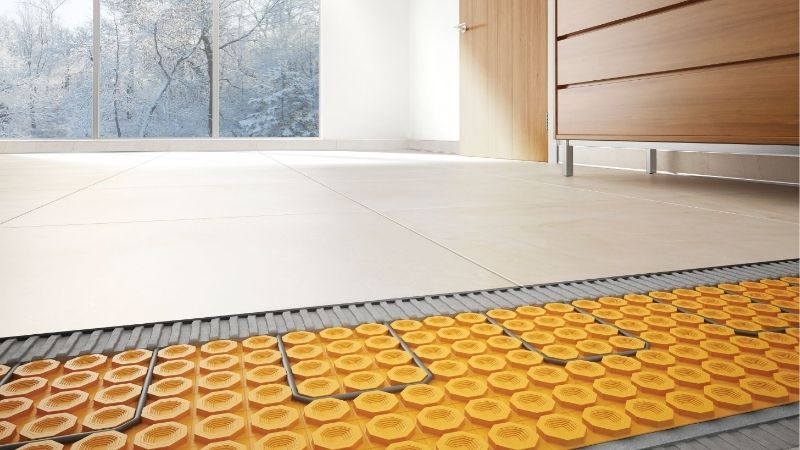
Buying a pre-spaced roll is a sensible middle ground when you want predictable warmth but do not want to design a loose-wire path. This TempZone roll places its heating cable on a narrow mesh backing that can be oriented along the main walking route. It also has a documented wet-location listing, an especially important starting point for bathroom planning. Its weakness is geometric: a bathroom interrupted by many corners may waste the convenience of a ready-made roll.
WarmlyYours’ TRT120-1.5×06 product page and its support specifications identify a 120-volt, 135-watt heater covering 9 square feet, with a manufacturer-rated output of 15 watts per square foot. The official US listing showed $169 in October 2026, a mid-level product-only cost within this comparison. The support record also names a cULus listing and 25-year product warranty, but the rating does not replace a GFCI-equipped control or approved bathroom electrical installation.
The roll measures 1.5 feet wide by 6 feet long, weighs about 2 pounds, and includes a 15-foot cold lead and backup floor sensor. A 0.125-inch heating element helps limit buildup within a properly specified tile assembly. The installer must turn the mesh without cutting heating wires; the existing subfloor, waterproofing plan and final tile thickness still dictate the finished installation. A damaged buried wire is harder to access than a failed wall-mounted heater, so resistance checks before and during covering matter.
Pros:
- Pre-spaced 9-square-foot roll reduces wire layout decisions for a simple aisle.
- Published 135-watt rating makes the electrical load clear before installation.
- Wet-location listing and 25-year warranty have model-specific documentation.
Cons:
- An 18-inch-wide roll is awkward in small notched-out floor sections.
- Separate thermostat and finished tile materials increase the actual project bill.
Who Should Buy It: Choose this roll for an uninterrupted walking strip; choose Nuheat N1C012 when an uncoupling membrane and cable routing are central to the job.
WarmlyYours TCT120-3.7W-030: For Awkward Layouts
Best For: Remodelers who need to place heat selectively around an off-center vanity or narrow doorway.
A cable spool offers something an ordinary roll cannot: the spacing and path can be planned around a bathroom’s actual heated footprint. That flexibility is valuable when a mat would have to bend back repeatedly around fixed cabinets. It is not a shortcut, however. The layout needs a drawing and approved fastening method before tile work starts, and widening the spacing trades floor output for coverage.
The WarmlyYours TCT120-3.7W-030 product page and its US electric floor heating catalog specify 30 feet of cable, 111 watts and 120 volts. The manufacturer lists coverage as 7.5 square feet at a tighter 3-inch spacing, approximately 10 square feet at 4-inch spacing, and up to 12.5 square feet at 5-inch spacing. Its catalog MSRP and October 2026 web listing were both $139; this is the entry-price component in our comparison, not a guaranteed lower installed cost once fixing strips and underlayment are counted.
The heating wire itself is 30 feet long, with a separately documented 15-foot cold lead and a floor sensor in the package. That narrow element permits turns a rectangular mat cannot make, but the electrical heating portion must not be shortened to suit a leftover space. WarmlyYours’ model documentation lists a 25-year warranty and wet-location status; approval for a particular wet assembly must still be checked against the complete design. Leave the final mains connection and protection checks to a licensed electrician.
Pros:
- Thirty-foot cable can navigate small floor sections with planned turning radius.
- Spacing options let a 111-watt element cover different approved areas.
- Manufacturer price of $139 leaves budget for appropriate fixing accessories.
Cons:
- Manual spacing raises the chance of uneven heating if layout is rushed.
- Fixing strips and floor build-up materials can erode the apparent savings.
Who Should Buy It: Pick this cable for jogs around built-ins; choose WarmlyYours TRT120-1.5×06 for a straight run that needs less spacing work.
Nuheat F1208: For a Small Rectangle
Best For: Owners with a clearly measured 4-foot-by-30-inch walkable patch and a simple tile replacement.
Nuheat’s advantage is the predetermined heating pattern: the cable is already sandwiched into fabric in the exact shape that will be installed. This minimizes the temptation to improvise wire spacing at the job site. Unlike a cable kit, the F1208 is not meant to be stretched over a larger area by shifting rows. It makes the most sense when the bathroom measurement happens to match its ready-made footprint.
Nuheat’s F1208 product page and its Standard Mat Selection Table name F1208 as a 120-volt mat rated at 120 watts, with 10 square feet of coverage and about 1 amp of current draw. The manufacturer’s October 2026 published price was $325.75, placing it toward the higher end of the six product-only listings. Nuheat states 12 watts per square foot for standard mats. This is a different output density from the 15-watt WarmlyYours roll, but material layers and thermostat behavior affect the warmth someone actually feels.
The manufacturer dimensions for F1208 are 48 by 30 inches, and the Standard Mats technical section lists a 10-foot cold lead. Its preconfigured fabric format is designed to go into thinset under compatible floor finishes. Nuheat requires resistance checks before, during and after installation for warranty validation, a meaningful precaution because an embedded open circuit means removing finished flooring. Confirm the thermostat’s ground-fault function with the electrician rather than assuming the mat itself provides the required protection.
Pros:
- Fixed 48-by-30-inch shape makes a measured bathroom patch straightforward to cover.
- Documented 120-watt load helps size the protected electrical control circuit.
- Fabric construction keeps heating-wire spacing fixed during careful thinset placement.
Cons:
- At $325.75, heating material costs more than comparable small rolls here.
- Rigid mat geometry cannot economically fill several separated irregular patches.
Who Should Buy It: Select F1208 when the shape already fits; compare SunTouch 12000430R if you want a similar-size rectangular mat at a lower listed retailer price.
Nuheat N1C012: For Membrane-Based Tile
Best For: Bathroom renovators already specifying uncoupling underlayment and wanting cable-route flexibility.
A membrane can solve a different problem from simply warming the feet: it can help isolate tile from some movement in the substrate when used as the manufacturer specifies. Nuheat N1C012 can be laid with suitable cable guides or used with the brand’s membrane, so it fits a renovation in which the tile assembly is being rebuilt anyway. The trade-off is procurement complexity: one price on the cable box does not buy the whole uncoupling and control system.
Nuheat’s N1C012 product page lists the model as a 120-volt, 47-foot cable rated at 146 watts and 1.22 amps, with approximately 12 square feet of standard coverage when installed using the published cable-guide spacing. The same source lists the cable at $256.46 in October 2026. Nuheat explains that spacing changes output density, including 12 or 15 watts per square foot in supported layouts; the fixed electrical input of the purchased cable must not be confused with the variable coverage area.
The 47-foot cable length allows its serpentine route to be designed around the walking zone. Nuheat’s cable system specifications identify a 10-foot cold lead, while the membrane technical sheet states a roughly 0.22-inch membrane thickness before the tile layers. An uncoupling membrane is not automatically a watertight shower pan: seams and penetrations need the specified waterproofing detailing, and the peel-and-stick version is not rated by Nuheat as waterproof. Testing cable resistance in stages is part of preserving the documented warranty conditions.
Pros:
- Forty-seven-foot cable accommodates a planned heated shape with membrane routing.
- Nuheat publishes a specific 146-watt, 1.22-amp electrical load.
- Compatible brand membrane combines heat routing with uncoupling tile support.
Cons:
- The $256.46 cable price excludes the membrane and thermostat entirely.
- Wrong membrane detailing can compromise the bathroom’s waterproofing strategy.
Who Should Buy It: Choose N1C012 for a coordinated Nuheat tile assembly; pick ThermoSoft TTM10-120 for a long pre-spaced mat that does not require laying every cable turn individually.
SunTouch 12000430R: For a Wide Walkway
Best For: Remodelers with a broad open route beside a tub or double vanity rather than a narrow corridor.
The chief appeal of this SunTouch mat is its generous 30-inch width: a wide walking strip can be covered by a relatively short length of mat. Because its heating wires are secured to an open-weave backing, the mat can be arranged before thinset is placed without handling an entire loose-cable spool. The problem comes if the bathroom is less than 30 inches wide at several points. The backing can be adjusted according to instructions, but the heating wire must remain intact and at the prescribed spacing.
The Home Depot identifies the SunTouch 12000430R in its listing and specifies a 120-volt heating mat covering 10 square feet and measuring 4 feet by 30 inches. Watts’ TapeMat product page states that the line uses roughly 1/8-inch-thick heating elements, a floor-sensing thermostat sold separately, and approved mortar embedding. At 12 watts per square foot for the specified TapeMat system, the corresponding 10-square-foot nominal load is 120 watts. The checked Home Depot listing showed $197.11 in October 2026; promotional or store-specific prices can change.
The 4-foot-by-30-inch sheet covers an area close to the Nuheat F1208 while arranging that area in a much wider footprint than WarmlyYours’ 18-inch Flex Roll. The manufacturer notes that a SunStat controller is sold separately, which matters because the protected thermostat is integral to safely operating an installed mat. A licensed professional must assess the wiring and installation zone; a mat intended for ordinary bathroom tile should not be presumed approved inside the shower unless that exact assembly is documented.
Pros:
- Thirty-inch width suits a broad walking area beside paired bathroom fixtures.
- Four-foot length makes the 10-square-foot coverage easy to visualize on plans.
- Watts documents the TapeMat’s 1/8-inch profile for typical tile installations.
Cons:
- Wide backing can be inconvenient around tight alcoves or plumbing penetrations.
- Retailer pricing fluctuates and does not include a separate SunStat controller.
Who Should Buy It: Use 12000430R for a wide rectangular patch; choose Nuheat F1208 if a 48-by-30-inch prebuilt sheet and its fabric design better suit your tile work.
ThermoSoft TTM10-120: For a Long Tile Run
Best For: People replacing tile along a longer bathroom route with about 15 square feet of open floor.
A 10-foot run is appealing when the main traffic path extends from the doorway to the vanity and tub. ThermoSoft’s mat gives that project a single pre-spaced strip instead of several short pieces needing carefully planned positions. It also provides a distinct middle option in our comparison: more heated area than the nine- and ten-square-foot mats without stepping up to a much larger circuit load. Plan the roll’s mesh turns in advance if the floor is not genuinely long and narrow.
ThermoSoft’s TTM10-120 product page identifies a 120-volt, 1.5-amp mat rated at 12 watts per square foot and a total 15-square-foot coverage area. That rating corresponds to 180 watts at the stated size. The official October 2026 online listing was $229.86, with a higher crossed-out reference amount on the page; the current purchase price is more useful than assuming that promotional percentage is permanent. The same documentation describes UL listing and a lifetime warranty on the heating elements, subject to its published terms.
This 10-foot-by-18-inch mat includes a manufacturer-described 10-foot power lead and uses a mesh assembly around 3/16 inch thick. Its length lets tile installers cover a narrow route without as many cable-placement decisions as a loose wire system. ThermoSoft specifies a GFCI-protected thermostat and compatible floor sensors for a complete installation, so the mat price is not a complete system quotation. Confirm whether the proposed mortar and waterproofing layers are approved together before closing the tile surface.
Pros:
- Ten-foot length covers a long bathroom path with one continuous mat.
- Documented 180-watt output is paired with a 1.5-amp rating.
- Manufacturer describes UL listing and lifetime heating-element warranty coverage.
Cons:
- A 10-foot roll can require multiple turns in a compact square bathroom.
- Thermostat, sensors and potentially leveling materials add to the listed $229.86.
Who Should Buy It: Buy TTM10-120 for an extended narrow walking path; choose WarmlyYours TCT120-3.7W-030 when the available floor is split into difficult smaller shapes.
How to Choose a Heated Bathroom Floor System
The most useful measurement is the net heated area under exposed floor, excluding objects and positions the installation manual prohibits. An electrical floor-warming system changes the floor surface experience, not the basic fact that a cold bathroom may also need ventilation, envelope improvements, or space heating. Decide on tile construction and the route for thermostat sensing before buying the heating material; the resulting constraints can reverse which product seems most affordable.
Start With the Unobstructed Floor Area
A bathroom described as 50 square feet may have far less floor available once the shower, permanent cabinets and fixtures are taken away. Draw the walking route and note the distances from fixed fittings, walls, toilet seals and drains using the product’s specific installation manual. WarmlyYours TRT120-1.5×06 occupies 18 inches by 6 feet, while SunTouch 12000430R occupies 30 inches by 4 feet. The square footage is similar, but the shapes are not interchangeable.
Do not buy a larger heating mat with the intention of trimming the heating wire to fit. A mesh carrier may often be cut and turned according to manufacturer diagrams; a resistance heating element ordinarily may not be cut. For complex rooms, choose a cable with explicitly supported spacings, such as the 30-foot WarmlyYours option, and have the installation plan reviewed before ordering.
Compare Output and Floor Construction Together
These six options publish roughly 12 to 15 watts per square foot at their stated mat dimensions or cable spacings, not a promise that every bathroom tile surface will reach the same temperature. Heat moves through the mortar, underlayment and tile, while slab losses, insulation and control settings change the warm-up time. The Nuheat Standard Mats specification lists 12 watts per square foot; WarmlyYours states 15 watts per square foot for the selected Flex Roll. A larger wattage is not proof of lower operating cost.
Use the exact flooring assembly approved by the chosen brand. A proper tile installation may require appropriate backer or uncoupling material, waterproofing membranes, and bond-compatible mortar. Nuheat distinguishes its waterproofable standard membrane, installed with the required seam detailing, from its peel-and-stick membrane, which it does not identify as waterproof. In a wet bathroom, floor heat cannot take the place of waterproofing.
Plan GFCI Protection and Professional Wiring
Electric heating beneath bathroom flooring is permanently installed electrical equipment. The control system needs appropriate ground-fault protection and floor sensing as specified by its manufacturer, and electrical connections should be made by a licensed electrician. The National Electrical Code and local amendments govern the precise protection, circuit and location requirements. A product’s UL or cULus listing does not waive those requirements. Ask the electrician to confirm voltage, existing circuit loads, thermostat capacity and the location of the sensor and junction box.
Pay particular attention to any intention to heat a shower floor. A standard bathroom mat should not be routed into a wet shower simply because it fits on paper; the particular heater, construction layers and wet location must be allowed by the manufacturer’s instructions and the local authority. Before, during and after embedding the heating element, installers should document the manufacturer-required resistance checks. This is a modest task before tile goes down and an expensive omission if a cable fails afterward.
Budget for the Finished System, Not a Mat Alone
A listed $139 cable can be more work to install than a $169 ready-made roll. Material totals need to include the thermostat, sensor, approved fastening or membrane, waterproofing where applicable, mortar and floor finish. Labor also varies depending on whether the tile was going to be removed anyway. Nuheat F1208’s published $325.75 compares directly with the other heating component prices in the table, but not with the cost of a finished floor.
Operating expense should be judged from the installed system’s wattage, your local electricity rate, the thermostat schedule and how often it actually calls for heat. Running a 135-watt mat is very different from powering a large 1,500-watt space heater, but it will also warm much less air. Insulation and timing can reduce unnecessary run time; claims that radiant electric cable somehow creates more thermal energy from each watt should be treated skeptically.
Frequently Asked Questions
Bathroom floor heat is easy to misunderstand because the product sits beneath several layers of construction. These questions address what shoppers often discover after they have already selected a mat size.
Can electric floor heat replace bathroom space heating?
Sometimes, but most small heating mats are primarily intended to warm the walking surface rather than meet the full room heat loss. The WarmlyYours nine-square-foot roll draws 135 watts, far below the electrical input of many portable space heaters. Whether a bathroom requires additional heating depends on its insulation, window losses, ventilation and local climate. A heat-loss assessment is more useful than a square-footage claim when whole-room heating is the objective.
Can you install radiant heat under existing bathroom tile?
Usually not without removing the finished floor when the selected product is a standard embedded mat or cable. These six examples are intended to become part of an approved flooring assembly beneath compatible surface material. Certain specialized underfloor systems install below a wood subfloor instead, but that is a different product category with its own insulation and joist-space requirements. For an intact tiled bathroom, account for demolition and retiling before choosing an embedded kit.
Is an electric heated floor safe near a shower?
Only when the exact product and planned assembly are approved for that location and are installed with the required ground-fault protection and waterproofing. WarmlyYours lists wet-location suitability for the selected TempZone models, but this does not establish that any arbitrary shower pan design is acceptable. A certified electrician and the waterproofing contractor should review the manufacturer’s installation details and local code together.
How long does a bathroom floor take to feel warm?
There is no dependable universal warm-up time. Tile thickness, subfloor mass, insulation below the heating layer, initial temperature and thermostat settings all matter. A thin, well-insulated tile assembly often responds differently from a thick assembly over a cold slab. Use a floor-sensing thermostat with a scheduled preheat period, then adjust based on your actual floor rather than treating a manufacturer’s example as a guaranteed result.
Final Thoughts
Before ordering a heated bathroom floor, make a scale drawing of every truly heatable walking area and give it to the electrician and tile installer for agreement on the floor build-up and protective controls. For a compact, uncomplicated tile route, WarmlyYours TRT120-1.5×06 remains our Best Overall purchase thanks to its documented 9-square-foot size, 135-watt output and wet-location listing; if your sketch is broken by multiple fixtures, a carefully planned WarmlyYours TCT120-3.7W-030 cable is the more defensible choice. Confirm the controller, floor-sensor and installation materials in the same quote so the lowest component price does not become the most expensive surprise.