Key takeaways
- Runs on the shared 18V M18 battery platform many garages already own.
- Lists a 150 PSI ceiling with a stated 1.10 SCFM figure at 35 PSI.
- Routes air through a 36-inch hose for awkward valve positions.
A cordless tire inflator handles routine pressure top-offs, not high-volume shop work or jump starting. These six picks split between bare battery-platform tools and one model that carries its own sealed cell. Match the target figure to the vehicle door placard on cold tires, since the National Highway Traffic Safety Administration tire care guidance, reviewed October 2026, points buyers to that placard rather than the sidewall number.
Quick Verdict: The Milwaukee M18 2848-20 is our Best Overall pick for M18 owners, citing a 150 PSI ceiling and a 36-inch hose on the brand page. This is an editorial pick based on published specs as of October 2026, not in-house testing. Check the current price and confirm the pressure rating on the listing before you buy.
As an Amazon Associate we earn from qualifying purchases.
By DIY Ideas 4 Home Editorial Team
The Best Cordless Tire Inflators Reviewed
These comparisons draw on each maker’s product page, model-specific manuals where posted, and current US retailer listings rather than hands-on trials. The measures that matter are the supported power source, published maximum pressure in matching units, auto-stop control, hose reach, and tool weight. Listed prices run from about $39.97 to $199.00 as of October 2026, and most figures exclude the battery and charger needed to run a bare tool. Treat each number as a manufacturer or retailer claim to confirm on the live listing.
| Product | Best For | Key Spec | Listed Price (as of October 2026) | Watch Out For |
|---|---|---|---|---|
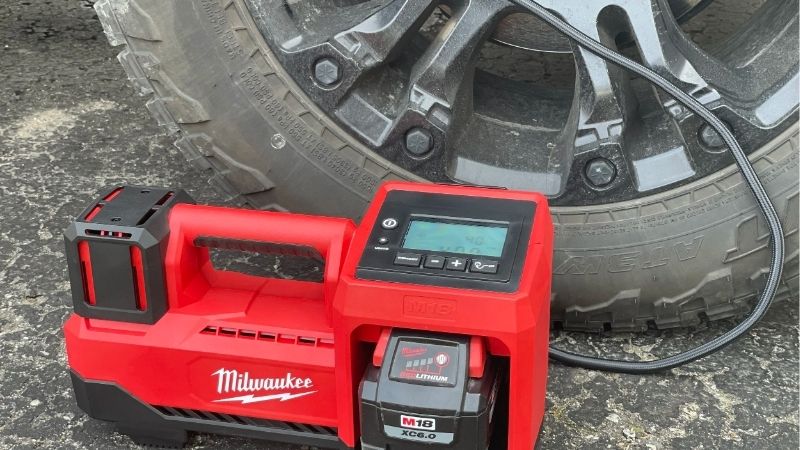
| Milwaukee M18 2848-20 | Best Overall | 150 PSI max; 18V M18; 36 in hose | $199.00 | No 12V or AC backup |
| RYOBI ONE+ PCL001B | Best Budget | 160 PSI claimed; 18V ONE+ | $39.97 | Bare tool; size not published |
| Makita LXT DMP180ZX | Best for compact LXT owners | 120 PSI; 18V LXT; 25.5 in hose | $155.49 | Lower ceiling than rivals |
| DEWALT 20V MAX DCC020IB | Best for 12V roadside backup | 20V, 12V DC, optional AC | $169.00 | Max PSI not published |
| CRAFTSMAN V20 CMCE520B | Best for three power sources | 160 PSI (retailer); 20V, 12V, 120V | $99.00 | PSI from retailer only |
| Fanttik X9 Pro | Best for rechargeable portability | 150 PSI; built-in 18.5 Wh cell | $62.99 | Recharge, no swap pack |
Milwaukee M18 2848-20: Best Overall
Best For: M18 owners who want a compressor-style inflator that runs off packs they already charge for other tools.
Milwaukee earns the top spot for anyone already invested in the red M18 lineup, because the tool pulls from batteries bought for drills and saws. Its edge is not a record pressure ceiling, since both the RYOBI and the CRAFTSMAN claim a higher 160 PSI figure. What stands out is the digital preset, the auto-stop, and a build aimed at frequent garage use. Shoppers with no M18 packs should weigh the added cost of a battery and charger first.
Milwaukee’s product page and operator’s manual for the 2848-20 list a 150 PSI maximum and manufacturer-stated airflow of 1.10 SCFM at 35 PSI, a figure tied to a defined back pressure rather than a speed rating. The same documentation describes an 18V M18 power source and a 36-inch air hose for reaching rear valve stems. At a listed $199.00 at Home Depot as of October 2026, it is the costliest bare tool here, so the value depends on owning compatible packs.
The inflator weighs about 7 pounds as a bare tool and routes air through that 36-inch hose, which helps when a stem sits awkwardly behind a wheel. Milwaukee sells it tool-only, so the pack, charger, and warranty registration follow the wider M18 system. Keep the chuck fitting clean and store the unit dry, since grit at the connector is a common failure point on inflators used at the roadside.
Pros:
- Runs on the shared 18V M18 battery platform many garages already own.
- Lists a 150 PSI ceiling with a stated 1.10 SCFM figure at 35 PSI.
- Routes air through a 36-inch hose for awkward valve positions.
Cons:
- Battery and charger are separate purchases without an existing M18 kit.
- Carries no 12V vehicle cord or wall adapter for roadside use.
Who Should Buy It: Pick the 2848-20 if you already run M18 packs; choose the DEWALT DCC020IB instead when a 12V vehicle cord for roadside backup matters more than platform fit.
RYOBI ONE+ PCL001B: Best Budget on ONE+
Best For: ONE+ battery owners who want the lowest bare-tool price for occasional pressure checks around the driveway.
Price is the headline here, and it only pencils out for people already holding RYOBI ONE+ batteries. As a bare tool the PCL001B undercuts every other pick, though that number leaves out the pack and charger that make it work. The trade-off against the Milwaukee is build intent: this is a lighter-duty top-off tool rather than a garage workhorse. Drivers who want a vehicle 12V cord will not find one on this model.
RYOBI’s product page for the PCL001B states a 160 PSI claimed maximum, an 18V ONE+ power source, a digital pressure readout, and automatic shutoff at the set figure. That 160 PSI headline sits close to the 150 PSI rated by Milwaukee and Fanttik, a gap too small to call a real advantage on passenger tires. The listed price of $39.97 at RYOBI direct as of October 2026 covers the bare tool, so budget for a ONE+ battery if you do not own one.
RYOBI does not publish a measured weight or length for the bare PCL001B, which keeps it hard to compare on size against the 7-pound Milwaukee M18 2848-20. The digital gauge and preset shutoff are the durability-relevant parts here, since repeated over-pressure cycling stresses any small motor. Confirm the exact ONE+ pack compatibility and check the readout against a separate dial gauge before trusting it on a long highway run.
Pros:
- Lowest listed bare-tool price among these six inflators.
- Shares the 18V ONE+ packs used across RYOBI cordless tools.
- Shows a digital readout and stops at the chosen pressure.
Cons:
- Published weight and overall dimensions are absent from the maker page.
- Offers no independent 12V vehicle input for stranded situations.
Who Should Buy It: Choose the PCL001B to spend the least on ONE+; step up to the Makita DMP180ZX if a lighter 2.3-pound body and a built-in work light matter more than price.
Makita LXT DMP180ZX: Best for Compact LXT Owners
Best For: LXT users who value a light, one-hand inflator for bicycles, small trailers, and car tires.
Portability defines this pick, so it suits LXT owners who want something easy to drop in a trunk. The DMP180ZX gives up outright pressure to the 160 PSI claims elsewhere, trading that ceiling for a far lighter body and a built-in light. Against the Milwaukee it is the more packable choice, though it cannot match that tool’s hose reach or airflow framing. Anyone needing wall or vehicle power should look at a three-source model instead.
Makita’s product page for the DMP180ZX lists a 120 PSI maximum on the US SKU, an 18V LXT power source, a 25.5-inch air hose, and a built-in LED work light. That 120 PSI figure is the lowest ceiling here, but it still clears common passenger placard targets, which sit well under any maximum. At $155.49 at Home Depot as of October 2026, it prices between the budget RYOBI and the Milwaukee, and it ships with no LXT battery or charger.
The bare tool weighs just 2.3 pounds and feeds air through a 25.5-inch hose, the lightest body in this group by a wide margin. That low mass is the reason to pick it over heavier garage inflators, especially for one-hand use on bicycle and trailer valves. Guard the hose and LED lens against impact in a cluttered trunk, and resist importing the 121 PSI figure printed on the differently suffixed non-US version.
Pros:
- Weighs only 2.3 pounds, the lightest bare tool compared here.
- Includes a built-in LED light and a 25.5-inch air hose.
- Draws on the same 18V LXT packs as other Makita tools.
Cons:
- Its 120 PSI ceiling sits below the 150 to 160 PSI rivals.
- No battery or charger comes with the bare DMP180ZX.
Who Should Buy It: Choose the DMP180ZX for the lightest LXT-compatible option; pick the CRAFTSMAN CMCE520B instead if you need 120V wall and 12V vehicle inputs alongside a battery.
DEWALT DCC020IB: Best for 12V Roadside Backup
Best For: Drivers who want a tool that also runs from a vehicle 12V socket when a pack is dead.
Flexibility of power source is the whole case for the DCC020IB, which can run off a 20V MAX pack or a vehicle 12V cord. That makes it the roadside pick, since a flat tool battery does not strand you if the car still supplies 12V. The compromise shows in the spec sheet, where DEWALT’s cited page does not publish a maximum pressure, so it cannot claim the top ceiling. Buyers chasing a confirmed PSI number will prefer the Milwaukee or CRAFTSMAN listings.
DEWALT’s product page for the DCC020IB describes three power options, a 20V MAX battery, a 12V DC vehicle cord, and an optional 110V AC adapter, plus separate high-pressure and high-volume modes. The same page does not publish a matching maximum PSI, which is why this model is not our overall pick despite its range. It lists at $169.00 at Home Depot as of October 2026 as a bare tool, and the AC adapter is an extra purchase rather than an included part.
Retailer listings put the tool near 7.2 pounds, while DEWALT’s own page does not independently resolve that weight, so treat the figure as a retailer measure. The dual-mode pump is the part that earns its keep, moving high volume to seat a bead and then switching to higher pressure. Mark the ceiling as unpublished, confirm the 12V cord is in the box, and never describe the optional adapter as standard equipment.
Pros:
- Runs from a 20V MAX pack or a 12V vehicle cord.
- Offers separate high-pressure and high-volume inflate and deflate modes.
- Optional 110V adapter adds a third wall-power path.
Cons:
- The cited manufacturer page publishes no maximum pressure figure.
- Wall adapter and battery are both bought separately.
Who Should Buy It: Take the DCC020IB for genuine 12V roadside backup; choose the Fanttik X9 Pro instead if a pocketable 0.96-pound unit with a sealed cell fits your travel kit better.
CRAFTSMAN V20 CMCE520B: Best for Three Power Sources
Best For: V20 owners who want one inflator that accepts battery, vehicle, and wall power without extras.
Versatility at a moderate price is what sets the CMCE520B apart, since it accepts three different inputs in one body. Where the DEWALT also offers multiple sources, this CRAFTSMAN pairs that flexibility with a lower listed price. The catch is provenance, because its headline pressure and weight come from the Lowe’s retailer listing rather than a hard manufacturer spec. Anyone who wants a maker-confirmed ceiling should lean toward the Milwaukee page instead.
The Lowe’s listing for the CMCE520B states a 160 PSI maximum, inputs for a 20V V20 pack, a 12V DC vehicle cord, and 120V AC wall power, plus auto-stop and a 20-inch hose. That 160 PSI number falls in the same near-tie band as the 150 PSI Milwaukee, so it does not translate to meaningfully better results on car tires. Listed at $99.00 at Lowe’s as of October 2026, it is mid-priced, but the page covers a product family, so match the exact CMCE520B SKU before ordering.
The retailer gives a 4.9-pound weight and a 20-inch hose, with a body that measures about 11.73 inches wide in the same listing. Because those figures come from the seller and not a maker spec sheet, confirm them against the unit you receive. The three-input design adds connectors that can wear, so inspect the 12V plug and wall lead for damage and calibrate the auto-stop against a gauge you trust.
Pros:
- Accepts 20V V20, 12V vehicle, and 120V wall power in one tool.
- Lists a 160 PSI ceiling with auto-stop and a 20-inch hose.
- Mid-range $99.00 price undercuts the DEWALT three-source option.
Cons:
- Pressure and weight appear only in the Lowe’s retailer listing.
- No battery or charger ships for V20 use.
Who Should Buy It: Pick the CMCE520B for three-input flexibility at a mid price; choose the Milwaukee M18 2848-20 if a maker-confirmed 150 PSI rating and 36-inch hose outweigh the extra cost.
Fanttik X9 Pro: Best for Rechargeable Portability
Best For: Travelers who want a tiny self-contained inflator with no separate battery platform to manage.
Pocketable size drives this pick, which carries its own sealed cell rather than borrowing a power-tool pack. That independence is the appeal for drivers who own no cordless system and just want a glovebox tool. The trade-off against platform models like the Milwaukee is clear, since a depleted internal cell means recharging rather than swapping in a fresh pack. Heavy-duty garage users will still prefer a larger battery-platform inflator.
Fanttik’s product page for the X9 Pro lists a 150 PSI manufacturer-stated maximum and an 18.5 Wh built-in battery, with a claimed 23-minute maximum continuous run time. That run-time figure is a brand claim tied to the maker’s own low-pressure examples, not a cross-model speed measurement, so read it as context. Priced at $62.99 at Fanttik direct as of October 2026, it costs more than the bare RYOBI yet needs no extra battery, which changes the real out-the-door total.
The unit weighs about 0.96 pounds in the brand’s own comparison, and Fanttik does not publish its package dimensions, so plan storage around a palm-sized body. That light sealed design is also its durability limit, because a worn internal cell cannot be swapped like a removable pack. Recharge it before a trip rather than relying on leftover charge, and note that the brand page has shown inconsistent in-stock and sold-out indicators.
Pros:
- Self-contained 18.5 Wh cell needs no separate battery platform.
- Weighs about 0.96 pounds for easy glovebox storage.
- Lists a 150 PSI ceiling at a low standalone price.
Cons:
- Requires recharging instead of a quick removable-pack swap.
- Brand page has shown inconsistent stock status over time.
Who Should Buy It: Choose the X9 Pro for a standalone travel inflator; pick the RYOBI PCL001B instead if you already own ONE+ batteries and want the cheapest bare tool.
How to Choose a Cordless Tire Inflator
Before you compare these six tools, decide how you will power the inflator and where you will use it. A bare battery-platform tool is a bargain only if you already own the matching pack, while a self-contained unit costs more upfront but needs nothing else. The sections below cover the four checks that separate these models in practice, with the caveat that a published maximum pressure describes a ceiling and not a filling speed.
Power Source and Included Battery
Four of these tools ship bare, meaning the pack and charger are extra. The Milwaukee needs an M18 battery, the Makita an LXT pack, the CRAFTSMAN a V20, and the RYOBI a ONE+ cell, so the right pick often follows the platform in your garage already. A 20V MAX or similar label describes a system, not a battery in the box. Only the Fanttik carries its own sealed cell, which removes platform cost but ends the option to swap in a charged pack.
Two models widen the power question further. The DEWALT and the CRAFTSMAN both accept a 12V DC vehicle cord, and the CRAFTSMAN adds 120V wall input as well. If you drive long distances, a 12V option is a genuine safety feature, since it does not depend on a charged tool pack at the moment you need air.
Published Maximum Pressure
Listed ceilings here run from 120 PSI on the Makita to 160 PSI on the RYOBI and the CRAFTSMAN, with the Milwaukee and Fanttik at 150 PSI. Those figures describe how high the pump can go, not how quickly it fills, and most passenger placards call for far less. The DEWALT page does not publish a maximum at all, so treat any ceiling you see for it as unconfirmed until the listing states one.
A 160 PSI rating sits only slightly above a 150 PSI rating, a difference too small to decide a purchase for ordinary car tires. Use the placard target as your real benchmark and keep the maximum in reserve for the occasional high-pressure trailer or sport tire.
Auto-Stop and Target Pressure
Every model here offers a digital preset or auto-stop that shuts the pump at a set figure, which guards against overinflation when you step away. That convenience does not replace a reliable gauge, since a drifting sensor can stop short or late. Set the value from the door placard and verify the result with a separate dial gauge until you trust the tool’s readout.
Auto-stop also protects the motor by ending the run instead of forcing air against a sealed tire. Follow each model’s duty-cycle note, since small inflators are built for short top-offs rather than continuous filling of several large tires in a row.
Vehicle 12V Backup
A 12V vehicle cord turns an inflator into a roadside tool that works even when its own pack is flat. The DEWALT and the CRAFTSMAN both list this input, while the Milwaukee, Makita, RYOBI, and Fanttik do not. For a daily commuter or a road-trip car, that backup can matter more than a slightly higher pressure ceiling.
Keep hands clear of a hot hose after a long run, and disconnect the battery before any service, as the NHTSA tire care material and each tool’s manual direct. A 12V socket draws real current, so follow the vehicle’s fuse rating and avoid running several accessories at once.
Frequently Asked Questions
These answers cover the practical questions a pressure number or price tag cannot settle. They also keep a portable top-off tool distinct from a shop compressor or a jump starter.
Can a Cordless Inflator Fill a Completely Flat Car Tire?
Usually yes for a standard passenger tire, but slowly, and only if the tire is still seated on the rim. These small pumps are built for top-offs, so a fully flat tire asks for a longer run that can approach a model’s duty-cycle limit. If the bead has unseated or the tire is damaged, stop and seek roadside help rather than forcing air. Watch the hose temperature during a long fill and let the motor rest if the manual calls for it.
Do Cordless Tire Inflators Include a Battery and Charger?
Often not. The Milwaukee, Makita, DEWALT, CRAFTSMAN, and RYOBI here are all sold as bare tools, so the pack and charger are separate costs unless you already own the platform. Only the Fanttik X9 Pro carries a built-in cell and arrives ready to charge over USB. Read the listing carefully, since a kit with a battery and a bare tool can appear under similar names.
Should I Use the PSI Shown on a Tire Sidewall?
No. The sidewall number is a maximum for the tire, not the recommended pressure for your vehicle. The NHTSA tire care guidance, reviewed October 2026, directs drivers to the placard on the door jamb or owner’s manual and to measure pressure on cold tires. Set the inflator’s target to that placard figure and recheck after the car has sat, since driving warms the air and raises the reading.
What Is the Difference Between Maximum PSI and Inflation Speed?
Maximum PSI is the highest pressure a pump can reach, while speed depends on airflow, hose size, and the tire’s starting pressure. A higher ceiling does not mean a faster fill, which is why airflow figures like the Milwaukee’s 1.10 SCFM at 35 PSI come with a stated back pressure. Compare speed only where makers publish airflow under the same conditions, and otherwise treat filling-time demos as marketing rather than standardized data.
Final Thoughts
For buyers already on the M18 platform, the Milwaukee M18 2848-20 stays the Best Overall choice thanks to its confirmed 150 PSI ceiling, 36-inch hose, and 1.10 SCFM airflow rating, though its value rests on owning compatible packs. One detail can flip that call: if you want a tool that still works from a dead-battery car, the DEWALT DCC020IB and its 12V vehicle cord deserve the nod, and travelers with no cordless system may prefer the self-contained Fanttik X9 Pro. Confirm the exact SKU, the battery situation, and the current price, then set your target from the door placard before buying any cordless tire inflator.