Key takeaways
- Six dedicated temperatures serve different teas without setting a custom target.
- The 1.7-liter capacity handles multiple mugs from a single fill.
- Cuisinart specifies a three-year limited warranty for this model.
An electric kettle makes the most sense when you match its temperature controls and pouring style to what you drink. For everyday boiling, a simple 1.7-liter jug is often enough; green tea enthusiasts benefit from selectable temperatures, while a narrow gooseneck helps control water flow for pour-over coffee. Household capacity, lid behavior, and the space needed beside the base matter just as much as wattage.
Quick Verdict: For most tea drinkers, the Cuisinart CPK-17P1 is our Best Overall choice: its 1.7-liter tank, six temperature presets, and 30-minute hold cover more daily uses than a basic boil-only model. Choose the Fellow Stagg EKG Pro for controlled pour-over brewing instead. These are editorial selections based on published manufacturer information as of October 2026, not in-house testing. Check the current price and the exact variant before purchasing.
As an Amazon Associate we earn from qualifying purchases.
By DIY Ideas 4 Home Editorial Team
6 Best Electric Kettles Reviewed
We selected six identifiable US-market models using manufacturer product pages and user documentation, with capacity, control method, pouring behavior, physical dimensions, and safety features as comparison points. Prices below are listed US prices observed in October 2026, not guarantees of checkout cost. This set runs from a $34.99 boil-only jug to a $199.95 specialty pour-over kettle, so paying more should buy a useful capability rather than simply a different finish. No laboratory boil-time or measured temperature-accuracy ranking is claimed here.
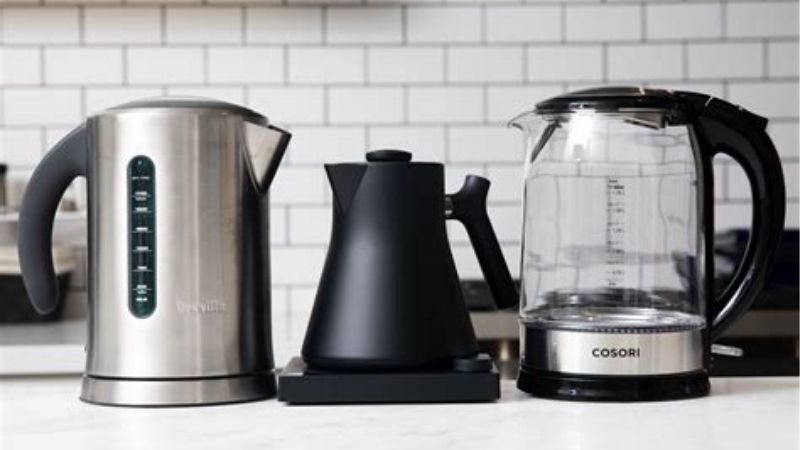
| Product | Best For | Key Spec | Listed Price (as of October 2026) | Watch Out For |
|---|---|---|---|---|
| Cuisinart CPK-17P1 | Best Overall tea and daily use | 1.7 L; 1500 W; six presets | $129.95, Cuisinart | Preset steps, not degree-by-degree dialing |
| Hamilton Beach 40880G | Best Budget household boiling | 1.7 L; 1500 W; boil-only | $34.99, Hamilton Beach | No selectable beverage temperature |
| COSORI CDK-SE151-KUS | Best for an insulated outer wall | 1.5 L; 1500 W; double-wall | $39.99, COSORI collection | No variable-temperature dial |
| OXO Brew 8716900 | Best for precise glass-jug control | 1.75 L; 104 to 212 F setting | $119.99, OXO | Glass requires careful handling |
| Breville BKE820XL | Best for five one-touch presets | 57 oz; 1500 W; five presets | $179.95, Breville | More expensive than Cuisinart |
| Fellow Stagg EKG Pro | Best for measured pour-over flow | 0.9 L; 1200 W; gooseneck | $199.95, Fellow selected finish | Small jug and slow narrow-spout service |
Cuisinart CPK-17P1: Best Overall
Best For: Households making several kinds of tea that want clear buttons instead of a temperature menu.
The Cuisinart fits a shared kitchen better than the narrow Fellow because one jug can handle several mugs, and its six dedicated choices are quicker to understand than a free-range dial. A standard wide spout also makes it a more practical water boiler for cooking. Its limitation is equally clear: someone who needs a setting between its programmed temperatures should consider the OXO instead. The preset approach is convenient rather than unusually customizable.
Cuisinart’s product page for the PerfecTemp CPK-17P1 specifies 1.7 liters, 1500 watts, and a 30-minute keep-warm setting. The accompanying Cuisinart instruction booklet identifies temperature choices of 160, 175, 185, 190, 200, and boiling at roughly 212 F, plus an auto-shutoff and boil-dry safeguard. Cuisinart listed the stainless finish at $129.95 in October 2026, with a three-year limited warranty and a removable scale filter. The six settings are nominal targets, not results independently measured by this publication.
Its product dimensions are 8.8 inches long, 6.1 inches wide, and 9.75 inches high, according to Cuisinart’s model page. That height leaves some but not unlimited access under wall cabinets; allow additional room to open the lid safely. The water window helps avoid unnecessary overfilling, though its translucent panel introduces one more area to clean. The detachable filter is useful where scale collects near the spout, but removing deposits still requires periodic cleaning of the metal chamber as the manual describes.
Pros:
- Six dedicated temperatures serve different teas without setting a custom target.
- The 1.7-liter capacity handles multiple mugs from a single fill.
- Cuisinart specifies a three-year limited warranty for this model.
Cons:
- Temperature choices are fixed rather than continuously adjustable across the full range.
- The stainless outer shell still warrants caution near small hands after heating.
Who Should Buy It: Buy it for family tea routines; choose the Fellow Stagg EKG Pro if slow, directed pouring matters more than kettle volume.
Hamilton Beach 40880G: Best Budget
Best For: Buyers who mainly need boiling water for tea bags, oatmeal, or hot-water cooking.
This Hamilton Beach is the straightforward counterpoint to programmable kettles: press its switch, wait for the boil, and lift the jug away. Its modest manufacturer price makes more sense than paying for temperature presets you would never use. Compared with the COSORI, you give up the insulated-wall construction, but gain a slightly larger stated capacity and a clear water-level indicator. It is intentionally simple, not a lower-cost substitute for precision tea preparation.
Hamilton Beach’s product listing for the 40880G lists it as a 1.7-liter, 1500-watt model with automatic shutoff, boil-dry protection, a concealed element, a water window, and a drip-conscious spout. The brand listed it at $34.99 in October 2026. Its one-switch operation does not let you request 175 F for green tea; you would need to let boiled water cool or select a kettle designed for that purpose. The product documentation does not promise a temperature hold program.
For fitting on a crowded counter, a retailer’s specification listing for model 40880G gives approximately 9.25 inches of height, 6.25 inches of width, and 8.75 inches of depth. Hamilton Beach’s use-and-care literature also cautions against touching hot surfaces or opening the lid during a heating cycle. The kettle’s removable jug stays separated from the powered base for serving, but the powered base must remain dry. Owners who make multiple small drinks should also check the model’s minimum-fill marking rather than guess how little water can be heated.
Pros:
- The $34.99 manufacturer listing makes this the lowest-price pick here.
- A 1.7-liter jug is generous for a basic boil-only kettle.
- Automatic shutoff and boil-dry protection are listed for model 40880G.
Cons:
- Its single switch cannot select lower brewing temperatures for delicate tea.
- Stainless outer surfaces can be hot after a complete boiling cycle.
Who Should Buy It: Choose it for boiling alone; take the Cuisinart CPK-17P1 when fixed, lower-temperature tea presets justify the added expense.
COSORI CDK-SE151-KUS: Best for Double-Wall Design
Best For: Shoppers prioritizing an insulated outer shell over precise control of tea temperature.
COSORI offers a different everyday compromise from the Hamilton Beach: its double-wall layout aims to limit how hot the exterior feels while leaving a stainless interior for boiling water. That design is useful in a busy kitchen, though it is not permission to hand a recently heated kettle to a child. The 1.5-liter capacity is smaller than the two 1.7-liter basic jugs in this comparison, and there is no customized temperature control to reward a tea hobbyist.
COSORI’s product listing for its 1.5L Double Wall Stainless Steel Electric Kettle showed $39.99 in October 2026. The company’s user manual for model CDK-SE151-KUS identifies a 120-volt, 1500-watt configuration, 1.5-liter capacity, and safeguards covering normal operation and cleaning. The manual specifies that the electric kettle must be used with its intended power base. Auto shutoff and boil-dry protection are presented in COSORI’s product materials, but users should still stay within the marked water level.
The CDK-SE151-KUS instruction booklet records dimensions of 9.1 by 6.3 by 10.2 inches and a weight of 2.51 pounds. Its taller construction needs adequate clearance above the lid, and the two-wall arrangement adds an exterior layer that cannot simply be scrubbed as though it were the inside of a pot. For scale, follow the manufacturer’s cleaning steps and dry the connector area before replacing the kettle on its base. This is a useful small-household alternative to Hamilton Beach, not a universal safety upgrade.
Pros:
- The double-wall body separates a stainless interior from the outer shell.
- Its 1500-watt US model uses a conventional 120-volt household outlet.
- A 1.5-liter reservoir suits repeated individual drinks without an oversized jug.
Cons:
- Insulation does not eliminate scalding risk from hot water or escaping steam.
- There is no preset for green tea or degree-by-degree heating.
Who Should Buy It: Buy this for an insulated kettle body; switch to the OXO Brew 8716900 when temperature adjustability matters more than a double wall.
OXO Brew 8716900: Best for Glass and Temperature
Best For: Tea drinkers who want visible water levels and a selectable setting beyond preset buttons.
OXO’s glass design offers a different kind of control: rather than choosing one of the Cuisinart’s preset beverage labels, you turn a dial to the temperature you want. That flexibility also makes it suitable for someone who regularly switches between different loose-leaf teas. It is less attractive for a person seeking an insulated outer wall because borosilicate glass does not remove burn risk, and a glass jug is less forgiving of knocks against a sink or faucet.
OXO’s product page for the Adjustable Temperature Kettle identifies SKU 8716900, a 1.75-liter or 60-ounce capacity, and a selectable temperature span from 104 to 212 F. The page states that it can hold the chosen temperature for up to 30 minutes, and lists the model at $119.99 as of October 2026. OXO specifies borosilicate glass, stainless steel, and silicone materials; the manufacturer describes the kettle as removable from its powered base during pouring. Temperature precision here describes selectable targets, not a promise of zero variation during each heating cycle.
At 10.4 by 7.8 by 13.4 inches on OXO’s specification panel, the glass kettle is taller than both the Hamilton Beach and the Breville. The full-height water view is easy to read, yet mineral deposits become highly visible on transparent walls and require gentle cleaning. Avoid striking the glass on metal fixtures or forcing a cold-water rinse while the vessel is very hot. Measure cabinet clearance before ordering: a tall kettle with an opening lid is awkward beneath a shallow upper cabinet.
Pros:
- The 104 to 212 F adjustment spans low-temperature and boiling use.
- OXO lists a 1.75-liter capacity, the largest jug in this comparison.
- A 30-minute hold allows a second serving without a fresh full heat.
Cons:
- At 13.4 inches tall, the kettle demands more vertical space.
- Glass shows hard-water deposits and needs protection against impacts.
Who Should Buy It: Choose it for dial-based tea preparation; select the COSORI CDK-SE151-KUS if the exterior construction matters more than transparent walls.
Breville BKE820XL: Best for One-Touch Tea Presets
Best For: Regular tea drinkers who prefer tactile preset controls and a slow-opening lid.
Breville differentiates this jug through its button-first approach and lid mechanism rather than through a larger volume. Its soft-opening lid is specifically meant to moderate abrupt steam release when the top opens. That can improve the handling routine, but users must still allow hot steam to clear before filling or washing. Compared with the Cuisinart, the Breville offers one fewer preset and costs more on the manufacturer pages checked here, so the lid behavior and control arrangement need to matter personally.
Breville’s US product page for the IQ Kettle model BKE820XL states 57 ounces, 1500 watts, five programmed temperature choices for different teas and French press coffee, and a 20-minute keep-warm function. The page also identifies automatic shutoff and boil-dry protection plus a one-year warranty. Breville listed the stainless steel unit at $179.95 in October 2026. Its product description names five beverage settings but does not establish that every beverage tastes best at a single universal temperature, so check the recommendations on your tea packaging too.
The BKE820XL specifications provide dimensions of 7.2 inches wide, 9.1 inches deep, and 9.8 inches tall, with a stated weight of 3.42 pounds. The base includes cord storage and accepts the jug in multiple orientations, helpful when left-handed and right-handed people share a counter. Breville sells replacement descaling supplies and base parts, but these are extra purchases rather than items promised with every kettle. The brushed-steel finish may show water spots; wiping after cooling is less abrasive than harsh scouring around the display and switch area.
Pros:
- Five named temperature settings address tea styles and French press coffee.
- The 20-minute hold feature supports a second cup after initial heating.
- A soft-opening lid is designed to reduce sudden splashing during opening.
Cons:
- Its $179.95 price is above the similarly sized Cuisinart.
- Breville’s stated warranty is one year, shorter than Cuisinart’s.
Who Should Buy It: Choose it if lid action drives your decision; buy the Cuisinart CPK-17P1 if another preset and a longer limited warranty are more important.
Fellow Stagg EKG Pro: Best for Pour-Over Coffee
Best For: Home brewers deliberately pouring small pulses of hot water over a coffee bed.
The Stagg EKG Pro is the specialist rather than the family boiler of this group. Its thin gooseneck spout and temperature dial suit controlled movement across a pour-over filter; the wide-spout Breville or Cuisinart is less suited to that same pouring rhythm. In exchange, Fellow sacrifices serving volume, and slowly transferring water to a saucepan is an awkward use of a narrow spout. It makes sense when brewing technique is the reason to buy the kettle, not merely an occasional experiment.
Fellow’s product page for the Stagg EKG Pro specifies a 0.9-liter or 30-ounce jug, US power up to 1200 watts, a 104 to 212 F temperature range, and adjustable temperature hold durations of 15, 30, 45, or 60 minutes. The displayed Pro selection in the Sesame and Maple finish was listed at $199.95 in October 2026; prices differ with model and finish. Fellow additionally describes scheduled heating and a brew stopwatch. Its updater app supports firmware changes, not remote operation, so treat an app-enabled description with care.
Fellow lists the assembly at 11.10 inches long, 6.77 inches wide, and 7.7 inches high, with a 2.5-foot power cord. That lower overall height makes a pouring station possible under some cabinets, though the handle extends horizontally and needs clearance from nearby appliances. The manufacturer says to heat fresh water only, never milk or another liquid, and explicitly prohibits placing the electric jug on a stovetop. Routine scale removal and careful handling of its lid are still necessary, regardless of the purchase price.
Pros:
- The gooseneck spout supports deliberate, narrow streams over coffee grounds.
- Adjustable 15 to 60-minute holds fit staggered brewing sessions.
- A 2.5-foot cord gives a documented placement constraint before purchase.
Cons:
- The 0.9-liter capacity is the smallest among these six kettles.
- Its narrow spout is inefficient for rapid filling of large cooking pots.
Who Should Buy It: Buy it for a dedicated coffee station; choose the Breville BKE820XL for faster general pouring into several mugs.
How to Choose an Electric Kettle
The most useful first decision is whether you need water at a selected temperature or only at a rolling boil. After that, consider how many people will be served, which hand motions are comfortable with a full jug, and whether the product can fit with its lid opened. A higher advertised wattage alone is not a reliable ranking of real-world boiling time because starting temperature and the water quantity also change the outcome.
Capacity and the Amount You Actually Heat
A 1.7-liter kettle holds substantially more water than Fellow’s 0.9-liter model, but filling a large kettle to the top for a single cup wastes time and energy. Compare the minimum water mark in each manual with your normal serving size instead of assuming a bigger jug performs worse. When a household routinely prepares several drinks, Cuisinart’s 1.7 liters or OXO’s 1.75 liters reduce how often someone returns to the sink. For a pour-over brewer measuring smaller batches, Fellow’s capacity may be entirely adequate.
Also assess carrying weight after adding water. A stainless kettle weighing a few pounds empty becomes noticeably heavier when filled. Buyers who have difficulty lifting a heavy container should examine the handle angle, base placement, and how accurately the spout directs water, ideally using a store display. Published capacity is a maximum fill limit rather than an instruction to boil that amount each time.
Presets Versus a Variable Temperature Dial
A fixed preset is easy to repeat when you brew the same drink every morning; Cuisinart offers six named targets, while Breville offers five. OXO and Fellow permit a broader selection within their published 104 to 212 F ranges, which is more useful for a recipe specifying an unusual water temperature. None of those printed target temperatures proves that water in your cup will remain at exactly that temperature after pouring into an unheated vessel. For sensitive tea, start with the tea seller’s recommendation and adjust to taste.
Hold time also changes convenience. Cuisinart and OXO advertise up to 30 minutes, Breville lists 20 minutes, and Fellow allows multiple hold durations through 60 minutes. These are operating settings, not promises of identical heat retention with the kettle removed from its base. If you usually empty the jug immediately, a keep-warm program adds little value compared with the Hamilton Beach’s simpler switch.
Spout Shape, Construction, and Cleaning
A wide spout helps pour into mugs or cooking pots without waiting. A gooseneck instead restrains flow so that a brewer can direct water to a small area. Neither is categorically better: the intended task determines which action is easier. OXO’s glass jug displays water and mineral scale clearly, but its transparent walls are vulnerable to impact. COSORI’s double wall changes the feel of the exterior while still containing water hot enough to scald. Cuisinart’s removable spout filter handles particles near the outlet, not mineral deposits throughout the entire kettle.
Hard-water buildup can make the interior look rough and affect how a kettle heats and pours. Follow the cleaning agent, dilution, rinse, and cooldown instructions for the exact model, particularly where electrical contacts meet the base. Avoid immersing powered components in water. The accessible opening and replaceable filters are practical maintenance considerations; fashionable colors are not evidence of easier descaling or superior durability.
Electrical Safety and Countertop Clearance
Several full-size picks list 1500 watts on a 120-volt US supply. Use an appropriately grounded outlet according to the manual and avoid overloaded power strips or improvised extension arrangements. Hamilton Beach’s electric-kettle use-and-care guidance warns that hot surfaces, spilled liquid, and steam can cause burns; that advice applies beyond its own brand. Never lift the lid into your face during heating, overfill past the marked line, or let the cord hang where someone can pull it.
Measure the actual space including the height required to raise the lid, not just the published product height. The OXO is about 13.4 inches tall as listed, whereas the Fellow is about 7.7 inches. A kettle against a wall or beneath a low cabinet may direct steam onto wood or finishes and leave little room to refill. Keep the base dry, unplug before cleaning, and periodically examine the cord and plug. Automatic shutoff and boil-dry protection are backup functions, not an excuse to walk away from a damaged appliance.
Frequently Asked Questions
These answers cover decisions that often surface after selecting a kettle: which liquids can be heated, what the displayed temperature represents, how maintenance works, and where the appliance belongs.
Can I Heat Milk in an Electric Kettle?
Do not heat milk unless the specific manufacturer’s instructions explicitly permit it. Fellow’s guidance for the Stagg EKG Pro states that its electric kettles are intended for clean water only; heating milk or other liquids can scorch or foul the device. For a hot milk drink, heat the milk separately in cookware designed for it and use the kettle for water.
Does a 1500-Watt Kettle Always Boil Faster Than a 1200-Watt One?
No. Rated power is only one input; kettle design, starting water temperature, and especially the amount heated affect the time. The Fellow holds 0.9 liters while the Cuisinart holds 1.7 liters, so comparing their time at maximum fill would not isolate the heating element. A fair comparison needs the same starting water volume and temperature under the same conditions.
Should I Leave Water in the Kettle Overnight?
For routine drinking water, emptying and periodically drying the kettle helps reduce standing-water residue, particularly if you will not use it soon. Consult the model’s manual rather than treating overnight storage as a performance or food-safety feature. In hard-water areas, visible scale calls for descaling according to the manufacturer, not harsh scraping against the heating surface.
Can an Electric Kettle Be Used on a Gas or Induction Stove?
No. An electric kettle designed for a detachable powered base must not be used as a stovetop pot. Fellow explicitly warns that setting its Stagg EKG Pro on a stove or induction surface can damage working components. Choose a separate stovetop kettle if you need heating without the electric base; the two products are built for different heat sources.
Final Thoughts
The Cuisinart CPK-17P1 remains our Best Overall electric kettle for most mixed tea routines because its six presets and 1.7-liter capacity are more broadly useful than a specialist spout. A coffee brewer who needs fine pouring control should deliberately choose the Fellow Stagg EKG Pro instead, while a household that only boils water can save substantially with the Hamilton Beach 40880G. Before ordering, check the kettle’s minimum-fill mark and your cabinet clearance, then confirm the exact model, finish, warranty, and current seller price at checkout.