Key takeaways
- Cordless mobility avoids setting up a compressor and hose.
- Supports 2-1/8-inch brads for some thicker trim assemblies.
- Compatible with existing DeWalt 20V MAX battery investment.
An 18-gauge brad nailer helps position narrow trim while glue cures, but it is not a replacement for structural screws or a framing nailer. A cordless model spares you the compressor, hose and extension cord; a pneumatic model can feel lighter in the hand and cost much less if an appropriate compressor is already in the shop. Nail length, the material underneath the finish piece, and the ability to control depth deserve more attention than claims about speed. These five current US models cover both power systems and specific project needs, with no claim that our editors physically tested them.
Quick Verdict: DeWalt DCN680B is best overall for owners of DeWalt 20V MAX batteries. It drives 18-gauge nails from 5/8 to 2-1/8 inches without a hose. At about $359 bare, Makita AF506 offers better value to compressor-equipped shops. Picks use October 2026 product information, not detailed research.
As an Amazon Associate we earn from qualifying purchases.
By DIY Ideas 4 Home Editorial Team
5 Best Brad Nailer Models Reviewed
The five choices include three cordless bare tools and two pneumatic nailers, with observed bare-tool prices of roughly $69 to $359 as of October 2026. We compared each exact model by supported 18-gauge nail lengths, power-system commitment, reported weight, ease of clearing jams and the true cost of making the tool ready to fire. A cordless listing marked tool-only does not include a battery and charger; a pneumatic nailer needs a compatible regulated compressor, coupler and hose. Source documents include DeWalt and Makita model pages and manuals, Ryobi and Milwaukee model-specific retail listings, and the Metabo HPT NT50AE2M manual.
| Product | Best For | Key Spec | Listed Price (as of October 2026) | Watch Out For |
|---|---|---|---|---|
| DeWalt DCN680B | Best Overall | 18 ga; 5/8 to 2-1/8 in; cordless | $359.00 | Battery and charger not included |
| Ryobi P321 | Best Cordless Value | 18 ga; 5/8 to 2 in; cordless | $149.00 | Tool only; shorter maximum brad than DeWalt |
| Milwaukee 2746-20 | Best for M18 Owners | 18 ga; 5/8 to 2-1/8 in; cordless | $329.00 | Battery and charger sold separately |
| Makita AF506 | Best Pneumatic Pick | 18 ga; 5/8 to 2 in; 70 to 120 PSI | $134.00 | Compressor and air hose needed |
| Metabo HPT NT50AE2M | Best Budget Pneumatic | 18 ga; 5/8 to 2 in; 70 to 120 PSI | $69.00 | Verify air supply and maintenance requirements |
DeWalt DCN680B: Best Overall
Best For: Home renovators already using DeWalt batteries who value full-room mobility and long trim nails.
DeWalt DCN680B is the flexible choice when installing baseboards around doors, shifting ladders and working upstairs with no convenient compressor location. The brushless motor runs on DeWalt 20V MAX lithium-ion packs, so owners of that battery platform can move between fastening and other cordless tools without extra hoses. Its advantage is logistical, not an assertion that every cordless brad sinks nails more deeply than air models. A full-size cordless mechanism is bulkier than the light pneumatic alternatives.
DeWalt’s DCN680B product page and N496636 manual specify 18-gauge fasteners from 5/8 to 2-1/8 inches, depth adjustment and a tool-free jam-release arrangement. The October 2026 Home Depot model listing was about $359.00 for the tool only. The manufacturer distinguishes DCN680B from the DCN680D1 kit, which adds battery, charger and a bag. Check your existing battery family and compatible charger before assuming the lower bare-tool price is the whole cost of ownership.
The maker lists DCN680B at about 5.3 pounds without the battery, much heavier than the 2.9-pound Makita pneumatic body. That added mass matters when reaching overhead to fit crown molding. Place the nose firmly on the exact point, set the driver depth on scrap of the same wood combination, and keep the other hand clear of the line of fire. Remove the battery before clearing a nail jam or adjusting accessible hardware according to the manual.
Pros:
- Cordless mobility avoids setting up a compressor and hose.
- Supports 2-1/8-inch brads for some thicker trim assemblies.
- Compatible with existing DeWalt 20V MAX battery investment.
Cons:
- $359 bare-tool price is the highest observed in this group.
- Heavier body can tire the wrist on prolonged overhead work.
Who Should Buy It: Choose DCN680B when moving between rooms is routine; if you already have shop air and mostly work at a bench, Makita AF506 costs far less and weighs less in the hand.
Ryobi P321: Best Cordless Value
Best For: Occasional trim installers with Ryobi ONE+ batteries who prioritize entry cost.
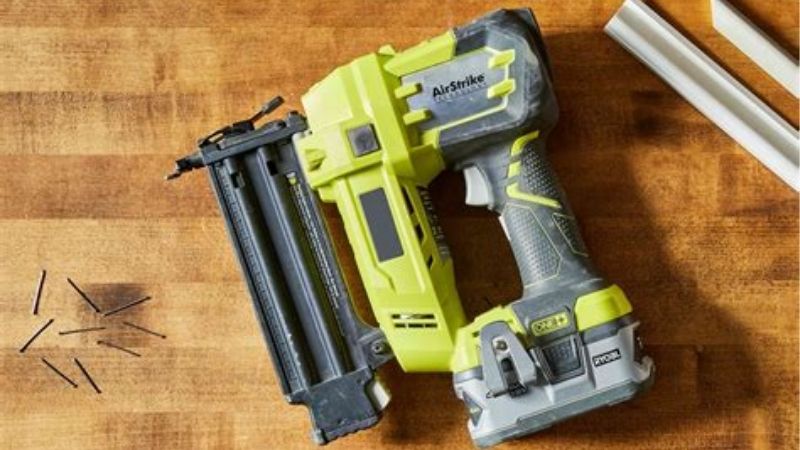
The P321 makes a cordless brad nailer plausible for someone hanging shoe molding or refurbishing a bookcase twice a year. Its AirStrike mechanism does away with a dedicated compressor, and the $149 listing leaves more budget for nails and protective gear than the higher-priced cordless alternatives. What the price does not do is include a compatible ONE+ pack and charger. People starting with no batteries should price a complete power setup rather than compare bare tool stickers.
Home Depot’s listing for Ryobi ONE+ P321 identifies the 18V 18-gauge AirStrike nailer with a supported 5/8-to-2-inch brad range. It was listed at $149.00 as of October 2026. Ryobi describes tool-free depth adjustment and jam-release access, but buyers should still consult the user manual for the exact trigger mode and recommended nail type. A 2-inch nail limit is distinct from the 2-1/8-inch maximum on DeWalt DCN680B and Milwaukee 2746-20.
The retailer gives dimensions near 9.61 inches long, 3.62 inches wide and 10.87 inches tall and a tool weight of approximately 5 pounds, before accounting for a battery in normal use. This is far more substantial than a pneumatic stapler-sized tool, so practice getting its nose into a tight inside corner before a visible final pass. Keep thin moldings against solid backing and test for blow-through on scrap; a brad that misses the stud can emerge at an unexpected angle.
Pros:
- $149 listed bare-tool price lowers the cordless entry barrier.
- Uses the widely shared Ryobi ONE+ 18V battery family.
- Tool-free adjustments simplify occasional trim jobs.
Cons:
- Charger and battery add cost for a first-time ONE+ buyer.
- Maximum 2-inch nail length is shorter than two premium cordless picks.
Who Should Buy It: Choose P321 for infrequent household trim work with ONE+ batteries; choose DeWalt DCN680B if your existing tools run on DeWalt packs and 2-1/8-inch fasteners matter.
Milwaukee 2746-20: Best for M18 Owners
Best For: Trim carpenters committed to Milwaukee M18 batteries and frequent repositioning.
The Milwaukee 2746-20 is the serious cordless alternative for someone who already owns the M18 battery ecosystem. It covers the longer brad size that some baseboard layers need, and it removes the snag risk of hauling an air line around furniture. Choosing it because the word professional appears on a listing is not enough; the practical question is whether its balance, battery availability and nose geometry suit the work better than the lighter air-powered machines.
Home Depot’s model 2746-20 listing states a 5/8-to-2-1/8-inch range for 18-gauge brads and shows $329.00 for the bare tool in October 2026. Milwaukee’s manufacturer materials identify the M18 FUEL design and compatible M18 REDLITHIUM batteries. This purchase does not include a battery or charger. Buyers should confirm the exact model, not mistakenly order the different-gauge 2743 or a kit whose accessories and price are not comparable.
Listed tool dimensions are approximately 11.9 inches long, 10.2 inches tall and 3.3 inches wide, and the bare tool weighs about 5.35 pounds. That shape can be harder to bring into a narrow drawer-box corner than Makita AF506 with its slim nose. Set the contact tip square to the molding and select a sequential actuation mode when supported and instructed. Remove the battery before opening the magazine or nose to deal with a jam.
Pros:
- Long 2-1/8-inch brad support suits some layered trim.
- M18 platform is convenient for owners of matching Milwaukee tools.
- No compressor or hose to manage in finished homes.
Cons:
- $329 tool-only cost excludes power accessories.
- Weight and head dimensions may limit tight-corner access.
Who Should Buy It: Choose 2746-20 if M18 is already your battery platform; do not switch battery ecosystems merely for it when Ryobi P321 or an air-powered AF506 covers your actual nail range.
Makita AF506: Best Pneumatic Pick
Best For: Owners of a capable compressor who want a precise, light nailer for repeated trim work.
The AF506 is a compelling choice for an equipped shop because its narrow nose reaches more of the little recesses where trim brads belong. At under three pounds, the nailer body is easier to hold overhead or inside cabinet frames than the cordless machines above. The catch is the equipment around it: air hoses snag at door openings, and a noisy compressor can be unwelcome when renovating an occupied home. Neither concern appears in the nailer’s low tool price.
Makita’s AF506 specification sheet and owner’s manual call for 70 to 120 PSI operating pressure, 18-gauge nails from 5/8 to 2 inches, and up to 100 brads in the magazine. The manufacturer also publishes a 1/4-inch NPT inlet and recommends checking air delivery at 90 PSI. Home Depot showed $134.00 for model AF506 in October 2026. Buyers with a small compressor should verify actual SCFM at the intended pressure rather than assuming the tank gallon rating ensures a suitable supply.
Makita gives the body dimensions as 9-7/8 inches long, 2-3/4 inches wide and 10-1/8 inches tall, with a 2.9-pound net weight. The package includes pneumatic oil, no-mar tips, an air fitting and a case. That light and narrow shape helps when fastening a decorative bead beside cabinet hardware. Disconnect the air hose and fully relieve the tool before clearing any jam; direct compressed exhaust away from face and dust-sensitive work surfaces.
Pros:
- 2.9-pound net tool is substantially lighter than cordless designs.
- Narrow nose and no-mar tips help on finish-grade projects.
- Manufacturer documents 70 to 120 PSI and 100-nail magazine.
Cons:
- Needs a regulated compressor, correct fitting and hose.
- Moving room to room involves dragging or rerouting an airline.
Who Should Buy It: Buy AF506 for a compressor-equipped workspace and frequent detailed trim; buy DeWalt DCN680B when no-hose mobility through an occupied home is worth the extra money.
Metabo HPT NT50AE2M: Best Budget Pneumatic
Best For: New DIY woodworkers who own an appropriate compressor and need a basic 18-gauge trim nailer.
The NT50AE2M is the inexpensive starting point for cabinet back strips, picture molding and general interior finish. Instead of paying for an integrated battery motor, the owner supplies regulated compressed air from a separate machine. That trade makes sense if the shop already has a compressor for blowing sawdust and other pneumatic tools. If the buyer is starting with no compressor, the total bill may be higher than the Ryobi P321 cordless setup after adding hose and fittings.
Metabo HPT’s owner’s manual for NT50AE2M gives the air operation requirements and supported 18-gauge fasteners; US retailer listings identify 5/8-to-2-inch brads at roughly 70 to 120 PSI. Lowe’s showed about $69.00 as of October 2026, depending on local availability and promotions. Unlike some higher-priced nailers, the important benchmark here is reliable placement with the correct nails, not a claim that a budget driver has the greatest power for hard tropical hardwood.
The tool body is approximately 10 inches long, 9 inches high and roughly 2 to 3 pounds depending on how the tool and fitting are weighed in individual listings. Verify dimensions and net weight using the exact current NT50AE2M revision before ordering foam inserts or a storage drawer. Protect its narrow nose from hard impacts, apply tool oil only as directed, and use a dedicated compressor regulator. The owner’s manual is the final authority for lubricant, hose and minimum-air requirements.
Pros:
- Low approximately $69 list price for an 18-gauge tool.
- Pneumatic body avoids heavy onboard batteries.
- 2-inch fastener range covers common thin trim applications.
Cons:
- Compressor, coupler, hose and regulation are separate costs.
- Dimensions and package extras vary across current retailer listings.
Who Should Buy It: Choose NT50AE2M for basic shop trim and an existing compressor; choose Makita AF506 if a narrower documented nose and included accessory kit justify the higher purchase price.
How to Choose a Brad Nailer
All five nailers can cause penetrating injuries, even when firing relatively small 18-gauge brads. OSHA’s Nail Gun Safety guidance recommends a full sequential trigger where practical, operator training, proper eye protection, and keeping the hands out of the fastener path. A nail can curve along hardwood grain or strike a concealed knot or another fastener and emerge from the side of the workpiece. Use clamps instead of holding a thin part with fingertips near the contact tip. Disconnect the air source or remove the battery before jam clearance, service or loading steps whenever the exact manual requires it.
Match Nail Length to the Joint
All these products use 18-gauge brads, but the supported maximum is not uniform. DeWalt DCN680B and Milwaukee 2746-20 support fasteners up to 2-1/8 inches, while Ryobi P321, Makita AF506 and Metabo HPT NT50AE2M top out at 2 inches. That eighth-inch difference is small in a marketing table but can affect projects with thick trim and multiple finish layers.
Start with the molding thickness and the solid backing underneath it. Nails are for holding many interior trim pieces in place while glue or other structural fasteners do the primary work. Too short a brad may not adequately grab the backing; too long a brad can damage wiring or pipework hidden in the wall or pass through thin stock. Check the fastening schedule for the particular product you are installing rather than selecting the longest nail automatically.
Account for the Whole Power System
A $69 pneumatic gun assumes that regulated air is already available. A compressor requires electrical power, sometimes oil or filter maintenance, a compatible hose and fitting, and enough delivered airflow for the intended firing pace. Makita publishes its recommended air consumption at 90 PSI, which is a better matching figure than the compressor’s tank size alone.
Cordless nailers eliminate the compressor but require a battery, a charger and recharge time. The DeWalt DCN680B, Ryobi P321 and Milwaukee 2746-20 offers compared here are all bare-tool listings. A buyer owning no matching packs should compare a fully usable kit price with the complete pneumatic setup, including compressor if necessary. A battery bought for other household tools can change the economics dramatically.
Choose a Shape That Fits Trim
A narrow nose helps when shooting against a cabinet corner or fitting a thin molding in a recessed profile. Makita AF506 weighs 2.9 pounds and has a 2-3/4-inch-wide housing; cordless tools are often around five pounds before or alongside their battery configuration. A few pounds make a real difference when installing crown moldings over a whole room, although cordless mobility can prevent repeated handling of a hose.
Examine the nose contact guard and no-mar tip, not merely the tool handle. On stained oak, a large nose mark can demand extra filling or refinishing. Make test shots into offcuts of the actual material combination, then adjust depth rather than attempting to repair a field of overdriven nails. Ensure the tool reaches any awkward corner without placing your body in the direct firing line.
Understand Triggers and Jam Clearing
Some nailers permit different actuation settings, but a faster firing mode should not be the default just because the work has many repetitive fasteners. OSHA notes that contact-trigger designs can increase accidental discharge risk compared with full sequential triggers. Confirm the installed trigger type and use the safer sequence indicated by the manufacturer, particularly on ladders and in cramped spaces.
Before clearing a jam, remove the energy source correctly: disconnect compressed air and depressurize a pneumatic tool or remove the battery from a cordless model as the manual specifies. Never point the nose at anyone to inspect it and never press the work-contact tip with a hand. Wear eye protection meeting ANSI Z87.1 expectations and consider hearing protection around compressors and hard surfaces.
Frequently Asked Questions
Buyers often discover these practical limits only after their first trim installation.
Can a brad nailer replace a finish nailer?
For light moldings and many small cabinet details, 18-gauge brads may leave smaller holes than heavier-gauge finish nails. They generally provide less holding strength than 15- or 16-gauge finish fasteners, so substantial door casings, heavy trim and structural joints may need a different nailer or mechanical fixing. Follow the trim manufacturer’s fastening directions instead of assuming that a longer 18-gauge brad makes all joints equivalent.
Do I need a compressor for a brad nailer?
Only for the pneumatic models in this selection, such as Makita AF506 and Metabo HPT NT50AE2M. The DeWalt, Ryobi and Milwaukee cordless models use their respective battery platforms. For air tools, match the compressor’s delivered SCFM at the required working pressure, not just the gallon count printed on its tank. A regulator and appropriate hose and fittings are mandatory parts of a complete air-powered setup.
Why does my brad nailer leave nails sticking out?
Common possibilities include insufficient power or pressure, an unsuitable nail length for dense material, the depth adjustment setting, or a nose that is not properly seated on the workpiece. Test on scrap of the same wood combination first. If the gun misfires or jams, stop and follow its manual for safe disconnection and clearing. Do not exceed the published 120 PSI maximum on pneumatic models in an attempt to force nails through a knot.
Can I use a brad nailer near electrical wiring?
Hidden wires and plumbing are a critical risk when driving any fastener into a finished wall. Locate studs and confirm that the proposed fastener length is appropriate for the construction; avoid areas where cable or pipe routing is unknown. Use manufacturer-approved fastener locations and avoid assuming trim thickness alone protects hidden services. If the project requires fastening near uncertain wiring or plumbing, investigate the wall safely before firing.
Final Thoughts
Choose the power setup that matches how and where you actually work. DeWalt DCN680B is our best overall choice for an existing 20V MAX household that frequently moves between rooms and needs brads up to 2-1/8 inches. Makita AF506 is a persuasive lighter alternative for a fixed shop already equipped with compressed air, while Ryobi P321 gives budget-minded ONE+ owners a lower-cost cordless entry. Whatever the model, practice depth settings on scrap, keep hands out of the fastener path and treat every jam as a reason to disconnect the tool before touching its nose.