A working carbon monoxide alarm should respond to its built-in Test button with the audible and visual sequence described in its manual. Learning how to test carbon monoxide detector alarms takes only a short routine, but the button cannot certify the sensor’s accuracy. Check the alarm when the home is quiet, keep the model instructions nearby, and treat any unexpected real warning as an emergency. There is no need to release carbon monoxide to test a household alarm.
Quick Answer: Identify your model, confirm that it has power, press its Test button as the manual directs, and listen for the full expected signal. Check the replacement date afterward. If the signal fails after the permitted battery checks, replace the alarm rather than assuming the home is protected.
As an Amazon Associate we earn from qualifying purchases.
By DIY Ideas 4 Home Editorial Team
Before You Start: Tools, Materials and Safety
The U.S. Fire Administration’s guidance, reviewed in 2021, says to test carbon monoxide alarms at least once a month. Some manufacturer’s instructions call for more frequent checks; for example, First Alert’s SM6 and SC6 installation guide specifies weekly testing. Allow several quiet minutes for the test and for reading the model label, rather than treating an unfamiliar beep as proof of protection.
| Tool or Material | Size or Spec | Why You Need It | Substitute |
|---|---|---|---|
| Alarm’s user guide | Exact brand and model | Identifies the correct button, sequence, and fault signals | Manufacturer’s online user guide |
| Safe access | Stable floor position or appropriate step stool | Reach an accessible wall-mounted alarm | Ask someone who can reach it safely |
| Replacement battery | Type specified by the alarm’s manual | Correct a low-battery signal in a user-serviceable model | None for sealed-battery units |
| Phone or dated note | Month and year | Record the test and alarm replacement date | Paper household safety log |
What the Test Button Actually Checks
The U.S. Consumer Product Safety Commission’s Carbon-Monoxide Questions and Answers explains that pressing Test checks whether the alarm circuitry operates, not whether the CO sensor is accurately measuring a gas concentration. A loud, correct self-test is necessary, but it is not a laboratory calibration. It also cannot confirm that a fireplace, furnace, or water heater is venting safely.
That distinction matters when the alarm has been painted, damaged, exposed to water, or stored in an unsuitable environment. Its speaker may still sound even though the unit should be replaced. Inspect the case and openings for damage while leaving the housing closed, and follow the manual’s cleaning or replacement direction. Never open a sealed sensor compartment to see if its internal parts are working.
Identify Your Model and Power Source
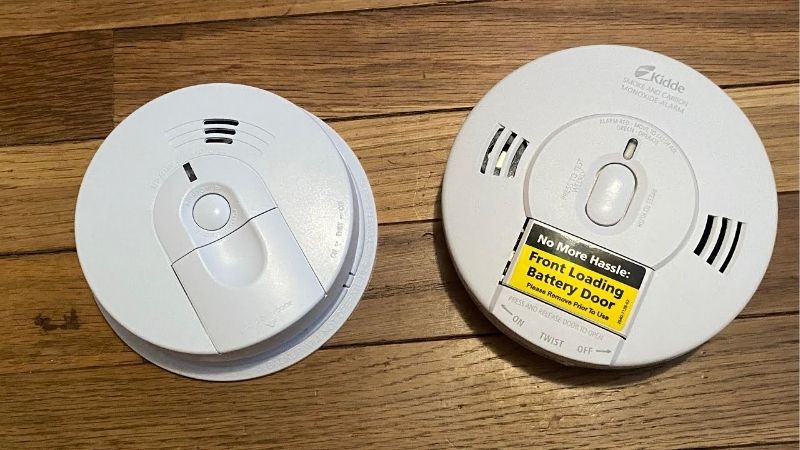
Read the label on the alarm body or its mounting plate and find the specific user guide. CO-only alarms, interconnected smoke-and-CO alarms, plug-in models, hardwired units, and sealed-battery models can behave differently. In First Alert’s SM6 and SC6 guide, the combined test sounds the smoke pattern before the CO pattern, so hearing the first part alone does not complete the test.
Check the printed manufacture, activation, and replacement information without assuming all alarms last the same number of years. A sealed battery is not a lifetime sensor. Kidde’s COB10 product page describes a ten-year sealed battery, but that does not set the replacement schedule for another brand or an older Kidde model. Compare the actual date and service-life rule for the unit in front of you.
When You Must Stop and Get Outside
If an alarm activates unexpectedly, you smell combustion fumes, or someone has symptoms such as headache, dizziness, or nausea, stop routine testing. The CPSC instructs households to go outdoors into fresh air, call emergency services or 911 from outside, and remain out until responders say it is safe to return. Do not search for the source while others remain inside.
Never use vehicle exhaust, a running generator, a stove, a flame, or any improvised source of CO as a test. First Alert’s SM6 and SC6 installation guide specifically warns against vehicle exhaust and open flames. Such experiments can cause poisoning, damage a detector, and produce a misleading result. A qualified professional can investigate combustion equipment without putting the household at risk.
How to Test a Carbon Monoxide Detector Step by Step
This procedure is for the built-in function test on an installed residential CO alarm, not for measuring airborne CO. Carry it out during an ordinary, uneventful period when no alarm is warning of danger. Keep the manufacturer’s exact instructions in view, since the press duration, light sequence, and fault indicators depend on the model.
Step 1: Find the Alarm and Its Instructions
Locate every CO alarm in the home, including the ones outside sleeping areas and on other floors. The CPSC’s carbon monoxide guidance recommends coverage on each level and outside sleeping areas, with battery-operated devices or battery backup. This check is not a substitute for following state or local placement rules; some households need additional units. Put missing coverage on the replacement list before moving on.
For each installed alarm, read the model number and find its Test, Test/Reset, or Test/Silence control. Use only the button or app action that the manufacturer calls a functional test. A Silence button may temporarily mute a warning without checking the electronics. If the label is illegible, the installation guide is missing, or the product has a fault indicator, contact the manufacturer rather than guessing at button combinations.
Step 2: Inspect the Unit and Check Power
Look for a cracked case, paint over the vent openings, moisture damage, missing batteries, or a loose plug. Follow the power-light and fault-indicator descriptions in the model’s guide; a green light does not have the same meaning on every brand. With a plug-in alarm, verify that the outlet has power without pulling apart the device. Do not remove an electrical cover or touch wiring on a hardwired installation.
If the unit accepts replaceable batteries, check their type, orientation, and contacts against the instructions before testing. The CPSC’s 2023 battery reminder advises replacing nonsealed batteries at least yearly, while sealed ten-year designs do not use the same procedure. For a plug-in model with backup batteries, the backup feature is valuable during an outage, but its maintenance still depends on the specific product guide.
Step 3: Press Test as the Manual Directs
Warn anyone nearby that you are about to test the alarm, especially people who may be startled or sensitive to loud sound. Stand at a safe distance from the sounder and operate the button exactly as described: some models require a brief press while others require a hold. Do not place your ear next to the grille. The horn should begin its programmed diagnostic signal if the unit is functioning according to its instructions.
Kidde’s Carbon Monoxide Frequently Asked Questions describes a typical CO-only test pattern of four quick beeps, about five seconds of silence, then four quick beeps. That sequence is a Kidde example, not a rule for every alarm. First Alert’s SM6 and SC6 installation guide describes three beeps followed by the CO sequence of four. Match the complete sound and indicator pattern to your own model, not a generic online video.
Step 4: Confirm the Whole Signal, Not One Beep
Listen until the expected test sequence ends, then check whether the alarm returns to its documented normal-monitoring state. An isolated chirp may be a low-battery or end-of-life notice, while a programmed test can include pauses and several stages. Do not assume one short noise means the self-test passed. On models with a digital display, watch for the demonstration or diagnostic symbols described in the manual.
A displayed number during a diagnostic sequence is not necessarily a real carbon monoxide measurement. Kidde’s explanation of test buttons and peak-level memory says diagnostic digits can be programmed test values rather than actual gas concentrations. Record a pass only if the sound, visual cues, and return to standby are all consistent with the product’s instructions. If anything differs, follow its troubleshooting directions before marking the result successful.
Step 5: Resolve a Failed Test Safely
If the horn remains silent or the display reports an error, first confirm you operated the correct control and did not confuse Test with Silence. For a user-serviceable battery model, replace weak batteries with the exact approved type, secure the compartment, and repeat the manufacturer’s test procedure. For plug-in models, confirm that the receptacle works; do not rely on a loose plug or a power strip as a permanent fix.
Replace an alarm that still fails after the manual’s permitted checks. First Alert’s SM6 and SC6 installation guide instructs owners to replace the unit immediately if the test still fails after checking its batteries. Do not try to repair the CO sensing element, bypass an error signal, or leave the home without working coverage while waiting for a replacement. If a hardwired alarm needs disconnection or wiring work, use a qualified electrician.
Step 6: Record the Date and Check Coverage
Once the unit passes, note the test date, location, model, battery condition, and printed replacement deadline. Set a reminder for the next test using the shortest interval specified by the product’s instructions. The U.S. Fire Administration recommends at least monthly testing, while Kidde’s FAQ recommends weekly tests for its alarms. A simple home safety log helps avoid missing a seldom-used basement or guest-room alarm.
Finish by checking the rest of the home, not just the device nearest the bedroom. The CPSC recommends CO alarms on every floor and outside sleeping areas; where appropriate, interconnected alarms add a warning in other locations when one alarm detects danger. Not every standalone alarm can communicate with other units, so check compatibility before purchase. A passing test on one device does not compensate for an absent, expired, or blocked alarm somewhere else.
Products That Help
If a failed or expired alarm needs replacement, the Kidde COB10 Carbon Monoxide Alarm has a manufacturer-described ten-year sealed battery and a test/hush control. It suits a location where replacing batteries is inconvenient, provided its installation directions fit the room. The Kidde COP Plug-In Carbon Monoxide Alarm uses wall power plus AA battery backup for continued coverage through outages; Kidde’s COP user guide names the approved replacement battery types.
For people who want a visible status reading, the Kidde COBD Carbon Monoxide Alarm is an AA-powered model with a backlit digital display, according to Kidde’s product page for the COBD. These are alternatives, not a reason to discard a current alarm that passes its checks and is still within its service life. Before buying, confirm the current listing, UL 2034 compliance, and any local requirements for interconnected or hardwired units.
Common Testing Mistakes to Avoid
Do not confuse a CO-only test with the smoke portion of a combination alarm. Do not judge a silent alarm by its indicator light alone, and do not keep using an expired detector because a test sound still works. CPSC guidance is explicit that the button does not assess sensor accuracy. Most importantly, do not create a CO source or use a garage or fireplace as a testing chamber.
If a device sounds while you are not intentionally running its documented test, treat it as a possible real warning until emergency personnel determine otherwise. Avoid pressing Silence repeatedly to make an unexpected signal stop. The goal of this routine is to detect an inoperative household warning device, not to demonstrate that CO cannot be present. Combustion equipment still needs proper maintenance and safe ventilation.
Frequently Asked Questions
A functional test tells you about the alarm’s self-check, but some situations need a different decision. These answers address replacement dates, mixed smoke-and-CO units, a display that reads zero, and whether an alarm must work during an outage.
Does a Passing Test Mean the CO Sensor Is Accurate?
No. The CPSC’s Carbon-Monoxide Questions and Answers states that the button test checks the alarm’s circuitry, not the accuracy of its sensing element. A unit can play its test sound without proving what concentration would trigger it during a real event. Follow the model’s published replacement date and replace any alarm with a fault, damage, or expired service life.
If the concern is a suspected CO leak, do not try to validate the detector by deliberately exposing it to exhaust or fumes. Get to fresh air and contact emergency responders if there is a warning or symptoms. After an incident is cleared, have the fuel-burning equipment evaluated by the appropriate technician before it is used again.
Is the Test the Same on a Smoke and CO Combination Alarm?
Not necessarily. Combination units often have different sounds for smoke and carbon monoxide, and the built-in diagnostic may demonstrate both sequences. In the First Alert SM6 and SC6 installation guide, the test uses three-beep smoke groups followed by four-beep CO groups. That model-specific example is a reminder to identify the device before interpreting its sound.
Use the unit’s printed label and current user guide rather than assuming that a beep count applies across manufacturers. Combination alarms can also use voice messages or app notifications that are not available on a basic CO-only alarm. If the sequence is incomplete, resolve the fault using the product instructions or replace the detector.
Can an Alarm Show Zero While CO Is Present?
Yes, a zero display is not proof that no carbon monoxide exists anywhere in the home. The number reflects the device’s design and operating conditions, and some alarms do not display every low-level exposure. The CPSC notes that CO safety depends on concentration and duration and that alarms are designed to warn before potentially life-threatening conditions. A household display is not a substitute for professional environmental testing.
For a display that flashes unusual digits only during Test, consult the diagnostic section of the guide before treating them as real readings. Kidde’s support explanation says test-mode numbers may be simulated values. If a reading appears outside test mode or people feel unwell, follow the manufacturer’s emergency guidance and seek help instead of trying to interpret it alone.
Should a Plug-In CO Alarm Work in a Power Outage?
Yes, if it is designed with working battery backup. The CPSC recommends battery-operated CO alarms or models with battery backup on every level and outside sleeping areas. A plug-in detector that loses its only power source cannot protect during an outage, which is especially concerning when generators or other fuel-burning equipment may be in use.
Kidde’s product page for the COP specifically describes AA backup batteries. Confirm the installed batteries meet that model’s user guide, and follow its instructions for checking the power source without creating an electrical hazard. Never operate a generator indoors or in a garage, including with the garage door open; the CPSC warns that CO can rapidly build up in enclosed spaces.
Final Thoughts
A normal self-test is one layer of CO safety, not permission to neglect a furnace, water heater, fireplace, or generator. After learning how to test carbon monoxide detector alarms, record each unit’s replacement deadline beside your recurring test reminder and make sure the household recognizes the difference between a planned test and an unexpected emergency warning. If a detector fails or coverage is missing, compare the Kidde COB10, COP, and COBD against the power, placement, and interconnection requirements of your home before checking current prices.