Key takeaways
- Four-stroke mower: SAE 30 for warm weather, 10W-30 for mixed or cooler weather, 5W-30 or synthetic if the manual allows it for cold starts.
- Walk-behind mowers take about 15 to 20 oz; riding mowers about 1.5 to 2.5 quarts. Always fill to the dipstick mark, not the bottle.
- Change the oil once a season or every 25 to 50 hours of use, whichever comes first, and after the first few hours on a new mower if the manual says so.
- Never overfill, and never mix oil into the fuel of a four-stroke engine.
- Disconnect the spark plug wire and tip the mower the right way before you drain it.
What oil does a lawn mower take? Most four-stroke mowers take SAE 30 in warm weather or 10W-30 across a wider temperature range, and most walk-behind engines hold only about 15 to 20 ounces (roughly half a quart). Riding mowers usually hold 1.5 to 2.5 quarts. The exact grade and amount are printed in your owner’s manual and often on the oil fill cap or the engine shroud, so check there before you pour.
This guide covers the oil type, how much oil a lawn mower needs, and how to change it step by step, with the mistakes that cause smoking, hard starting and engine damage. It applies to common four-stroke push mowers, self-propelled mowers and riding mowers; two-stroke engines are different and are covered in a short section below.
Our top picks


As an Amazon Associate we earn from qualifying purchases at no extra cost to you.
Key takeaways
- Four-stroke mower: SAE 30 for warm weather, 10W-30 for mixed or cooler weather, 5W-30 or synthetic if the manual allows it for cold starts.
- Walk-behind mowers take about 15 to 20 oz; riding mowers about 1.5 to 2.5 quarts. Always fill to the dipstick mark, not the bottle.
- Change the oil once a season or every 25 to 50 hours of use, whichever comes first, and after the first few hours on a new mower if the manual says so.
- Never overfill, and never mix oil into the fuel of a four-stroke engine.
- Disconnect the spark plug wire and tip the mower the right way before you drain it.
What Oil Does a Lawn Mower Take? Grade by Weather and Engine
Lawn mower engines are air-cooled and run hot, so they use a detergent oil rated for small engines. The grade you choose depends on the outdoor temperature range where you mow. The table below follows the pattern most engine makers publish; your manual overrides it.
| Mowing conditions | Common oil choice | Notes |
|---|---|---|
| Warm weather, above about 40 F | SAE 30 | The traditional small-engine oil; thicker at start-up in cold weather |
| Wide temperature range, spring through fall | 10W-30 | Flows better when cool and still protects when hot; very common choice |
| Cool or cold starts | 5W-30 or a synthetic grade | Only if the manual lists it for your engine |
| High heat, heavy use | SAE 30, or a synthetic if allowed | Check oil level more often |
| Two-stroke engine | Two-stroke oil mixed with fuel | Never use plain four-stroke oil in the tank |
Most manuals also name an API service class (a code such as SJ or higher on the bottle). Choosing oil that meets or exceeds the class in the manual is more important than the brand name.
Is 10W-30 Good for Lawn Mowers?
Yes, in most cases. Many small-engine makers list 10W-30 as acceptable, and it is a safe choice if your mower sees a range of temperatures in the season. Two cautions apply. First, some manuals recommend SAE 30 only for hot weather and note that 10W-30 can raise oil consumption in very high heat, so check the oil level more often if you use it in a heat wave. Second, if the manual specifies a particular grade, follow it, especially while the engine is under warranty.
Can You Use Regular Car Oil in a Lawn Mower?
Many manuals allow automotive oil of the correct grade (SAE 30 or 10W-30) with the right API service class, because both are detergent four-stroke oils. Avoid non-detergent oil in most four-stroke mowers; it does not carry contaminants away from the engine. Small-engine oils sold in mower-sized bottles are often a convenient choice because the volume matches the crankcase, and some are formulated for air-cooled engines. If in doubt, buy the type the manual names.
How Much Oil Does a Lawn Mower Take?
Capacity depends on the engine. The ranges below are typical, not exact; the dipstick and the manual are the final word.
| Mower type | Typical oil capacity | Common oil |
|---|---|---|
| Walk-behind push mower | 15 to 20 oz (about 0.5 to 0.6 quart) | SAE 30 or 10W-30 |
| Self-propelled walk-behind | 15 to 22 oz | SAE 30 or 10W-30 |
| Single-cylinder lawn tractor engine | About 1.5 to 2 quarts | SAE 30 or 10W-30 |
| V-twin riding mower or zero-turn | About 1.75 to 2.5 quarts, plus the filter | SAE 30 or 10W-30, or as listed |
Fill to the full mark on the dipstick with the mower on level ground. Small engines are sensitive: a few ounces too much can cause smoke and a fouled spark plug, while too little can wreck the engine.
How to Check the Oil Level
- Park the mower on a flat surface and let the engine sit for a few minutes after running.
- Clean the area around the dipstick or fill cap so dirt does not fall in.
- Pull out the dipstick, wipe it clean and reinsert it as the manual describes. On many engines you rest it on the opening without screwing it in; on others you screw it fully in.
- Pull it out again and read the level. It should sit between the add and full marks.
- If it is low, add small amounts, wait a minute and recheck. Do not overfill.
Also look at the oil color. Dark oil is normal after running, but milky or gritty oil, or a strong fuel smell, means something is wrong and you should have the mower checked.
How to Change Lawn Mower Oil: Step by Step
A change takes about 15 to 20 minutes on a push mower. Use the steps below along with your manual, since drain plugs and tip directions differ.
- Run the engine briefly. Warm oil drains more completely. Do not run it so long that the engine is hot to the touch.
- Stop the engine and disconnect the spark plug wire. This prevents accidental starting. Wait for the engine to cool enough to touch safely.
- Use up or limit the fuel. If you will tip the mower, run it close to empty first, or siphon the tank, because fuel can leak when the mower is tilted.
- Set up the drain pan. Choose a pan or container large enough for the oil and a rag for spills.
- Drain the oil. There are three common ways: remove a drain plug if the engine has one; tip the mower on its side with the air filter and carburetor facing up and let the oil run out of the fill opening; or use a siphon or extractor through the dipstick tube.
- Let it drain fully. Give it a minute or two after the flow slows to a drip.
- Refill. Return the mower to level ground. Use a funnel and add about three-quarters of the stated capacity, then check the dipstick and add small amounts up to the full mark.
- Replace the plug, cap and dipstick. Wipe up any spills, then reconnect the spark plug wire.
- Start the engine. Let it run for a minute, shut it off and re-check the level.
- Dispose of the old oil. Take it in a sealed container to a recycling center or an auto parts store that accepts used oil.
How to Drain Lawn Mower Oil When There Is No Drain Plug
Most push mowers have no drain plug. The usual method is to tip the mower on its side, with the air filter and carburetor side facing up, so oil does not flow into the intake. Tipping the wrong way floods the air filter or the carburetor with oil and causes smoking or hard starting. If you tipped the mower the wrong way by accident, let it sit, check and clean the air filter and expect some smoke when you restart. An oil extractor pump through the dipstick tube is a tidier option and avoids tipping entirely.
How Often to Change the Oil
| Situation | Typical interval |
|---|---|
| New mower | Check the manual: some engines call for an early change after the first 5 hours |
| Normal residential use | Once per season, or every 25 to 50 hours |
| Dusty, hot or heavy use | Closer to 25 hours |
| Riding mower with an oil filter | Every 50 hours, with a new filter, or per manual |
| Storage | Changing oil before winter storage keeps acids and contaminants out of the engine |
Common Oil Mistakes
- Overfilling. Too much oil causes smoking, a fouled spark plug and loss of power. If you overfill, drain a little.
- Running low. Many small engines burn some oil; check the level before every few mows.
- Mixing oil into the fuel of a four-stroke. That is for two-stroke engines only.
- Using non-detergent oil. Most four-stroke mowers need detergent oil.
- Tipping the mower the wrong way. Keep the air filter and carburetor facing up.
- Skipping the filter on riding mowers. A filter change is part of the routine on engines that have one.
What About Two-Stroke Lawn Mower Engines?
Two-stroke mowers are uncommon today, but some older or specialty machines use them. They have no oil sump to fill; oil is mixed with the fuel at a ratio the manufacturer specifies, such as 40 to 1 or 50 to 1. Use fresh fuel and two-stroke oil that matches the maker’s spec. If your mower has a fill cap marked for oil and a dipstick, it is a four-stroke.
Gear That Helps
- Husqvarna 4-Cycle SAE 30 Mower Engine Oil (32 oz): a straightforward SAE 30 option in a mower-sized bottle.
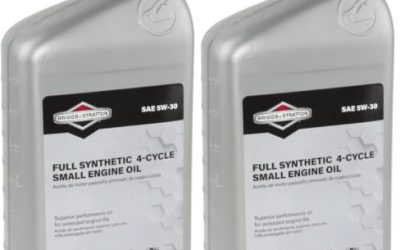
- Toro Full Synthetic SAE 10W-30 4-Cycle Engine Oil (32 oz): a synthetic 10W-30 for mowers that allow it.
- STP Premium Synthetic Blend 4 Cycle Small Engine Oil, SAE 10W-30: a synthetic-blend 10W-30 for mowers and other small engines.
- NEIKO 20762A Oil Drain Pan (2 gallon): a low pan that catches oil from tipped or drain-plug mowers.
Check each product against your manual before use; these are examples of oils that match the common grades, not a recommendation for every engine.
Before You Start: Safety
- Disconnect the spark plug wire before you tip or work under the mower.
- Work outdoors or in a well-ventilated space, away from flames and sparks.
- Let the engine cool; the exhaust and muffler stay hot.
- Wipe up spilled oil and gasoline immediately.
- Wear gloves and eye protection when draining and handling used oil.
FAQ
What kind of oil for a lawn mower should I use?
Use the grade named in your manual. For most four-stroke mowers that is SAE 30 in warm weather or 10W-30 over a wider range of temperatures.
How much oil does a lawn mower take?
A walk-behind mower typically holds about 15 to 20 ounces, and riding mowers about 1.5 to 2.5 quarts. Fill to the dipstick mark, not to a number.
Is 10W-30 good for lawn mowers?
Generally yes. It is a common, accepted grade, but if the manual specifies SAE 30 for hot weather, follow it and check the level more often in heat.
How do I drain lawn mower oil without a drain plug?
Tip the mower on its side with the air filter and carburetor facing up and pour the oil out of the fill opening into a pan, or use an oil extractor through the dipstick tube.
How often should I change lawn mower oil?
Once per season or every 25 to 50 hours is typical for residential use, and more often in dusty or hot conditions. Check your manual for your engine.
What happens if I put too much oil in a lawn mower?
Extra oil can cause smoke, a fouled spark plug, hard starting and loss of power. Drain the excess until the level is on the full mark.
Can I use synthetic oil in a lawn mower?
Often yes, if the manual allows it. Synthetic oil can help in cold starts and heavy heat, but it does not remove the need for regular changes.
Last updated: November 2026
More from Amazon
Programs that pair well with the guide above. Offers and eligibility are set by Amazon and may change.
A free business account with business pricing and bulk-buying tools for work, shop or home office.
Create a business accountFree shipping on eligible items, Prime Video and more. Eligible new members can start with a free trial.
Start a Prime free trialAudiobooks and podcasts to listen to on the go. Eligible new members can start with a free trial.
Try Audible freeAd-free music streaming. Eligible new subscribers can start with a free trial.
Try Music Unlimited freeAs an Amazon Associate we earn from qualifying purchases.