Key takeaways
- Match the saw to your battery platform first: a bare tool on a battery you own is usually the best value.
- Barrel-grip saws give more control on tight curves; top-handle saws push better through thick stock.
- Orbital action cuts faster in softwood and plywood; set it to zero for clean laminate, metal and plastic.
- Blade choice changes the cut more than the motor does: fine teeth for veneer, coarse teeth for framing lumber.
- For a few cuts a year, a budget 20V or 12V saw is enough; brushless pays off with frequent use.
The best cordless jigsaw for a homeowner is one with orbital action you can switch off, a tool-free blade change, a bevel shoe that tilts to about 45 degrees, and a battery that already powers your drill. Everything else, including brushless motors and LED lights, is a refinement on top of those four basics. This guide ranks the best cordless jigsaw options for curved cuts, sink cutouts, scroll work and trim, using maker listing details and spec sheets, and it explains which blade, speed and orbital setting to pick so the saw you buy actually follows a line.
Our top picks


As an Amazon Associate we earn from qualifying purchases at no extra cost to you.
Key takeaways
- Match the saw to your battery platform first: a bare tool on a battery you own is usually the best value.
- Barrel-grip saws give more control on tight curves; top-handle saws push better through thick stock.
- Orbital action cuts faster in softwood and plywood; set it to zero for clean laminate, metal and plastic.
- Blade choice changes the cut more than the motor does: fine teeth for veneer, coarse teeth for framing lumber.
- For a few cuts a year, a budget 20V or 12V saw is enough; brushless pays off with frequent use.
Quick picks: best cordless jigsaw by situation
| Pick | Grip | Platform | Best for |
|---|---|---|---|
| DEWALT DCS334B | Top handle | 20V MAX | All-round brushless saw for frequent projects |
| DEWALT DCS335B | Barrel grip | 20V MAX | Tight curves and close control |
| Milwaukee M18 FUEL D-handle | D-handle | M18 | Heavy cuts in thick stock |
| Bosch GST18V-50N | Top handle | 18V | Precise cuts for finish carpentry |
| CRAFTSMAN V20 RP CMCS650B | Keyless | V20 | Budget-friendly step up |
| RYOBI ONE+ HP PBLJS01 | Top handle | ONE+ 18V | Homeowners already on ONE+ |
| BLACK+DECKER BDCJS20B | Top handle | 20V MAX POWERCONNECT | Occasional cutouts on a tight budget |
Barrel grip or top handle: which cordless jigsaw style fits your work
The grip style changes how you steer. A top-handle (D-handle) jigsaw lets you press down with your whole hand, which helps when you push through 2x lumber or thick plywood. A barrel-grip jigsaw puts your hand lower and closer to the line, so many woodworkers find it easier to follow a tight radius on a countertop cutout or a decorative curve. Neither is “better”; the right one depends on whether your projects are mostly rough cuts in framing or finish work in sheet goods.
- Choose a barrel grip if you cut sink openings, scrolled shelf ends, circles and detail work.
- Choose a top handle if you cut plumbing holes through subfloor, shape fence boards or trim thick stock.
- If you are unsure, the top-handle style is the more common choice and gives you more downward leverage.
How We Chose these cordless jig saws
We did not personally use these saws. This list is research-based: we compared maker listing details, specification sheets and the feature sets that matter for curved cuts, then kept saws that are real, current models from established tool brands, sold as bare tools or kits. We prioritized variable speed, orbital settings, bevel capability, blade-change method, battery platform breadth and brushless motors, and we limited the list to two models per brand. We do not quote prices, only tiers, because tool pricing moves often. Always confirm the exact bevel range, stroke length and included accessories on the maker page or listing before you buy.
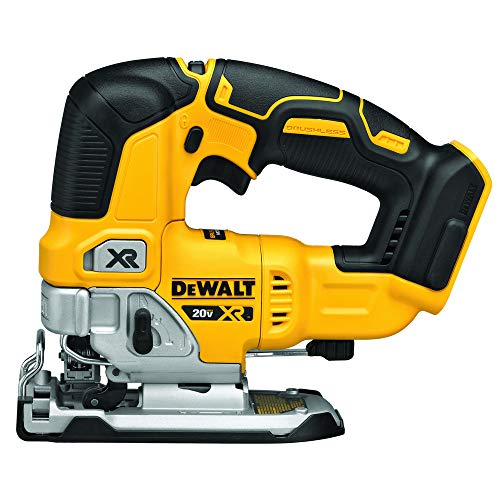
1. DEWALT DCS334B: Best for frequent DIYers on 20V MAX
- DEWALT 20V MAX XR jigsaw, bare tool
- Brushless motor · 3,200 blade speed · LED light
- Top-handle design · battery and charger sold separately
- Platform: 20V MAX, shared with DEWALT drills and impact drivers
Best for: homeowners who already own DEWALT 20V MAX batteries and cut curves, cutouts and trim every few weeks.
Skip if: you only need two or three cuts a year, or you are on a different battery platform.
Pros:
- Brushless motor listed for long runtime per charge
- Built-in light helps follow a pencil line
- Large battery ecosystem means easy swapping
- Strong resale and widespread blade availability
Cons:
- Bare tool means you buy battery and charger separately if you have none
- Higher cost tier than entry-level saws
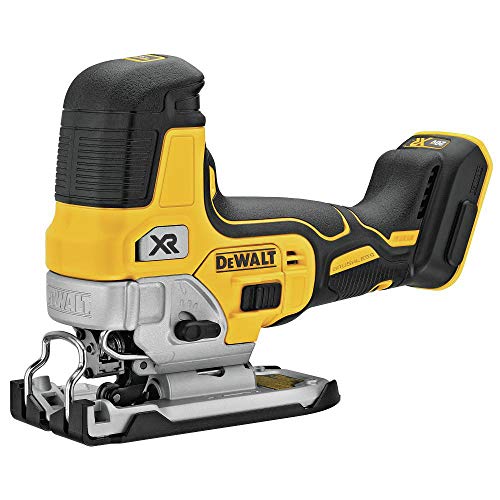
2. DEWALT DCS335B: Best barrel grip for tight curves
- DEWALT 20V MAX jigsaw, bare tool
- Barrel grip · 3,200 blade speed · cordless
- Lower hand position for close control
- Platform: 20V MAX
Best for: finish work such as countertop cutouts, scrolled edges and craft projects where steering matters more than brute force.
Skip if: you mostly rough-cut thick lumber and want maximum downward pressure from a top handle.
Pros:
- Barrel grip keeps your hand near the work for better visibility
- Same 20V MAX batteries as the rest of the platform
- Often easier to keep square on a tight radius
Cons:
- Listing does not state a brushless motor, so check the maker page if that matters to you
- Some users find barrel grips less comfortable on long cuts
3. Milwaukee M18 FUEL D-handle jigsaw: Best for thick stock and long jobs
- Milwaukee M18 FUEL D-handle jigsaw, bare tool
- FUEL line · M18 battery platform · D-handle grip
- Check maker page for stroke length and orbital settings
- Platform: M18, one of the largest cordless platforms
Best for: remodelers and serious DIYers who already run M18 tools and want a saw built for repeated use.
Skip if: you are buying your first cordless tool and have no M18 batteries.
Pros:
- M18 FUEL line is positioned as the brand’s higher-performance tier
- Wide choice of M18 batteries for light or heavy work
- D-handle suits pushing through thicker material
Cons:
- Premium tier for a tool many homeowners use occasionally
- Bare tool only, so factor in battery cost
4. Bosch GST18V-50N: Best for precise finish carpentry
- Bosch GST18V-50N 18V brushless top-handle jigsaw, bare tool
- Brushless motor · top handle · 18V
- Bosch is known for precision-focused jigsaw designs
- Check maker page for stroke length, orbit settings and bevel stops
Best for: people who cut cabinet openings, laminate and trim and care about straight, clean edges.
Skip if: you want a platform that also covers a huge range of yard tools.
Pros:
- Brushless motor in an 18V class saw
- Bosch blades with T-shank are widely available
- Suited to refined work in sheet goods
Cons:
- Bare tool, battery sold separately
- Fewer platform tools than the biggest brands in some categories
5. CRAFTSMAN V20 RP CMCS650B: Best budget step-up
- CRAFTSMAN V20 RP cordless jigsaw, bare tool
- 3 orbital settings · up to 3,200 SPM
- Variable speed, keyless blade change
- Platform: V20
Best for: homeowners on the V20 platform who want faster cutting and three orbital settings without paying for a premium brushless saw.
Skip if: you need the longest runtime or a brushless motor and this listing does not state one.
Pros:
- Three orbital settings for matching speed to material
- Keyless blade change speeds up swaps
- Typically sits in a mid-price tier
Cons:
- Bare tool; battery sold separately
- Platform is smaller than DEWALT or Milwaukee
6. RYOBI ONE+ HP PBLJS01: Best for ONE+ owners
- RYOBI ONE+ HP 18V brushless cordless jigsaw, tool only
- Brushless motor · 18V ONE+ platform
- Check maker page for orbital settings and bevel range
- Battery and charger sold separately
Best for: homeowners whose garage is already full of ONE+ batteries and who want a saw that shares them.
Skip if: you are not on ONE+ and are buying batteries from scratch.
Pros:
- Very large range of ONE+ tools and batteries
- Brushless HP series positioned above the entry ONE+ line
- Good fit for weekend-project use
Cons:
- Tool only, so total cost depends on batteries you own
- Not aimed at daily professional jobsite use
7. BLACK+DECKER BDCJS20B: Best for occasional cutouts on a tight budget
- BLACK+DECKER 20V MAX POWERCONNECT cordless jigsaw, tool only
- Platform: 20V MAX POWERCONNECT
- Entry-level pricing tier
- Check listing for blade speed and bevel details
Best for: renters, first-time DIYers and anyone who needs a handful of curved cuts a year.
Skip if: you cut hardwood, thick stock or metal regularly.
Pros:
- Low entry cost for a cordless jigsaw
- Shares batteries with other BLACK+DECKER 20V MAX tools
- Good enough for light plywood and trim
Cons:
- Not built for demanding, frequent work
- Tool only, battery sold separately
Also consider
- Bosch JS120N: 12V max barrel-grip jigsaw, bare tool · variable speed · tool-free blade change. A compact choice for light curves and cabinet work.
- RIDGID R86344B: 18V brushless cordless jigsaw, tool only. Worth a look if you already own RIDGID batteries.
- CRAFTSMAN CMCS600D1: V20 jigsaw kit · 3 orbital settings · up to 2,500 SPM · battery and charger included. A kit option for first-time buyers.
- BLACK+DECKER 20V MAX brushless jigsaw kit: listing mentions a 2.5Ah battery and charger, a 24T steel blade and a 6T wood blade. Check the listing for full details.
Buying guide: how to choose a cordless jigsaw for curved cuts
Battery platform comes first
The battery is often more expensive than the tool, so buy the saw that matches the platform you already own. A bare tool on a battery you have is typically cheaper than a kit. If you own nothing yet, consider which brand also offers the drill, impact driver and sander you are likely to need next.
Orbital action and blade speed
Orbital action moves the blade slightly forward on the upstroke, which makes the cut more aggressive. Use the highest orbital setting on softwood and rough plywood. Drop to zero or one for laminate, veneer, metal and plastic, where aggressive motion causes chipping or heat. Several saws on this list advertise three orbital settings and speeds up to about 3,200 strokes per minute, which gives a useful range; check each listing for the exact numbers on a given model.
Blade-change system and shank
Tool-free blade changes save time and fingers. Most current jigsaws use T-shank blades, which fit across brands. Confirm the shank type before you buy a blade assortment. A good starter set includes fine-tooth blades for laminate and metal, medium blades for plywood and coarse blades for lumber.
Bevel capability
Most modern jigsaws tilt the base for angled cuts, commonly up to 45 degrees in either direction. Look for a base that locks without tools and has detents at common angles. Check the maker page for the exact range.
Brushless or brushed motor
Brushless motors usually give longer runtime and last longer with heavy use. For a homeowner who cuts curves a few times a month, a brushed saw is acceptable. If you plan to cut for hours, brushless is worth the extra cost tier.
Light, dust control and shoe
An LED light helps follow a line in a dim garage. A dust blower keeps the pencil line visible. A flat shoe, ideally with a non-marring cover, protects finished surfaces.
| Material | Blade teeth | Orbital setting | Speed |
|---|---|---|---|
| Framing lumber | Coarse (about 6 TPI) | High | High |
| Plywood | Medium (about 10 TPI) | Medium | Medium to high |
| Laminate and veneer | Fine, reverse-tooth or down-cut | Zero | Medium |
| Thin metal | Fine (about 18 to 24 TPI) | Zero | Low to medium |
| Plastic and PVC | Medium to fine | Zero | Low to medium |
How to cut a smooth curve with a cordless jigsaw
- Mark the line clearly with a pencil and lay masking tape over it on laminate to limit chipping.
- Clamp the workpiece so the cut area overhangs the bench.
- Choose the blade and set orbital action for the material.
- Rest the shoe flat on the surface before you pull the trigger.
- Let the blade reach full speed, then guide the saw forward without forcing it.
- For tight curves, use a narrow scroll blade and relief cuts to avoid bind.
- For inside cutouts, drill a starter hole in the waste area large enough for the blade.
- Keep the battery cool and stop if the blade deflects.
Common mistakes to avoid
- Pushing too hard, which makes the blade bend and the cut wander.
- Using a dull blade; replace it as soon as cutting slows.
- Leaving high orbital action on for laminate and thin metal.
- Not clamping the work, which causes vibration and rough edges.
- Buying a kit when you already own matching batteries.
Frequently asked questions
What is the best cordless jigsaw for a beginner?
A saw on your existing battery platform with variable speed and a tool-free blade change. The DEWALT DCS334B and RYOBI PBLJS01 are strong options if you already own those batteries, and the BLACK+DECKER BDCJS20B suits very light use.
Is a barrel-grip or top-handle jigsaw better for curves?
Barrel grips often give better control on tight curves. Top handles give more downward pressure for thick stock. Choose by the type of cutting you do most.
Do I need a brushless cordless jigsaw?
Not for occasional use. Brushless motors help with runtime and durability if you cut often or work with dense material.
Can a cordless jigsaw cut metal?
Yes, with a metal-cutting blade, orbital set to zero, a slower speed and a drop of cutting oil. Check the owner’s manual for the maximum thickness the saw can handle.
Why does my jigsaw cut drift off the line?
Common causes are a dull or wrong blade, too much feed pressure, or high orbital action. Slow down, use a fresh blade and set orbital lower.
Are blades interchangeable between brands?
Most current saws use T-shank blades that fit across brands, but confirm in the manual before buying a large assortment.
Should I buy a kit or a bare tool?
Buy a bare tool if you own batteries on that platform. Buy a kit if you are starting out and need the battery and charger anyway.
12V versus 18V and 20V: how much battery does a jigsaw need
A jigsaw is not the hungriest tool in the garage. It spends most of its time cutting thin sheet material, so a compact 12V saw such as the Bosch JS120N can handle cabinet panels, craft plywood and trim without much trouble. Step up to 18V or 20V and you gain headroom for thick lumber, long cuts and denser hardwood, and you can run the same battery in a drill or circular saw. The trade-off is weight: a 20V saw with a large battery can feel noticeably heavier at the end of a long scroll cut.
| Class | Typical strength | Typical limit | Good fit |
|---|---|---|---|
| 12V compact | Light, easy to steer | Slows in thick hardwood | Trim, cabinet panels, craft work |
| 18V / 20V MAX | Power for most home jobs | Heavier with large packs | Plywood, fence boards, countertops |
| Larger packs (5Ah and up) | Longer runtime | Weight and cost | Long sessions, remodel days |
If most of your cuts are under about an inch thick, a mid-size battery gives you a good balance of weight and runtime. Heavier packs make sense only if you cut for long stretches without a break.
Cordless versus corded: is a cord still worth it for curved cuts
Corded jigsaws deliver steady power with no battery to charge, and many cost less than a cordless bare tool plus battery. For a workshop with an outlet nearby, a corded saw is a sensible option. Cordless wins when you work in a garage with limited outlets, cut outdoors, trim in an attic or a crawl space, or want to avoid dragging a cord across a finished surface. For most homeowners who already own a cordless drill, the battery they have makes the cordless version cheaper in practice.
Safety and care for your cordless jigsaw
- Remove the battery before you change a blade.
- Clamp the workpiece so it cannot move or vibrate during the cut.
- Wear eye protection and hearing protection; use a dust mask when cutting MDF or treated lumber.
- Keep your hands behind the shoe and away from the path of the blade.
- Check the owner’s manual for the maximum cutting thickness in wood and metal.
- Store batteries at room temperature and follow the maker’s charging guidance.
- Wipe sawdust from the base plate and guide roller to keep the cut square.
Match the project to the saw
| Project | Best approach | Blade idea | Watch for |
|---|---|---|---|
| Kitchen sink cutout | Barrel grip, orbital low | Fine, down-cut or reverse tooth | Chipping on the finished face |
| Decorative shelf ends | Barrel grip, scroll blade | Narrow scroll blade | Blade bind on tight radii |
| Fence board shaping | Top handle, orbital high | Coarse wood blade | Rough edges that need sanding |
| Plumbing holes in subfloor | Top handle | Medium wood blade | Hidden nails and pipes |
| Thin sheet metal | Orbital zero, low speed | Fine metal blade | Heat and burrs |
| Round tabletop | Trammel or guide, steady feed | Medium to fine | Blade drift on thick stock |
For best results on finished surfaces, apply painter’s tape along the cut line, cut slightly outside the line and sand to the mark. A jigsaw is a shaping tool first and a finishing tool second, so plan on a little cleanup.
Gear that helps
- A starter blade set covering fine, medium and coarse teeth in T-shank.
- Two or more clamps so the work stays still.
- Masking tape for chip-free laminate cuts.
- A compass or trammel for circles.
Dust, light and visibility: small features that change the cut
A jigsaw hides its own cut line, because the blade and shoe sit directly on the pencil mark. Features that improve visibility therefore matter more than they look on a spec sheet. A built-in LED light, such as the one listed on the DEWALT DCS334B, lights the cut in a dim garage. A dust blower or a dust port clears chips so you can see the line. A clear or open shoe, or a laser guide on some models, helps you steer. When comparing two saws of similar power, choose the one with the better visibility.
- Check that the light stays on after you release the trigger long enough to read your line.
- Use a vacuum with the dust port when cutting MDF, to keep fine dust out of the air.
- Wipe the base plate so the saw glides without scratching veneered panels.
Which one should you buy?
If you own DEWALT 20V MAX batteries, the DCS334B is the all-round pick and the DCS335B is the one for tight curves. If you are on Milwaukee M18, the M18 FUEL D-handle saw fits demanding projects. For precision finish work the Bosch GST18V-50N is a strong choice, while the CRAFTSMAN CMCS650B and RYOBI PBLJS01 suit buyers already in those ecosystems. For a handful of light cuts a year, the BLACK+DECKER BDCJS20B keeps costs low. Whichever you choose, pair it with quality blades, because blade choice often matters more than the saw.
Sources
- DEWALT product listings and specification pages
- Milwaukee Tool product pages
- Bosch Power Tools product pages
- CRAFTSMAN and RYOBI product listings
- BLACK+DECKER product listings
Last updated: November 2026
More from Amazon
Programs that pair well with the guide above. Offers and eligibility are set by Amazon and may change.
A free business account with business pricing and bulk-buying tools for work, shop or home office.
Create a business accountFree shipping on eligible items, Prime Video and more. Eligible new members can start with a free trial.
Start a Prime free trialAudiobooks and podcasts to listen to on the go. Eligible new members can start with a free trial.
Try Audible freeAd-free music streaming. Eligible new subscribers can start with a free trial.
Try Music Unlimited freeAs an Amazon Associate we earn from qualifying purchases.