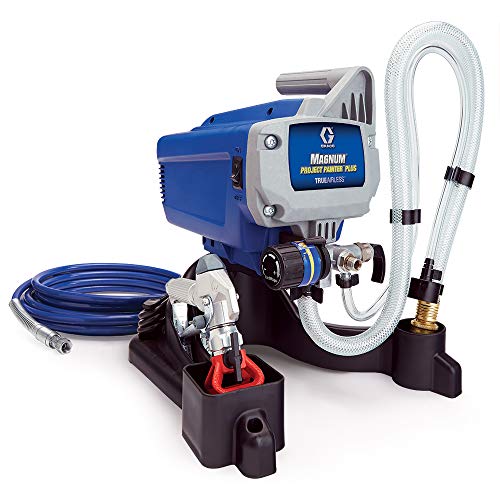
The Graco Magnum X5 is the best paint sprayer for latex paint for most homeowners because it is an airless unit that pulls unthinned latex straight from a 5-gallon bucket; step up to the Graco Magnum X7 for repeated large jobs, choose the Wagner Control Pro 130 for less overspray on fences and siding, and use the Graco TrueCoat 360 only for small touch-up projects. Latex is thick, so sprayer type matters more than any feature list: airless handles it unthinned, HVLP and many handhelds need thinning and are slower.
Our top picks
 HomeRight Super Finish Max HVLP Paint and
- Life changing paint sprayer: this paint sprayer requires…
- Easy to use for eager Painters: fast and…
- Lightweight: despite having more power than the finish…


As an Amazon Associate we earn from qualifying purchases at no extra cost to you.
Quick answer: pick by project size and paint thickness
- Whole rooms, exteriors, fences, decks, unthinned latex: Graco Magnum X5.
- Several houses a year, thick coatings, long hose runs: Graco Magnum X7.
- Siding, decks and fences with less overspray and mist: Wagner Control Pro 130 (HEA airless).
- Straight-from-bucket spraying in the same class as the Magnum X5: Titan ControlMax 1700.
- One or two gallons: touch-ups, a single room, small furniture: Graco TrueCoat 360 handheld airless.
- Light projects and trim with a low-cost handheld: Wagner Flexio 3000, with thinning expected.
- Cabinets, doors, furniture and fine finishes: Fuji Semi-PRO 2 HVLP, with thinned latex or a cabinet-grade enamel.
How we chose
This guide is research-based. We compared manufacturer specifications and published sprayer comparisons, favoring models that multiple independent sources agree can spray latex, and we separated what each sprayer type can handle unthinned from what needs thinning. Prices are not covered; relative tiers are noted instead. Specs we could not confirm are labeled as class-level descriptions. We make no claim of having used any of these sprayers.
The criteria that decide whether a sprayer works with latex:
- Sprayer type: Airless forces paint at high pressure through a small tip and needs no thinning for most latex. HVLP atomizes with high air volume at low pressure, giving a fine finish but typically requiring thinning for thick latex. Handheld units trade capacity for convenience.
- Maximum pressure: Around 3,000 PSI is the practical standard for airless homeowner units spraying latex.
- Tip size: The orifice controls flow and finish. Interior walls and ceilings generally use roughly 0.015 to 0.017 inch tips; exterior siding, fences and thick paint use about 0.017 to 0.021 inch. Check the sprayer manual for the tip it supports.
- Thinning needs: A sprayer that handles latex straight from the bucket saves time and avoids weaker coverage.
- Cleanup time: Latex cleans with water, but airless pumps have more internal parts to flush than handhelds.
- Coverage per hour: Governed by flow rate and technique, not just the sprayer name.
Comparison table
| Model | Type | Pressure | Latex handling | Best project | Skip if |
|---|---|---|---|---|---|
| Graco Magnum X5 | Airless, stand sprayer | Up to 3,000 PSI | Unthinned latex from a 5-gallon bucket | Rooms, exteriors, fences | You only paint small items |
| Graco Magnum X7 | Airless, larger stand or cart | Class above X5; confirm on label | Unthinned latex, thicker coatings | Large and frequent jobs | One or two jobs a year |
| Wagner Control Pro 130 | HEA airless | Confirm on label | Unthinned paints and stains from the bucket | Siding, decks, fences | You need maximum flow for huge jobs |
| Titan ControlMax 1700 | Airless | Confirm on label | Unthinned from the bucket | Whole-house interiors | You want a handheld |
| Graco TrueCoat 360 | Handheld airless | Confirm on label | Suited to 1 to 2 gallon jobs | Touch-ups, single rooms | Your project is a whole house |
| Wagner Flexio 3000 | Handheld, light-duty | Confirm on label | Expect to thin thick latex | Trim, small furniture, fences in sections | You need fast wall coverage |
| Fuji Semi-PRO 2 | HVLP turbine | Low pressure, high air volume | Needs thinning for thick latex | Cabinets, doors, furniture | Large walls and ceilings |
Best paint sprayers for latex, one by one
1. Graco Magnum X5: best overall for latex
Specs: Airless · Up to 3,000 PSI · Pulls paint directly from a 5-gallon bucket · Sprays unthinned latex.
It tops many comparison lists for homeowners because it sits where capability and price meet. Pulling straight from a 5-gallon bucket removes the refill-and-stir routine of a small cup, which is where most wall-painting time is lost. Three thousand PSI is enough to atomize standard interior and exterior latex without thinning.
Pros: unthinned latex; bucket feed; strong all-round capability; widely supported tips and parts.
Cons: more overspray than HEA or HVLP; cleanup takes longer than a handheld; requires masking.
Best for: walls, ceilings, fences, decks, whole rooms. Skip if: you only spray furniture or one small project.
2. Graco Magnum X7: best for large and repeated jobs
Specs: Airless · Larger pump than the X5 (confirm output on the label) · Sprays unthinned latex · Often sold as a cart version.
Some lists place the X7 first, particularly the cart version, for its capability with thicker coatings and long hoses. If you paint multiple rooms and exterior surfaces every year, the extra capacity reduces fatigue and strain on the pump.
Pros: greater capacity; better with thick coatings and longer hose runs; durable for repeated work.
Cons: costs more; heavier; overkill for a single room.
Best for: serious DIYers, house exteriors. Skip if: you paint once or twice a year.
3. Wagner Control Pro 130: best for reduced overspray on exteriors
Specs: HEA (high efficiency airless) · Sprays unthinned paints and stains from the bucket · Mid-range tier.
HEA technology uses lower pressure to cut mist and bounce-back. That matters on windy exteriors, fences close to neighboring cars or plants, and decks where drift is a problem. It is positioned as a mid-range option for homeowners who want airless speed with a more controllable spray.
Pros: less overspray; unthinned paint; mid-range tier.
Cons: lower maximum flow than larger airless units; still needs careful masking.
Best for: siding, decks, fences, exterior trim. Skip if: you will paint very large areas every week.
4. Titan ControlMax 1700: best alternative in the X5 class
Specs: Airless · Sprays unthinned paint from the bucket · Homeowner to light-contractor class.
It appears alongside the Graco X5 and X7 as a unit that sprays unthinned latex from the bucket. Choose it if you prefer its warranty, service network or ergonomics, and confirm the tip size and pressure on the current manual.
Pros: bucket feed; unthinned latex; competitive alternative.
Cons: fewer homeowner guides than the Graco line; verify service availability near you.
Best for: large interiors. Skip if: you want a handheld or a very light unit.
5. Graco TrueCoat 360: best handheld for small latex jobs
Specs: Handheld airless · Suited to projects using about 1 to 2 gallons · Compact, cup-fed.
A handheld airless gives you an airless-style finish without a hose and stand. It is quick to set up and clean, so it is practical for a bedroom ceiling, a shed or touch-ups after repairs. A small cup limits endurance, so it is not suited to a full house.
Pros: fast setup and cleanup; compact; airless finish.
Cons: small capacity; slower on large areas.
Best for: touch-ups and one-room jobs. Skip if: you plan to paint several rooms.
6. Wagner Flexio 3000: best light-duty handheld for trim and furniture
Specs: Handheld · Light-duty class · Specs and recommended thinning should be confirmed in the manual.
Handheld sprayers in this class work best with paint thinned to the manufacturer’s recommended range. They are a sensible match for outdoor furniture, small fences in sections and trim, and a weak match for long wall runs.
Pros: low setup effort; easy cleanup; lightweight.
Cons: thinning usually needed; slower on large surfaces.
Best for: small furniture and trim. Skip if: you need to cover rooms fast.
7. Fuji Semi-PRO 2: best HVLP for fine finishes
Specs: HVLP turbine · Low pressure, high air volume · Best on cabinets, doors and furniture.
HVLP is the wrong tool for whole-room wall painting, but it excels on cabinets, doors and trim, where finish quality matters more than coverage speed. Thick latex generally needs thinning with a compatible conditioner, or use a water-based cabinet enamel the maker recommends.
Pros: fine finish; low overspray; strong for cabinets and furniture.
Cons: premium tier; slow on large areas; latex needs thinning.
Best for: cabinets, doors, trim. Skip if: you are painting walls.
Criteria with concrete thresholds
Sprayer type by project
- Over 500 square feet of surface: airless with a bucket feed.
- 100 to 500 square feet: airless or HEA; a handheld is slow.
- Under 100 square feet or 1 to 2 gallons: handheld airless.
- Cabinets, doors, furniture: HVLP.
Tip size by surface
- Interior walls and ceilings, standard latex: about 0.015 to 0.017 inch.
- Exterior siding, fences and decks: about 0.017 to 0.019 inch, larger for thick coatings.
- Trim and detail: about 0.011 to 0.013 inch to control spray width.
Thinning
- Airless: usually none for standard latex; follow the sprayer and paint label.
- HVLP and light handhelds: small amounts of water or conditioner as the paint label allows, adjusted until the spray stops spitting.
Worked example: how much paint and time for one room
Use this step-by-step logic to estimate gallons, passes and hours. Inputs are planning assumptions.
- Calculate wall area. A 12 by 14 foot room with 8-foot ceilings has a perimeter of 52 feet, so 52 x 8 = 416 square feet of wall.
- Subtract openings. A door (about 21 square feet) and two windows (about 30 square feet total) leave about 365 square feet.
- Apply the label coverage. Many latex labels cite about 350 to 400 square feet per gallon on smooth walls. Spraying typically uses somewhat more because of overspray and texture.
- Gallons per coat: 365 / 350 is about 1.04, so plan 1.25 gallons to cover waste.
- Two coats: 2.5 gallons, which is half of a 5-gallon bucket.
- Time estimate. A homeowner airless with a 0.015 to 0.017 inch tip can cover a wall coat in well under an hour once masked. Masking and cleanup usually take longer than spraying.
- Cleanup budget. Allow about 20 to 30 minutes to flush an airless pump with water until it runs clear; a handheld takes roughly 10 minutes.
The conclusion: for one room the sprayer’s speed barely matters because prep dominates. Airless pays off when you paint multiple rooms, a ceiling and trim, or an exterior. For a single room or a small fence, a handheld is more efficient overall.
Prep, technique and cleanup for latex
- Mask thoroughly; airless overspray reaches farther than most people expect. Cover floors, windows and fixtures.
- Strain old or thick latex through a paint strainer before spraying to prevent tip clogs.
- Test the spray on cardboard; adjust pressure until edges are even and tails disappear.
- Hold the gun about 12 inches from the surface, move steadily, and overlap each pass by about half.
- Flush water through the pump and hose until clear, then clean the tip and filter. Store the pump with water or pump-protectant fluid as the manual directs.
Safety guidance
- Never place your hand or fingers near the tip. Airless spray can inject paint under the skin, which is a medical emergency that requires immediate professional care.
- Engage the trigger lock whenever you pause, and depressurize the system before clearing a tip or changing parts.
- Wear a respirator rated for paint mist, eye protection, and cover skin and hair.
- Ventilate interior rooms and keep ignition sources away; confirm paint type before spraying near heat.
- Plug electric sprayers into a grounded outlet and keep cords away from wet areas.
Frequently asked questions
What is the best type of paint sprayer for latex paint?
An airless sprayer is best for most latex projects. It atomizes thick paint at high pressure and usually needs no thinning.
HVLP suits cabinets and fine finishes, while handheld units suit small jobs.
Do I need to thin latex paint for a sprayer?
Airless sprayers usually do not need thinning. HVLP and light handhelds typically do, within the limits on the paint can.
Always check both the sprayer manual and the paint label, since over-thinning weakens coverage and finish.
What tip size works for latex paint?
Interior walls generally use about 0.015 to 0.017 inch tips; exterior and thicker coatings use about 0.017 to 0.021 inch.
Larger tips deliver more paint and need more masking, so start with the smaller size that still gives even coverage.
Is the Graco Magnum X5 enough for a whole house?
Yes, for most homeowners. It is built for interior rooms, exteriors, fences and decks, and it sprays unthinned latex from a 5-gallon bucket.
If you paint frequently or use very thick coatings, the Magnum X7 offers more headroom.
Is a handheld sprayer good enough for walls?
Only for small areas. A handheld with a small cup suits touch-ups and about 1 to 2 gallons of paint.
Refilling the cup repeatedly makes whole-room painting slower than using a bucket-fed airless unit.
How long does cleanup take after spraying latex?
Plan about 20 to 30 minutes for an airless pump and about 10 minutes for a handheld. Latex cleans with water.
Flush until the water runs clear, then clean the tip and filter to avoid clogs next time.
Can I use the same sprayer for oil-based paint and latex?
Many airless sprayers can, but you must flush thoroughly and use the correct cleaning solvent between paint types.
Check the manual for compatibility. Cross-contamination causes clumps, clogs and poor finishes.
How can I reduce overspray?
Use a smaller tip, lower pressure, an HEA-style sprayer, and keep the gun about 12 inches from the surface.
Spray exteriors on calm days and mask nearby objects well, since fine mist travels farther than expected.
Final verdict
For most homeowners the Graco Magnum X5 is the safest choice for latex because it sprays unthinned paint from the bucket at about 3,000 PSI. Upgrade to the Magnum X7 for frequent large jobs, choose the Wagner Control Pro 130 when overspray on exteriors is the main concern, and keep the Graco TrueCoat 360 for small touch-ups. Add the Fuji Semi-PRO 2 only if cabinets and furniture are on your list. Confirm tip sizes and pressures in the current manual before you buy, and follow the injection and ventilation safety rules every time.