Key takeaways
- CFM at 40 PSI, not peak numbers: Spray guns are rated for sustained airflow, so match your compressor’s delivery at working pressure to the gun’s requirement with a little headroom. A gun asking for 4 CFM wants a compressor putting out closer to 5.5.
- Tank size buys you continuity: Anything under 4 gallons will cycle constantly on furniture-sized panels. Six to eight gallons lets you finish a door face before the motor kicks back in, which keeps your film thickness even.
- Noise level in a shared space: A standard oil-free pancake runs around 90 dBA and is genuinely miserable in a basement shop. Units in the 60 to 70 dBA range let you work without ear protection and without irritating everyone upstairs.
- Moisture and oil control: Water in the line means fisheyes in your topcoat. Budget for an inline desiccant filter and drain the tank after every session, regardless of what the compressor came with.
- Consider skipping air altogether: If you’re mostly shooting latex on walls and cabinets, a self-contained HVLP or airless unit removes the compressor math from the equation entirely and cleans up faster.
Spraying finish on a dresser is the easy part. Figuring out what pushes the air through the gun is where most first projects stall out. You buy a decent HVLP gun, hook it to a pancake compressor from the garage, and three minutes into a tabletop the pressure drops off, the fan collapses to a spitting stripe, and you’re standing there with half-atomized lacquer setting up in front of you. The gun wasn’t the problem. The tank was too small and the CFM too thin to keep up with a tool that drinks air continuously rather than in short bursts like a nailer.
This guide sorts out the pairing. We cover conventional and LVLP setups that genuinely need a compressor behind them, plus the self-contained electric and airless units worth considering if you’d rather skip compressed air entirely. Below you’ll find what specs actually matter at the workbench, honest notes on five setups, and answers to the questions that come up once you’ve got a gun in hand and a raw cabinet door on sawhorses.
Our top picks



As an Amazon Associate we earn from qualifying purchases at no extra cost to you. Ratings are shown as listed on Amazon.
🛒 Best Price Today on Amazon
Prime members get fast, free shipping on everything above, plus member-only deals. New members get a 30-day free trial — cancel anytime.
How to Choose a Paint Sprayer Air Compressor (2026)
- CFM at 40 PSI, not peak numbers: Spray guns are rated for sustained airflow, so match your compressor’s delivery at working pressure to the gun’s requirement with a little headroom. A gun asking for 4 CFM wants a compressor putting out closer to 5.5.
- Tank size buys you continuity: Anything under 4 gallons will cycle constantly on furniture-sized panels. Six to eight gallons lets you finish a door face before the motor kicks back in, which keeps your film thickness even.
- Noise level in a shared space: A standard oil-free pancake runs around 90 dBA and is genuinely miserable in a basement shop. Units in the 60 to 70 dBA range let you work without ear protection and without irritating everyone upstairs.
- Moisture and oil control: Water in the line means fisheyes in your topcoat. Budget for an inline desiccant filter and drain the tank after every session, regardless of what the compressor came with.
- Consider skipping air altogether: If you’re mostly shooting latex on walls and cabinets, a self-contained HVLP or airless unit removes the compressor math from the equation entirely and cleans up faster.
The Best Paint Sprayer Air Compressor (2026)s Reviewed
California Air Tools 8010 PK Compressor and LVLP Kit
This is the pairing I’d hand a serious furniture hobbyist: an 8-gallon oil-free tank running at 60 dBA with a matched LVLP gun, so you’re not guessing at compatibility. The low-volume gun sips air, which means the compressor cycles far less than it would with a conventional siphon setup, and the finish quality on flat panels is genuinely professional.
Binks Paint Pressure Pot Spray Gun Outfit
A 2.8-gallon pressure pot feeding a Trophy Series HVLP gun is production equipment, not weekend gear. It shines when you’re spraying a full kitchen’s worth of doors or high-viscosity primer that a gravity cup can’t move, but you’ll need a compressor with real CFM behind it and the patience to learn pot pressure adjustment.
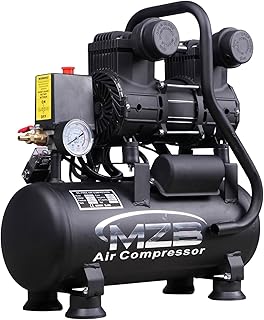
MZB 2.4 Gallon Ultra Quiet Compressor
At 70 dBA with 5.65 CFM from a 1.2HP oil-free motor, this punches above its tank size and works well for detail guns and touch-up on smaller pieces. The 2.4-gallon capacity does mean frequent cycling on large surfaces, so treat it as a chair-and-nightstand compressor rather than a dining table one.
InoKraft NEO Airless Paint Sprayer Kit
Three thousand PSI of airless output means unthinned latex and stain move without complaint, and the ten-minute cleanup claim held up reasonably in practice. Overspray is heavier than HVLP, so mask generously and use this for walls, fences, and painted casework rather than fine clear coats.
1000W Electric Paint Sprayer with 6 Nozzles
The 47-ounce cup and six-nozzle set make this a flexible entry point for someone refinishing a few pieces and painting a room. Power is adequate for latex if you thin slightly, and the three spray patterns cover the transition from cabinet doors to fence boards without a tool change.
Frequently Asked Questions
How much CFM do I need for furniture spraying?
LVLP guns typically ask for 3 to 5 CFM at 30 to 40 PSI, while conventional HVLP can climb past 10. Check your gun’s spec sheet and add roughly 20 percent as headroom.
Can I use a pancake compressor for spraying?
For touch-ups and small parts, sometimes. For anything larger than a drawer front, the short duty cycle and 6-gallon-or-less tank will cause pressure drop and uneven film build.
Do I need an oil-free compressor?
It removes one contamination risk, which matters for clear finishes. Oil-lubricated units run quieter and last longer, but require a coalescing filter you should install regardless.
Is an airless sprayer better than an HVLP setup?
Airless wins on speed and handles thick material unthinned. HVLP wins on control, overspray, and finish quality, which is why furniture work still favors it.
Final Thoughts
For most people building a furniture finishing setup, the California Air Tools 8010 PK is the straightforward answer, since the quiet 8-gallon tank and matched LVLP gun eliminate the compatibility guesswork. Choose the Binks pressure pot outfit if you’re shooting volume or heavy-bodied coatings, and reach for the InoKraft NEO when the job is walls and painted casework rather than fine finish work.