Building a steel base for a walnut slab table sounds simple until you price out the air side of the job. A plasma torch wants clean, dry, steady air, which traditionally means a 20-gallon tank minimum, a moisture separator, quick-connects, and a compressor cycling loud enough to end conversation in an attached garage. Plenty of furniture makers stall right there and go back to an angle grinder and a stack of cutoff wheels, which is slower, dirtier, and leaves an edge you have to file before it ever touches a weld.
Plasma cutters with an onboard compressor collapse that whole setup into one case you can carry to the driveway. This guide covers what actually matters when you’re cutting 11-gauge tube and 1/4″ plate for legs, brackets, and shelf frames: real cut capacity versus marketing numbers, duty cycle on a residential breaker, torch standards that keep consumables cheap, and where each machine earns its keep.
Our top picks


As an Amazon Associate we earn from qualifying purchases at no extra cost to you.
🛒 Best Price Today on Amazon
Prime members get fast, free shipping on everything above, plus member-only deals. New members get a 30-day free trial — cancel anytime.
How to Choose a Plasma Cutter With Built In Air Compressor (2026)
- Match capacity to your stock, not the headline: Trust the rated clean cut, not the severance figure. A 3/8″ clean cut handles nearly all furniture steel, including 2×2 square tube, hairpin blanks, and 1/4″ mounting plates, with margin left over.
- Check your circuit before your cart: A 40A machine on 120V can pull enough to nuisance-trip a shared 15A kitchen circuit. Dual-voltage units give you a 240V dryer outlet option when you need full amperage for thicker plate.
- Read duty cycle alongside compressor recovery: Onboard pumps are small. Long continuous cuts heat the machine and outrun the air supply, so look for generous duty ratings and thermal protection if you’re sectioning long rails.
- Decide between HF start and non-HF pilot arc: High-frequency starting is reliable but can interfere with nearby electronics. Non-HF pilot arc systems are gentler on shop Wi-Fi, laptops, and CNC controllers sharing the space.
- Verify the torch standard and consumable supply: IPT40, PT31, and similar common torches mean tips and electrodes cost a few dollars and ship overnight. Proprietary torches turn routine wear into a project delay.
The Best Plasma Cutter With Built In Air Compressor (2026)s Reviewed
FLARING 240V 45A Plasma Cutter
This is the balanced pick for furniture work: 45 amps on 240V, a genuine 3/8″ clean cut, and 5/8″ severance, all with no hose to hunt down. The IGBT inverter holds a stable arc through mill scale, and the digital readout makes repeating a setting across a dozen identical legs straightforward.
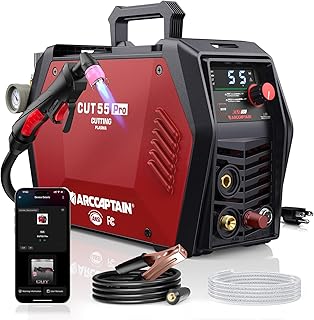
ARCCAPTAIN iControl CUT55 Pro
The most capable machine here, with 55 amps, dual voltage, a 1/2″ clean cut, and non-touch pilot arc that lets you cut expanded metal and rusty reclaimed stock without dragging the tip. App control and 2T/4T trigger modes are genuinely useful on long production runs where holding the trigger gets tiring.
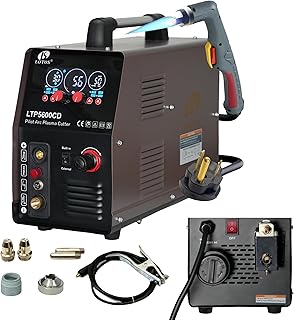
LTP5600CD 56A Drag-Cut
Built around touch-and-go drag cutting, which is the fastest way to learn plasma if you’re coming from a grinder. It rides the tip along the workpiece for consistent standoff, and it powers through rusty sheet up to 5/8″ without a tank in the picture.
YESWELDER CUT-55DS PRO 55A
Non-HF starting plus a rear-mounted air filter makes this the sanest choice for a shop full of sensitive electronics, and the IPT40 torch keeps consumables inexpensive and easy to source. Confirm on the listing whether your specific variant ships with the onboard pump, since this line appears in both configurations.
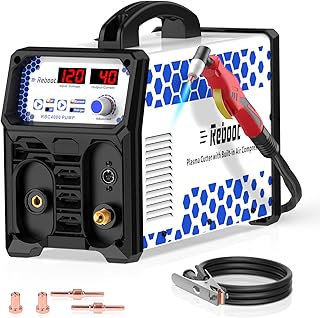
Reboot 40A 120V Plasma Cutter
The entry point: 120V only, 40 amps, and a 3/8″ clean cut with roughly 0.6″ severance, which covers tube frames, brackets, and decorative panel work. Best suited to occasional projects rather than all-day cutting, but hard to beat for a garage with one outlet and no compressor.
Frequently Asked Questions
Does an onboard compressor cut as cleanly as shop air?
On material within the machine’s rated clean-cut range, yes. Push into severance thickness and you’ll notice more dross and a slower travel speed than a big tank delivers, because pressure sags during extended cuts.
What thickness do I actually need for metal furniture?
Most table bases, shelf brackets, and bed frames use 14-gauge to 1/4″ steel. A 3/8″ clean-cut rating gives comfortable headroom for all of it.
Can I run one on a standard household outlet?
120V models generally work on a dedicated 20A circuit. Share that circuit with a shop vac or fridge and you’ll trip the breaker mid-cut.
Do I still need a moisture filter?
Onboard filtration handles most humidity, but in damp climates an inline desiccant filter noticeably extends tip life and reduces edge spatter.
Final Thoughts
For most makers building furniture, the FLARING 240V 45A hits the right mix of cut capacity, arc stability, and simplicity. Step up to the ARCCAPTAIN iControl CUT55 Pro if you want 1/2″ capability and pilot-arc starting for reclaimed steel, or start with the Reboot 40A if a single 120V outlet is all your garage offers.