Key takeaways
- Match diameter to your GPM, not your PSI: A 20-inch head starved of flow just smears water around. Under 2.5 GPM, stick with 14 or 15 inches; above 3.5 GPM, the bigger housings finally earn their keep.
- Check the connector before you click buy: Most residential machines run 1/4-inch quick-connect. Some heavy-duty heads use 3/8-inch, which means an adapter or a swap on your lance — worth knowing on day one instead of mid-project.
- Wheels beat skids on wood: Four casters keep the nozzle bar at a fixed height so you get an even cut across the board face. Skid-style shrouds catch on raised grain and screw heads.
- Look for a stainless or coated housing: Bare stamped steel starts weeping rust into your rinse water by the second season, and rust stains on light decking are a genuine headache to lift.
- Confirm the swivel spins freely by hand: A stiff bearing is the number one failure point on budget heads. Spin the bar before first use; if it hesitates, expect streaking.
Anyone who has spent a Saturday dragging a zero-degree tip across cedar decking knows the aftermath: zebra stripes burned into the boards, fuzzed grain where the water dug too deep, and a nagging suspicion the deck looked better dirty. A wand concentrates all your machine’s energy into a pencil-thin line, which is exactly wrong for a horizontal surface you plan to walk on barefoot. Surface cleaners solve that geometry problem by spinning two or four nozzles under a shrouded housing, spreading the same flow across a wide swath at a consistent height and angle.
This guide sorts through the surface cleaner attachments actually worth bolting onto your machine in 2026, with a bias toward what matters on wood: deck width versus board layout, connector fitting, caster quality, and whether the skirt drags on softwood. I have pulled these apart in my own garage, so the notes below lean practical rather than spec-sheet deep.
Our top picks


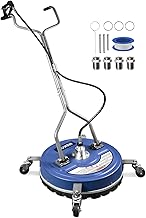


As an Amazon Associate we earn from qualifying purchases at no extra cost to you. Ratings are shown as listed on Amazon.
🛒 Best Price Today on Amazon
Prime members get fast, free shipping on everything above, plus member-only deals. New members get a 30-day free trial — cancel anytime.
How to Choose a Pressure Washer Deck Cleaner (2026)
- Match diameter to your GPM, not your PSI: A 20-inch head starved of flow just smears water around. Under 2.5 GPM, stick with 14 or 15 inches; above 3.5 GPM, the bigger housings finally earn their keep.
- Check the connector before you click buy: Most residential machines run 1/4-inch quick-connect. Some heavy-duty heads use 3/8-inch, which means an adapter or a swap on your lance — worth knowing on day one instead of mid-project.
- Wheels beat skids on wood: Four casters keep the nozzle bar at a fixed height so you get an even cut across the board face. Skid-style shrouds catch on raised grain and screw heads.
- Look for a stainless or coated housing: Bare stamped steel starts weeping rust into your rinse water by the second season, and rust stains on light decking are a genuine headache to lift.
- Confirm the swivel spins freely by hand: A stiff bearing is the number one failure point on budget heads. Spin the bar before first use; if it hesitates, expect streaking.
The Best Pressure Washer Deck Cleaner (2026)s Reviewed
Westinghouse Universal 16.5″ Surface Cleaner
The sweet spot for most homeowners with a mid-tier gas unit: 16.5 inches covers ground quickly without bogging down, and the stainless housing has held up through repeated seasons without staining. The 4400 PSI ceiling means it will not be the weak link in your setup.
LidoDola 14″ Surface Cleaner
A well-thought-out kit for electric washer owners, with two extension wands and spare nozzles included so you are not hunting for replacements after your first hard scrub. The 14-inch footprint tracks nicely between deck railings and around stair stringers.
MEKOH 20″ Heavy-Duty Surface Cleaner
Built for people cleaning large expanses — long driveways, wide patios, big platform decks — with dual handles that give you real control over an otherwise unwieldy head. Verify your 3/8-inch fitting and a genuine 4 GPM before ordering, because this one needs volume to shine.
Hourleey 14″ Surface Cleaner
Straightforward, well-priced, and rated to 4000 PSI, this is the head I would hand someone tackling their first deck restoration. The four-wheel chassis rolls smoothly over composite and pressure-treated pine alike.
Westinghouse Universal 15″ Surface Cleaner
Tuned for the 2000 to 3400 PSI electric and small-gas crowd, which is where a lot of budget heads overreach and disappoint. Slightly narrower than its 16.5-inch sibling, making it more manageable on stairs and tight side yards.
Frequently Asked Questions
Will a surface cleaner damage wood decking?
Far less than a wand, since the pressure is distributed and the nozzle height is fixed. Still, start on a low-visibility board, keep moving at a steady walking pace, and consider a lower-pressure nozzle set for soft cedar or redwood.
Do I need to match the diameter to my washer?
Flow rate matters more than pressure. Divide it simply: roughly 1 GPM per 5 inches of cleaning width is a workable rule of thumb for even results.
Can I use deck cleaning solution through one of these?
Not through the head itself. Apply your cleaner separately with a pump sprayer or downstream injector, let it dwell, then follow with the surface cleaner for the mechanical rinse.
Why is my deck coming out streaky?
Usually a clogged or worn nozzle, or a swivel that has stopped spinning at full speed. Pull the bar, clear both jets with a tip cleaner, and confirm it rotates freely under water.
Final Thoughts
For most decks, the Westinghouse 16.5″ is the safest all-around bet, with the Westinghouse 15″ a better match if you are running an electric machine under 3 GPM. If your project is a sprawling patio-and-driveway combo and you have the flow to feed it, the MEKOH 20″ will cut your afternoon in half.