Our Short List of 3

- Model: MV4560
- Type: Hand pump pressure test kit
- Gauge range: 0 to 30 psi
- System adapters: 4 (bayonet large/small, deep/shallow, GM/Ford threaded)

- Model: 12270
- Type: Hand pump system and cap tester
- Gauge range: 0 to 30 psi, color-coded dial
- System and cap testing: Up to 30 psi
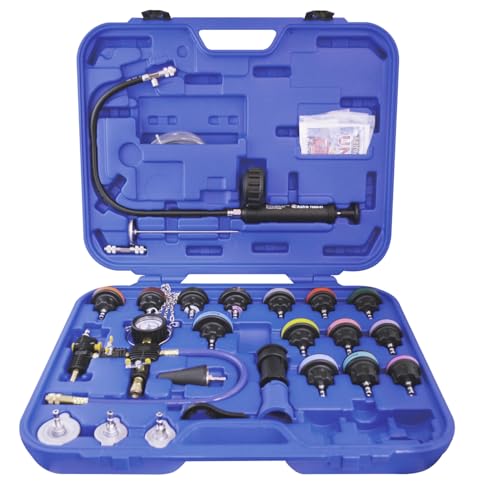
- Model: 78585
- Type: Hand pump pressure tester with vacuum refill tool
- Gauge range: 0 to 35 psi (0 to 2.5 bar)
- Test caps: 17, color-coded
All 5 Picks at a Glance
| Product | Specs | Action |
|---|---|---|
| 1. Mityvac MV4560 Radiator/Cooling System Pressure Test Kit |
| Check price on Amazon |
| 2. Stant 12270 Cooling System and Pressure Cap Tester |
| Check price on Amazon |
| 3. Astro Pneumatic 78585 Universal Radiator Pressure Tester and Vacuum Type Cooling System Kit |
| Check price on Amazon |
 4. Orion Motor Tech Coolant Pressure Tester Kit, 33pc Master |
| Check price on Amazon |
 5. OEMTOOLS 27069 Cooling System Pressure Test Pump |
| Check price on Amazon |
Key takeaways
- Five radiator pressure tester kits compared on adapters, gauge range and cap testing, so you can pressurize a cold system and pinpoint leaks.
Coolant loss is easy to misread. A system can lose a cup of coolant a week through a seeping hose joint or a hairline crack in a plastic tank, yet show nothing on the ground, because the leak only opens under load, then seals again as it cools. A radiator pressure tester removes the guesswork. You fit an adapter in place of the cap, pump the system up by hand with the engine cold, and watch the gauge. If the needle holds, the system is tight. If it falls, coolant is escaping somewhere, and because the system stays pressurized while stationary, you can walk around with a flashlight and find the drip, the hiss or the wet seam.
The five kits below cover the main approaches: a compact kit with just enough adapters for common cars, a classic metal pump tester built around cap testing, two large universal kits with deep adapter sets, and a pump-only option for people who already own adapters. Every kit here works with a hand pump, so none needs shop air.
Disclosure: As an Amazon Associate, we earn from qualifying purchases made through links on this page, at no extra cost to you.
How to Choose a Radiator Pressure Tester Kit
Work on a cold engine, every time. A hot system holds scalding coolant under pressure, and removing the cap can erupt it toward your face and hands. Let the engine cool fully, until the upper hose is soft and cool to the touch, before the cap comes off. Every test here is done cold and static, engine off.
Pump to the number stamped on the cap, never past it. Most passenger car caps fall in the 13 to 18 psi range, printed on the cap itself. That number is your target. Going beyond it can split a tired radiator tank, balloon an old hose or push coolant past seals that were fine at normal pressure. A gauge reading to 30 or 35 psi gives headroom, not an invitation.
Read the needle before you hunt for the leak. At cap pressure, stop pumping and watch. A needle that holds steady for several minutes means the system is sealed; a slow fall means a small leak, a fast drop a big one. Then, with pressure held in the system, listen for hissing at hose joints and look for wetness at the water pump weep hole, radiator end tanks and heater hose fittings. Leaks invisible on an unpressurized engine announce themselves under pressure.
The adapter set decides which cars you can test. Older cars used one common bayonet cap on the radiator itself. Modern cars moved the cap to a plastic expansion tank, and each maker uses its own thread or bayonet size: European, Asian and US tanks all differ. Four adapters cover a narrow slice of common cars; seventeen to twenty-three cover most home garages. Confirm the kit lists an adapter for your exact car before buying, especially a European model with a threaded tank cap.
Check that the kit can test the cap itself. The cap is a relief valve with a spring and two seals, and it wears out. A weak cap vents early, the system runs below its intended pressure, and coolant gets pushed into the overflow on every drive, with no leak anywhere. Cap test adapters clamp the cap to the pump so you can watch whether it holds its stamped pressure. If the system test holds but coolant still vanishes, the cap is the prime suspect, and a kit without cap adapters cannot clear it.
Know what a pressure test cannot see. An internal leak, such as a failing head gasket, may not drip anywhere. Clues come from combining observations: pressure climbing quickly on the gauge with the engine idling, bubbles pulsing in the tester hose, or pressure loss with no external wetness at all. A suspected internal leak still deserves a follow-up check before parts come off.
Separate pressure testing from vacuum filling. Some larger kits add a vacuum purge and refill tool. It uses shop air to pull the drained system into vacuum, prove it holds, then draw fresh coolant in without trapped air pockets. Useful after a coolant change, but a different job from leak hunting, and it needs an air compressor the pump does not. Buy it if you change coolant often; skip it if you only hunt leaks.
The 5 Best Radiator Pressure Tester Kits
1. Mityvac MV4560 Radiator/Cooling System Pressure Test Kit
- Model: MV4560
- Type: Hand pump pressure test kit
- Gauge range: 0 to 30 psi
- System adapters: 4 (bayonet large/small, deep/shallow, GM/Ford threaded)
The MV4560 is the focused option: a hand pump, a gauge calibrated to 30 psi, and six adapters chosen for common cars. Four cooling system adapters cover large and small bayonet filler necks plus a threaded GM and Ford pattern, and two dual-function cap adapters, one for US caps and one for Asian caps, let you test the cap on its own. The gauge face uses colored bands matched to common cap pressures. It will not fit every European tank, but for one or two family cars it answers the questions that matter: does the system hold pressure, and does the cap?
2. Stant 12270 Cooling System and Pressure Cap Tester
- Model: 12270
- Type: Hand pump system and cap tester
- Gauge range: 0 to 30 psi, color-coded dial
- System and cap testing: Up to 30 psi
The 12270 has been a bench standard for decades. The metal hand pump drives a large, color-coded dial that reads to 30 psi, and the tester checks both the cooling system and the pressure cap up to that 30 pound ceiling. It ships with an adapter for standard A-size caps and a spacer for deep filler necks, covering most older radiators with the classic bayonet neck. Late-model cars with threaded expansion tanks need extra adapters sold separately, so owners of newer European cars should look at the bigger kits below. For older vehicles, or anyone who mainly suspects a tired cap, this is the durable, no-nonsense pick.
3. Astro Pneumatic 78585 Universal Radiator Pressure Tester and Vacuum Type Cooling System Kit
- Model: 78585
- Type: Hand pump pressure tester with vacuum refill tool
- Gauge range: 0 to 35 psi (0 to 2.5 bar)
- Test caps: 17, color-coded
The 78585 is the full-service kit. Its pump and gauge read from 0 to 35 psi, and the case holds seventeen color-coded test caps for domestic and import systems, two cap test connectors in blue and black for checking the original cap, a universal adapter, and a temperature gauge. The kit also adds a vacuum purge and refill tool that uses shop air to evacuate the system and draw coolant back in without air locks, a real time saver after a radiator or water pump swap. At 12.5 pounds it is the heaviest kit here, but as one case that tests, verifies caps and refills, it is hard to beat.
4. Orion Motor Tech Coolant Pressure Tester Kit, 33pc Master
- Model: RCP
- Type: Hand pump pressure tester with vacuum purge and refill tool
- Adapters: 22 radiator adapters plus 1 universal adapter
- Pressure gauge range: 0 to 35 psi (0 to 2.5 bar)
Orion Motor Tech takes the opposite route: instead of a handful of chosen adapters, this master kit packs twenty-two radiator adapters plus a universal adapter, covering the threaded and bayonet tanks used by Mercedes-Benz, BMW, Audi, VW, Ford, GM, Toyota, Honda and most other common makes. The hand pump gauge reads 0 to 35 psi, and the kit adds a vacuum purge and refill tool with its own gauge reading down to minus 30 inHg, plus a probe thermometer reading from 32 to 400 degrees F. Adapters are color-coded with molded size markings, and seventeen spare O-rings ride in the case. At 9.28 pounds it stores easily.
5. OEMTOOLS 27069 Cooling System Pressure Test Pump
- Model: 27069
- Type: Hand pressure test pump only
- Gauge range: 4 to 30 psi (maker listing)
- Adapters included: None; works with most adapters sold separately
The 27069 is not a kit at all, and that is its appeal. It is the pump and gauge alone, with a working range the maker lists as 4 to 30 psi, built to connect to adapter collections many mechanics already own. If your shelf already holds adapters from a previous set, another full adapter case buys duplicates. The catch is worth stating plainly: with no adapters in the box, it cannot connect to any car on day one unless you already have them, so first-time buyers should choose a complete kit above instead.
Comparison Table
| Product | Gauge range | Adapters | Cap test | Vacuum refill | Best for |
|---|---|---|---|---|---|
| Mityvac MV4560 | 0 to 30 psi | 4 system, 2 cap | Yes | No | Most home garages |
| Stant 12270 | 0 to 30 psi | A-size adapter, deep-neck spacer | Yes | No | Older cars, cap checks |
| Astro Pneumatic 78585 | 0 to 35 psi | 17 test caps, universal | Yes | Yes | Full service in one case |
| Orion Motor Tech 33pc Master | 0 to 35 psi | 22 plus universal | Yes | Yes | Widest vehicle coverage |
| OEMTOOLS 27069 | 4 to 30 psi | None included | With separate adapter | No | Owners with adapters already |
FAQ
How much pressure should I pump into the cooling system?
Pump to the figure stamped on your cap, which on most cars falls between 13 and 18 psi, and stop there. Extra pressure can damage an old radiator or hose and does not make leaks easier to find.
The needle falls but I cannot see any coolant. What next?
Keep the system pressurized and inspect slowly with a flashlight, checking the water pump weep hole, hose joints and radiator end tanks. Also check the passenger footwell: a heater core leak shows inside the cabin, while an internal leak may show no drip at all, which points toward a head gasket check.
Can a pressure tester tell me if my cap is bad?
Yes, if the kit includes cap test adapters, as the Mityvac, Stant, Astro and Orion kits here do. The cap clamps to the pump, and you watch whether it holds its stamped pressure and vents just above it. A cap that vents early explains coolant loss with a system that tests tight.
Do I need the vacuum refill tool, or is the hand pump enough?
The hand pump alone finds leaks. The vacuum tool earns its place after draining the system, because it pulls air out before filling and draws coolant in without trapped pockets that cause overheating later. It needs an air compressor, so weigh that first.
Why does the manual insist the engine must be cold?
A hot system is a sealed vessel of scalding coolant above its normal boiling point, held in only by the cap. Opening the cap hot releases that pressure instantly and can spray boiling coolant. Cold and depressurized is the only safe state for fitting the tester.
Conclusion
A pressure tester turns coolant loss from a guessing game into a measurement. Choose the Mityvac MV4560 for a compact kit that covers common cars and tests the cap too. Choose the Stant 12270 for a metal, old-school tester centered on bayonet necks and cap checks. The Astro 78585 and the Orion Motor Tech master kit both add deep adapter coverage and vacuum refill tools. The OEMTOOLS 27069 pump suits anyone who already owns adapters. Whichever you pick, work cold, pump only to the cap figure, and let the needle tell you whether to go hunting.
More from Amazon
Programs that pair well with the guide above. Offers and eligibility are set by Amazon and may change.
A free business account with business pricing and bulk-buying tools for work, shop or home office.
Create a business accountFree shipping on eligible items, Prime Video and more. Eligible new members can start with a free trial.
Start a Prime free trialAudiobooks and podcasts to listen to on the go. Eligible new members can start with a free trial.
Try Audible freeAd-free music streaming. Eligible new subscribers can start with a free trial.
Try Music Unlimited freeAs an Amazon Associate we earn from qualifying purchases.