Our Short List of 3

- Type: Hand-pump pressure bleeder
- Tank capacity: 2 qt
- Adapter included: 1100 adapter, 45 mm threaded, for most European master cylinders
- Gauge: Built-in pressure gauge

- Type: Pressure bleeding system
- Reservoir capacity: 1.2 gal (4.5 L)
- Adapters included: 7 master cylinder adapters
- Connections: Quick-change
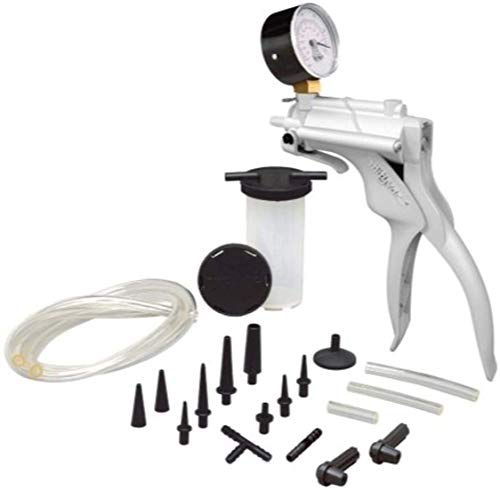
- Type: Hand vacuum pump kit
- Pump: Selectline MV8010, hand-operated
- Max vacuum: 25 inHg (85 kPa)
- Max pressure: 25 psi (172 kPa)
All 5 Picks at a Glance
| Product | Specs | Action |
|---|---|---|
| 1. Motive Products 0100 European Power Brake Bleeder — the pressure tank for European reservoirs |
| Check price on Amazon |
| 2. Mityvac MV6840 Pressure Bleeding System — the multi-car pressure system |
| Check price on Amazon |
| 3. Mityvac MV8000 Automotive Tune-Up and Brake Bleeding Kit — the original hand vacuum kit |
| Check price on Amazon |
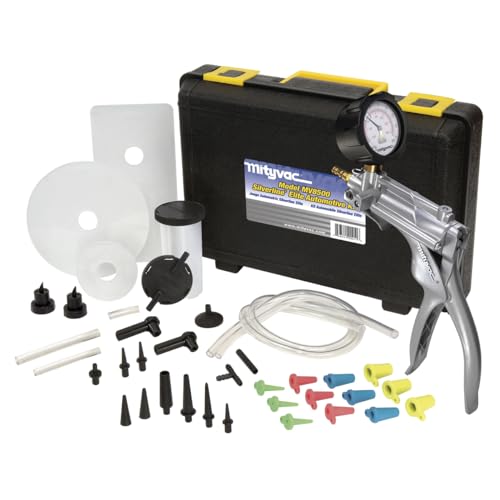 4. Mityvac MV8500 Silverline Elite Automotive Kit — the metal-bodied hand pump kit |
| Check price on Amazon |
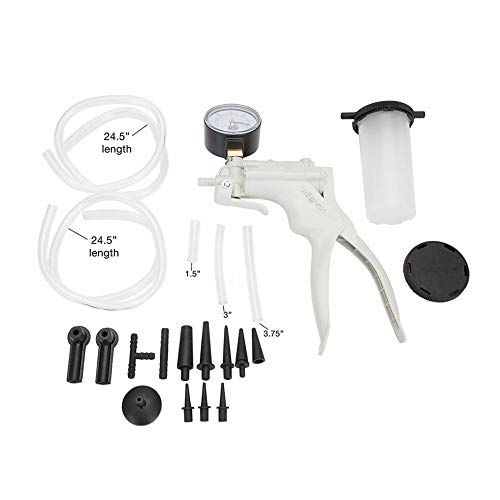 5. OEMTOOLS 25136 Automotive Tune-Up and Brake Bleed Kit — the simple vacuum kit for occasional use |
| Check price on Amazon |
Key takeaways
- Compare five brake bleeder kits for one-person fluid changes: hand vacuum pumps and pressure tanks matched by adapter fit, tank size and bleeding method.
Brake fluid absorbs moisture from the air from the day it is poured in, and old, wet fluid boils sooner, corrodes calipers and wheel cylinders from the inside, and leaves the pedal soft. Changing it means pushing old fluid out through the bleeder screw at each wheel, a job that classically needs one person pumping the pedal and another working the wrench. A brake bleeder kit removes the second person. One family pulls fluid from the wheel end with a hand vacuum pump; the other pushes fresh fluid down from the master cylinder reservoir with a pressurised tank.
This guide is about bleeding hardware only: catch bottles, hoses, reservoir adapters and the pumps that move the fluid. It is a different shelf from vacuum gauges for engine diagnosis, covered in a separate guide on this site. A vacuum gauge reads manifold vacuum to judge engine health; here, a similar hand pump works as a fluid-moving tool, earning its place only in a kit with a sealed catch bottle and bleeder screw adapters.
Disclosure: As an Amazon Associate, we earn from qualifying purchases made through links on this page, at no extra cost to you.
How to Choose a Brake Bleeder Kit
Two families, two directions of flow. A hand vacuum bleeder connects at the bleeder screw and sucks fluid and air out of the caliper into a catch bottle. It is inexpensive, compact, and the pump doubles as a vacuum tester for other jobs. A pressure bleeder works the other way: a hand-pumped tank of fresh fluid seals onto the master cylinder reservoir and pushes fluid through the whole system, so you open each bleeder screw and let clean fluid run until it comes out clear. Pressure bleeding is faster for a full change and cannot pull false air in at the wheel end.
The vacuum method has one classic trap. A vacuum pump draws not only on the fluid column but also on the loose threads of the bleeder screw itself. Open the screw too far and air slips in past the threads, filling the hose with endless small bubbles that look exactly like air leaving the system. The fix is simple: crack the screw open only as far as flow needs, and pack a little brake grease or silicone grease around the threads before connecting the hose. Sealed threads mean the bubbles you see are real.
With a pressure bleeder, the adapter cap is the whole decision. The tank can only push fluid if its cap seals the reservoir neck airtight, and necks differ widely: many European cars use a threaded cap around 45 mm, older American cars often use rectangular reservoirs clamped by a plate and chain, and many modern reservoirs use bayonet lugs. A kit whose adapter does not match your car is a tank you cannot use. Check the adapter list against your reservoir first, and count on a separate adapter for a second car from a different maker.
Follow the wheel order for your car. Bleeding follows the sequence in the service information for the vehicle, usually beginning with the wheel farthest from the master cylinder and working closer, though some cars with diagonal split systems or unusual ABS layouts specify a different order. The kit does not change the sequence; it only changes who has to be there.
Never let the reservoir run dry. The one unforgivable error is emptying the master cylinder mid-job. Air drawn into it turns a one-hour fluid change into a full re-bleed, and on many ABS-equipped cars air trapped in the hydraulic control unit needs a scan tool bleed routine to shift. Vacuum users should pause and top up between wheels; pressure users get this protection free, because the tank feeds fresh fluid continuously.
Handle the fluid with respect. Brake fluid strips paint on contact, so wipe any spill off bodywork at once and keep a rag under every connection. It also pulls moisture from the air, the very reason for changing it: fluid from a bottle opened months ago has already begun absorbing water, so work from a fresh, sealed bottle and never pour caught fluid back in.
The two-person pedal method still exists, and it has a hidden cost. A helper pumping the pedal works with no kit at all, but it is slow, a mistimed wrench stroke sucks air back in, and on an older master cylinder, pushing the pedal to the floor drives the seals across a rough, unused section of bore that can tear them and cause an internal leak soon after. A kit is gentler on old hydraulics as well as quicker.
The 5 Best Brake Bleeder Kits
1. Motive Products 0100 European Power Brake Bleeder — the pressure tank for European reservoirs
- Type: Hand-pump pressure bleeder
- Tank capacity: 2 qt
- Adapter included: 1100 adapter, 45 mm threaded, for most European master cylinders
- Gauge: Built-in pressure gauge
The benchmark one-person bleeder for European cars. Fill the two-quart tank with fresh fluid, pump it up by hand, and the sealed 1100 adapter, a 45 mm threaded cap, locks onto the reservoir necks used by most Audi, BMW, Mercedes, Porsche, Volkswagen, Volvo and Saab models. Pressure feeds fluid through the system while you walk from wheel to wheel opening bleeder screws, with no pedal pumping and no risk of the reservoir emptying. A built-in gauge keeps pressure where it should be. Owners of American or Japanese cars should choose the same tank paired with their reservoir’s adapter rather than forcing this cap to fit.
2. Mityvac MV6840 Pressure Bleeding System — the multi-car pressure system
- Type: Pressure bleeding system
- Reservoir capacity: 1.2 gal (4.5 L)
- Adapters included: 7 master cylinder adapters
- Connections: Quick-change
Where the Motive tank covers one adapter family well, the MV6840 arrives ready for a whole fleet. Its 1.2 gallon reservoir holds enough fluid for complete changes on large vehicles, and seven interchangeable master cylinder adapters cover a wide spread of American, Asian and European reservoirs, swapping through quick-change connections. An integrated pressure relief valve vents excess pressure before it can stress a plastic reservoir, and the outfit packs into a storage case. It is the heaviest kit here, best suited to a home shop that maintains several different cars rather than one.
3. Mityvac MV8000 Automotive Tune-Up and Brake Bleeding Kit — the original hand vacuum kit
- Type: Hand vacuum pump kit
- Pump: Selectline MV8010, hand-operated
- Max vacuum: 25 inHg (85 kPa)
- Max pressure: 25 psi (172 kPa)
The MV8000 is the kit that defined the vacuum method for home mechanics. Its Selectline hand pump, model MV8010, pulls up to 25 inHg of vacuum and can also deliver positive pressure, with a gauge reading 0 to 30 inHg. For bleeding, the pump connects through a 4.5 oz reservoir bottle that catches old fluid before it can reach the pump, and the kit adds tapered adapters and bleed screw adapters for the wheel end. Because the same pump tests vacuum-operated systems all over the car, this is the pick for a driver who wants one tool that bleeds brakes on Saturday and checks a vacuum hose a week later.
4. Mityvac MV8500 Silverline Elite Automotive Kit — the metal-bodied hand pump kit
- Type: Hand vacuum and pressure pump kit
- Pump: MV8510, zinc-aluminum die-cast body
- Fluid reservoir: 4.5 oz
- Uses: Brake and clutch bleeding, diesel fuel priming, vacuum and pressure testing
The MV8500 takes the same vacuum method and builds it around a pump meant to survive decades of shop use. Its MV8510 pump body is zinc-aluminum die cast rather than moulded plastic, and it handles vacuum and pressure work: brake and clutch bleeding, diesel fuel priming and fluid transfer. The kit includes the 4.5 oz fluid reservoir, adapters and hoses, all in a carrying case. Choose it over the MV8000 if the pump will live a hard life in a busy garage; choose the lighter kit if it will hang on a hook between annual fluid changes.
5. OEMTOOLS 25136 Automotive Tune-Up and Brake Bleed Kit — the simple vacuum kit for occasional use
- Type: Hand vacuum pump and brake bleed kit
- Gauge: Vacuum gauge included
- Kit contents: Hand pump, fluid reservoir bottle, adapters and connection tubing
- Uses: One-person brake and clutch bleeding, vacuum testing
The 25136 follows the same layout as the Mityvac vacuum kits, a hand pump with a vacuum gauge, a catch bottle and adapters and tubing, in a lighter, simpler package aimed at the occasional user. It bleeds brakes and clutches one wheel at a time and covers basic vacuum checks between brake jobs. The pump and fittings are built for home duty rather than daily professional work, a fair trade for a tool that may only come out once a year.
Comparison Table
| Product | Method | Reservoir | Adapter coverage | Best for |
|---|---|---|---|---|
| Motive Products 0100 | Pressure tank | 2 qt | One 45 mm threaded European adapter | European cars, full fluid changes |
| Mityvac MV6840 | Pressure system | 1.2 gal | 7 master cylinder adapters | Several different cars, large vehicles |
| Mityvac MV8000 | Hand vacuum | 4.5 oz catch bottle | Bleed screw and tapered adapters | Bleeding plus general vacuum testing |
| Mityvac MV8500 | Hand vacuum | 4.5 oz catch bottle | Bleed screw and tapered adapters | Heavy use, metal pump durability |
| OEMTOOLS 25136 | Hand vacuum | Catch bottle included | Bleed screw adapters | Occasional home use |
FAQ
Is a vacuum bleeder or a pressure bleeder better for a full fluid change?
A pressure bleeder is usually faster and cleaner for a complete change, because it pushes fresh fluid through continuously and keeps the reservoir full by itself. A vacuum kit stores smaller and its pump doubles as a vacuum tester, but it works one wheel at a time and you must keep topping up the reservoir by hand.
Why do bubbles keep appearing in the hose with a vacuum bleeder?
Most endless bubbles are false air leaking in around the bleeder screw threads, not air leaving the system. Open the screw only as far as needed for flow and seal the threads with a smear of brake grease or silicone grease before connecting the hose. Genuine air slows and stops; thread leakage does not.
In what order should I bleed the wheels?
Follow the sequence given for your vehicle in its service information. The common pattern begins with the wheel farthest from the master cylinder and works toward the closest, but diagonal-split and some ABS layouts specify a different order, and the maker’s sequence wins.
Can I bleed an ABS-equipped car with one of these kits?
For a routine fluid change, yes: keep the reservoir full so no air enters, and bleed at the wheels in the specified order. If air has already entered the ABS hydraulic unit, after the reservoir ran dry or a component was replaced, many vehicles need a scan tool routine that cycles the ABS valves, and no hand kit replaces that step.
Can I reuse the fluid caught in the bleeder bottle?
No. Caught fluid is contaminated and exposed to air and moisture, and brake fluid absorbs water quickly. Work from a fresh sealed bottle, dispose of old fluid with other automotive waste, and wipe spills off painted surfaces at once, because the fluid strips paint.
Conclusion
Match the method to your garage. The Motive Products 0100 is the cleanest route to a full fluid change on a European car, and the Mityvac MV6840 extends the same pressure method across many makes with seven adapters and a big reservoir. If you would rather pull from the wheel end, the Mityvac MV8000 remains the balanced hand vacuum kit, the MV8500 rebuilds it around a die-cast pump for hard use, and the OEMTOOLS 25136 covers occasional bleeding in a simpler package. Whichever kit you choose, technique decides the result: seal the bleeder screw threads, follow the maker’s wheel order, and never let the master cylinder run dry.
More from Amazon
Programs that pair well with the guide above. Offers and eligibility are set by Amazon and may change.
A free business account with business pricing and bulk-buying tools for work, shop or home office.
Create a business accountFree shipping on eligible items, Prime Video and more. Eligible new members can start with a free trial.
Start a Prime free trialAudiobooks and podcasts to listen to on the go. Eligible new members can start with a free trial.
Try Audible freeAd-free music streaming. Eligible new subscribers can start with a free trial.
Try Music Unlimited freeAs an Amazon Associate we earn from qualifying purchases.