Our Short List of 3

- Type: Handheld pulse tester with cleaning adapters
- Model: EM276SET
- Power source: 12V vehicle battery
- Pulse modes: 4 (single, 50-pulse, 100-pulse, continuous)

- Type: Handheld pulse tester and cleaner kit, dual channel
- Model: TK-F4
- Pulse modes: 8 (4 signal patterns x 12V/5V drive)
- Injectors per run: 2

- Type: Visual spray pattern and flow tester
- Model: JT200
- Injector support: 6V/12V MPI top-feed; not for GDI
- Simulated speed range: 100 to 9,900 rpm
All 5 Picks at a Glance
| Product | Specs | Action |
|---|---|---|
| 1. allsun EM276SET Fuel Injector Tester and Adapter Kit — the simple pulse tool for one injector at a time |
| Check price on Amazon |
| 2. THIKPO TK-F4 Fuel Injector Tester and Cleaner Tool Kit — two injectors side by side, with a 5V drive |
| Check price on Amazon |
| 3. FOXWELL JT200 Fuel Injector Tester and Cleaner — visual spray and flow checks without a cleaning bath |
| Check price on Amazon |
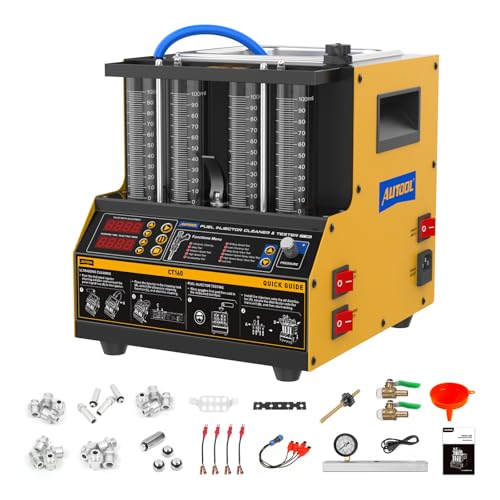 4. AUTOOL CT160 Fuel Injector Cleaner and Tester Machine — the four-injector bench machine for regular shop work |
| Check price on Amazon |
 5. AUTOOL CT500 GDI Fuel Injector Cleaner and Tester — six positions and the drive voltages GDI injectors need |
| Check price on Amazon |
Key takeaways
- Compare five fuel injector testers and cleaners, from battery pulse tools to ultrasonic bench machines with flow tubes, matched by injector type and job.
A rough idle, a misfire under load or fuel use that creeps up for no clear reason often traces back to one injector that flows less than its neighbours, dribbles when it should be shut, or sprays in a lopsided stream instead of a fine cone. A fuel injector tester lets you prove which injector is at fault before spending on parts, and cleaning can often bring a gummed-up injector back to even flow.
The tools here fall into two families. Handheld pulse tools clip onto a vehicle battery and fire one or two removed injectors with timed pulses, so you can hear the click, watch the spray and push aerosol cleaner through the inlet. Bench machines go further: an ultrasonic bath loosens deposits while the injector is pulsed open, then a pressurised rail feeds the set into graduated tubes so you can compare delivered volume injector by injector. Between them sits one visual tester that skips the bath but still measures flow side by side. All five are gasoline tools; none belongs near a diesel common-rail injector.
Disclosure: As an Amazon Associate, we earn from qualifying purchases made through links on this page, at no extra cost to you.
How to Choose a Fuel Injector Tester
Decide how deep the diagnosis needs to go. A pulse tool answers the simple questions: does the injector click, does it spray at all, does cleaner come through evenly? That is enough to find a dead or clogged injector on a weekend project. A bench machine answers the harder question of how much each injector delivers in a fixed time, which you need when the engine runs but one cylinder is clearly weaker than the rest.
Know the four checks that matter. First, coil resistance: measure each injector with a multimeter and compare it against the manual and its siblings, since an outlier points to a failing coil. Second, leakage: held under pressure with no pulse applied, the tip should stay dry. Third, spray shape: a healthy injector makes a fine, even cone, while a dirty one squirts a crooked jet or drips. Fourth, flow balance: run every injector for the same time into separate tubes and compare volumes. A spread of more than a few percent across a set is a real finding, and the one check a basic pulse tool cannot give you.
Match the tool to the injector type. Port injection (PFI) injectors work at modest fuel pressure and usually run on a plain 12V drive, and every tool here handles them. Gasoline direct injection (GDI) injectors work at far higher pressure and many need a raised drive voltage to open fully, so a tool that only offers low-voltage pulses may fire one weakly or not at all. Check the drive voltages a tester offers against what your injectors need.
Cleaning only counts if you retest afterwards. The proof is in the second flow run: volumes should tighten up across the set and spray cones should match. If one injector still lags after two cleaning cycles, it is a replacement candidate, not a candidate for a third bath.
Budget for the small parts. Every removed injector needs fresh O-rings and a new inlet micro filter before it goes back on the rail. Old O-rings harden and leak, and the tiny basket filter traps the debris you just cleaned out. A seal kit for the set costs little and is not optional.
Work safely around fuel. Use the dedicated test fluid the maker specifies for bench work; it is far less volatile than gasoline and will not attack the machine’s tubes and seals. Never fill a bench tester with gasoline. Pulse tools used with aerosol cleaner still demand a ventilated space, no sparks or open flame near, eye protection, and a fire extinguisher within reach. Diesel common-rail injectors run at pressures that can injure skin and need specialist equipment, so they are outside the scope of every tool here.
The 5 Best Fuel Injector Testers
1. allsun EM276SET Fuel Injector Tester and Adapter Kit — the simple pulse tool for one injector at a time
- Type: Handheld pulse tester with cleaning adapters
- Model: EM276SET
- Power source: 12V vehicle battery
- Pulse modes: 4 (single, 50-pulse, 100-pulse, continuous)
The EM276SET is the classic handheld tester most home mechanics meet first. It clips onto a 12V battery, plugs onto a removed injector and fires it in four pulse modes: a single long pulse, a run of 50 pulses, a run of 100 shorter pulses, and a continuous mode for flushing. The mode lock keeps conditions identical from one injector to the next, which matters when comparing spray behaviour across a set by eye. The bundled adapters cap onto a can of injector cleaner so each pulse pushes cleaner through while you watch the tip. It cannot measure volume, but for finding a stuck, leaking or silent injector it covers the groundwork honestly.
2. THIKPO TK-F4 Fuel Injector Tester and Cleaner Tool Kit — two injectors side by side, with a 5V drive
- Type: Handheld pulse tester and cleaner kit, dual channel
- Model: TK-F4
- Pulse modes: 8 (4 signal patterns x 12V/5V drive)
- Injectors per run: 2
The TK-F4 adds a second output channel to the handheld idea, so two injectors can be pulsed together and their sprays compared in the same moment rather than from memory. Its eight pulse modes combine four signal patterns with two drive levels, 12V and a lower 5V setting for injectors that should not be driven at full battery voltage. Eight cleaning adapter sizes cover most port injectors, with dedicated adapters for certain BMW, VW and Audi applications in the box. A 40-inch power cord and 20-inch test leads give enough reach on a bench, and reverse polarity plus short circuit protection guard against wiring mistakes that kill cheap testers. It still cannot put a number on flow, but as a comparison tool it beats single-channel testers.
3. FOXWELL JT200 Fuel Injector Tester and Cleaner — visual spray and flow checks without a cleaning bath
- Type: Visual spray pattern and flow tester
- Model: JT200
- Injector support: 6V/12V MPI top-feed; not for GDI
- Simulated speed range: 100 to 9,900 rpm
The JT200 takes a different route: a small bench unit built around clear graduated cylinders, so you can watch each spray pattern form and read delivered volume instead of guessing from a puddle. It simulates engine speeds from 100 to 9,900 rpm, works with 6V motorcycle and 12V car injectors, and takes traditional top-feed MPI injectors on adapters from 9 to 14.5 mm. Watching the cone is genuinely useful, because a distorted stream or poor atomisation shows up here even when an injector still clicks and flows near the right volume. The limits are clear: no ultrasonic bath, so cleaning is light duty, and the maker states plainly that GDI and diesel injectors are not supported.
4. AUTOOL CT160 Fuel Injector Cleaner and Tester Machine — the four-injector bench machine for regular shop work
- Type: Bench tester and cleaner with ultrasonic bath
- Model: CT160
- Injectors per run: 4
- Ultrasonic power: 70 W at 28 kHz, with heating function
The CT160 is where testing becomes measurement. Four injectors mount on a rail above graduated tubes while a microcomputer controls pressure in a closed loop, and the programme runs through idle, medium and high speed simulations, acceleration and variable speed runs, leakage checks and spray volume comparisons. Before any of that, the heated ultrasonic bath works deposits loose while the injectors are pulsed, and a reverse flush clears debris out the way it came in. Pulse width adjusts in fine 0.1 ms steps and simulated speed runs to 7,500 rpm, so results repeat closely enough to trust a before-and-after comparison. This is the machine a small workshop buys once and uses for years, and the natural pick when flow balance numbers matter more than portability.
5. AUTOOL CT500 GDI Fuel Injector Cleaner and Tester — six positions and the drive voltages GDI injectors need
- Type: Bench tester and cleaner with ultrasonic bath
- Model: CT500
- Injectors per run: 6
- Drive voltages: 12V, 70V, 120V
The CT500 stretches the bench formula to six injectors and adds the feature direct injection work demands: selectable drive voltage. Alongside the usual 12V it offers 70V and 120V settings, because many GDI injectors will not open correctly on a plain 12V pulse, and testing them at the wrong voltage produces misleading flow figures. Fifteen functions cover ultrasonic cleaning, reverse flushing and on-vehicle style cleaning plus the full spread of leakage, spray and volume tests, with pulse width adjustable up to 40 ms. The adapter set is the widest here, running from 11 mm to 15.8 mm fittings with brand-specific cables included. It is a big, heavy unit aimed at workshops that see direct injection engines weekly; for a port-injected project car it is more machine than the job requires.
Comparison Table
| Product | Type | Injectors per run | Flow measurement | GDI support |
|---|---|---|---|---|
| allsun EM276SET | Handheld pulse tool | 1 | No | No |
| THIKPO TK-F4 | Handheld pulse tool, dual channel | 2 | No | Adapters included; 12V/5V drive |
| FOXWELL JT200 | Visual spray and flow tester | 2 | Yes, graduated cylinders | No |
| AUTOOL CT160 | Bench machine, ultrasonic bath | 4 | Yes, graduated tubes | Limited; see maker notes |
| AUTOOL CT500 | Bench machine, ultrasonic bath | 6 | Yes, graduated tubes | Yes, 70V/120V drive |
FAQ
Can a pulse tool tell me which injector flows the least?
Not with a number. A pulse tool shows whether an injector clicks, sprays and passes cleaner, and running two at once lets you spot a visibly weaker spray. To rank a set by volume you need graduated tubes: a visual tester or a bench machine.
Do I have to remove the injectors to test them?
For everything here, yes. These tools work with the injector removed from the rail, which is also what lets you fit fresh O-rings and inlet filters before refitting. On-car cleaning canisters exist, but they clean blind and test nothing.
Can I put gasoline in a bench tester to make results more realistic?
No. Makers specify a dedicated test fluid because gasoline vapour is a fire hazard around electrical equipment and its solvents can damage machine tubes and seals. Test fluid also behaves consistently, so flow comparisons stay repeatable.
Will these tools work on GDI injectors?
Only some. Port injectors run happily on 12V pulses, but many GDI injectors need raised drive voltage, and the FOXWELL JT200 excludes them outright. The CT500 offers 70V and 120V drive settings for that reason.
What should I replace every time injectors come off?
The O-rings at both ends of each injector and the small inlet basket filter inside its top. Reusing hardened O-rings invites fuel leaks, and a clogged inlet filter undoes the cleaning you just did.
Conclusion
Match the tool to the question you are asking. To find the injector that has gone silent or blocked solid, the allsun EM276SET does it for the least fuss, and the THIKPO TK-F4 adds side-by-side comparison and a gentler 5V drive. The FOXWELL JT200 earns its place when you want to see spray shape and read flow without a full bench. For repeatable flow balance figures on port injectors, the AUTOOL CT160 is the workhorse, and the CT500 is the step up for six-cylinder sets and direct injection drive voltages. Whichever you choose, finish properly: retest after cleaning and refit every injector with fresh seals and filters.
More from Amazon
Programs that pair well with the guide above. Offers and eligibility are set by Amazon and may change.
A free business account with business pricing and bulk-buying tools for work, shop or home office.
Create a business accountFree shipping on eligible items, Prime Video and more. Eligible new members can start with a free trial.
Start a Prime free trialAudiobooks and podcasts to listen to on the go. Eligible new members can start with a free trial.
Try Audible freeAd-free music streaming. Eligible new subscribers can start with a free trial.
Try Music Unlimited freeAs an Amazon Associate we earn from qualifying purchases.