Our Top Picks
 Dolphin Automatic Robotic Pool Vacuum CleanerNautilus CC Plus16 x 10 x 16 inches20.8 poundsCheck on Amazon
As an Amazon Associate we earn from qualifying purchases

“Pool vacuum” is an umbrella term for four very different machines, and picking the wrong family is the most common reason owners end up disappointed. A robotic cleaner runs on its own power and filters debris inside its body. A suction-side cleaner borrows power from your pump and sends debris to your filter. A pressure-side cleaner runs off a return line and traps debris in its own bag. A handheld vacuum is a spot tool you guide yourself. The best pool vacuums for your yard depend on your pool type, the debris your trees drop, and how much of the work you want to hand over.
This guide compares one strong, currently sold example of each family, explains how the families differ, and matches each type to the pool and the owner it suits. If you already know you want a robot, the two robotic picks below bracket the choice: one corded and proven, one cordless and newer. If your pool already has the plumbing for a suction or pressure cleaner, those routes can cost less to run than you might expect.
Quick Picks
| Product | Best for | Key spec |
|---|---|---|
| Dolphin Nautilus CC Plus | Inground pools up to 50 ft, set-and-forget weekly cleaning | 2-hour cycle, 60 ft swivel cable, dual top-load filters |
| Aiper Scuba S1 | Cordless cleaning of floor, walls and waterline | 150-minute runtime, pools up to 1,600 sq ft, 4 cleaning modes |
| Polaris Vac-Sweep 360 | Pressure-side cleaning without a booster pump | Runs off a dedicated return line, triple jets, debris bag |
| Hayward Poolvergnuegen 2-Wheel | Suction-side value for pools up to 16 x 32 ft | Self-adjusting turbine vanes, programmed steering |
| Pool Blaster Max | Spot cleaning, steps, spas and above-ground pools | Cordless handheld, up to 1 hour per charge, reusable filter bag |
How to Choose the Best Pool Vacuums for Your Pool
Start with the cleaner family, not the brand
Robots are independent: they carry their own motor and filtration, so they do not wear on your pump or load your main filter, and the better ones scrub as well as vacuum. Suction-side cleaners are the simplest automatic option — your pump pulls them along and debris lands in your filter or a leaf canister — but they add run time to your pump schedule. Pressure-side cleaners push debris into an onboard bag, which keeps your filter cleaner and handles big leaf loads well, though some models need a booster pump. Handhelds clean nothing on their own, but nothing beats them for steps, spas and quick touch-ups between automatic runs.
Match the cleaner to pool type and size
Every cleaner carries a pool-size rating, and it is a hard limit, not a suggestion. A robot rated for pools up to 50 ft cannot cover a 60 ft lap pool, and a suction cleaner sized for a 16 x 32 ft pool will leave the far end of a larger pool dirty. Above-ground pools with soft walls rule out most wall-climbing robots and pressure cleaners; look for floor-only robots or handhelds there. Inground pools open up all four families, but check surface compatibility — most cleaners here suit gunite, fiberglass and vinyl, while wheeled suction models use different tires for delicate surfaces.
Think about your debris, not just your dirt
Fine dust and sand demand fine filtration: robot filter cartridges and your main filter handle it well, while a pressure cleaner’s bag is comparatively coarse. Leaves are the opposite problem — volume matters more than fineness, so a pressure cleaner with a large bag or a robot with a roomy basket wins. Acorns, twigs and seed pods can jam the throat of a suction cleaner, whose intake is only a couple of inches wide. Match the machine to the mess your yard actually makes in its worst month, not its best.
Runtime, cycles and coverage
Corded robots and plumbed cleaners run as long as you let them; a typical robot cycle is about two hours. Cordless robots are limited by the battery — around 150 minutes on the Aiper below — which is plenty for a mid-size pool but tight for a large one that also needs wall and waterline passes. Coverage matters as much as minutes: a cleaner that scrubs walls and the waterline removes the brushing chore, while a floor-only model leaves you the walls with a brush.
Filtration and upkeep
Ask where the debris ends up and how often you will empty it. Robot cartridges and baskets rinse with a hose in a minute or two. Pressure bags need emptying before they drag and tear. Suction cleaners push everything into your pump basket and filter, so heavy debris seasons mean more frequent filter cleaning or backwashing. A leaf canister on the suction hose is a cheap way to keep the worst of it out of the filter.
The Picks in Detail
Dolphin Nautilus CC Plus — the corded robot benchmark
Maytronics’ Nautilus CC Plus is the reference point for plug-in robotic cleaning: a corded robot for inground pools up to 50 ft that vacuums and scrubs floors and walls in a 2-hour cycle, then shuts off. CleverClean navigation scans the pool and steers a systematic pattern rather than wandering, dual scrubbing brushes work on algae film as it goes, and the 60 ft cable has an anti-tangle swivel. Two filter cartridges load from the top, so emptying them does not mean flipping a dripping robot over, and a weekly timer on the power supply can run it every 24, 48 or 72 hours.
- Strength: Independent of your pump and filter, with genuine wall scrubbing and a set-and-forget weekly schedule.
- Trade-off: It cleans floors and walls but does not scrub along the waterline, and the cord needs a poolside outlet within reach.
- Skip it if… your pool is above-ground, longer than 50 ft, or you cannot stand managing a floating cable.
Aiper Scuba S1 — the cordless robot
The Scuba S1 drops the cable entirely. Its battery runs up to 150 minutes per charge, it is rated for inground pools up to 1,600 sq ft, and unlike the Dolphin above it cleans the waterline as well as floors and walls. WavePath Navigation 2.0 plans an efficient route, caterpillar treads keep it planted on drains, steps and corners, and four modes — Auto, Eco, Floor only and Wall only — let you choose a full clean or a light maintenance pass. Eco mode spreads short cleans across the week on one charge. When the battery dies it parks itself at the waterline for retrieval with the included hook.
- Strength: True cordless freedom plus waterline cleaning, with modes that stretch one charge across a week of light upkeep.
- Trade-off: Runtime is a hard ceiling — a big or very dirty pool can need a recharge mid-job — and there is no app control.
- Skip it if… your pool is larger than 1,600 sq ft or you want to start and schedule cleans from your phone.
Polaris Vac-Sweep 360 — pressure-side without the booster pump
Most pressure cleaners need a separate booster pump; the Vac-Sweep 360 is the exception, running off a dedicated return line on your existing pump. Triple jets power it around the pool while it vacuums, sweeps and scrubs, and a tail sweep stirs debris out of corners and steps toward the intake. Everything it collects goes into a single-chamber all-purpose bag, so leaves never reach your filter, and an in-line back-up valve pulls it out of corners when it gets stuck. It suits inground pools of all finishes that have the pressure line plumbed in.
- Strength: Big debris capacity and filter-friendly operation with no booster pump to buy, wire or maintain.
- Trade-off: It only works if your pool has a dedicated pressure return line, and the bag is coarse, so fine silt mostly passes through to the filter.
- Skip it if… your pool lacks a pressure line, or your main problem is fine dust rather than leaves and grit.
Hayward Poolvergnuegen 2-Wheel — the suction-side workhorse

Known to most owners simply as “The Pool Cleaner,” Hayward’s 2-wheel suction model (W3PVS20JST) connects to your skimmer or a suction port and lets your pump do the work. Self-adjusting turbine vanes keep suction strong even when debris passes through, patented tire treads help it climb, and a programmed steering system turns it out of corners and off steps so it covers the whole floor instead of circling one spot. It is sized for inground pools up to 16 x 32 ft, and an adjustable roller skirt keeps suction sealed over drains and uneven plaster.
- Strength: No extra motor, battery or pump — a simple, widely serviced design that runs whenever your pump runs.
- Trade-off: Debris goes to your filter, so heavy leaf fall means more filter maintenance, and large twigs can block its throat.
- Skip it if… your pool is bigger than 16 x 32 ft, or your pump is undersized and already struggles to run the filter.
Pool Blaster Max — the handheld for everything automatic cleaners miss
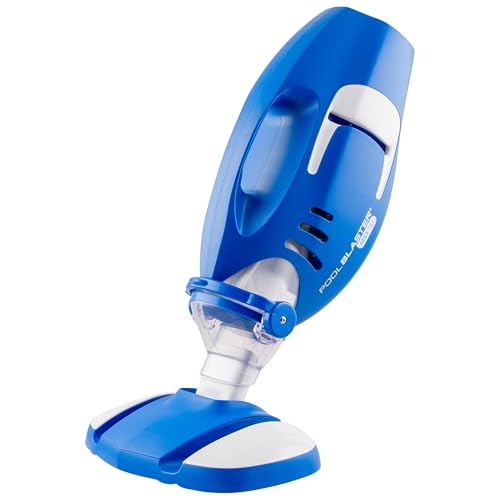
Water Tech’s Pool Blaster Max is a cordless, rechargeable handheld vacuum with its own motor and a reusable filter bag, so it needs no hose, pump or priming. Used by hand it cleans spas, steps, swim-outs and water features; clipped onto a standard telescopic pole (not included) it vacuums the floor of inground and above-ground pools. The wide head and large debris chamber suit it to leaf piles and grit after a storm, and it runs up to an hour on a charge — long enough for a full spot-clean session without dragging out the automatic cleaner.
- Strength: Instant, hoseless spot cleaning anywhere in the pool, from spa corners to the deep-end floor.
- Trade-off: You are the navigation system — it cleans only where you push it, and the pole is sold separately.
- Skip it if… you want the whole pool cleaned while you do something else; pair it with an automatic cleaner instead.
Which One Fits Your Situation
A leafy inground pool under big trees
Choose the Polaris Vac-Sweep 360 if you have a pressure line, or the Dolphin Nautilus CC Plus if you do not. Both keep leaf volume out of your main filter, which is the real battle in autumn.
A mid-size inground pool and a busy owner
The Aiper Scuba S1 fits: drop it in, let Eco mode maintain the pool across the week, and run Auto mode before guests arrive. No cable to coil, no plumbing to check.
A smaller inground pool on a value budget
The Hayward Poolvergnuegen 2-Wheel is the economical route to automatic cleaning — your existing pump is the engine, and parts and service are available everywhere pool supplies are sold.
An above-ground pool, spa or swim spa
The Pool Blaster Max is the practical pick. Most automatic cleaners are built for inground pools, while the handheld works in any body of water you can reach with a pole.
Fine dust, sand and pollen country
Prioritize filtration fineness: the Dolphin’s cartridges (with optional ultra-fine panels) or the Scuba S1’s filter box, emptied and rinsed often. A pressure bag alone will not catch the finest material.
Common Mistakes
- Buying by brand before checking the cleaner family works with your pool’s plumbing and surface.
- Oversizing or undersizing: ignoring the manufacturer’s pool length or square-foot rating.
- Running a suction cleaner without a leaf canister in leaf season, then blaming the cleaner for a clogged filter.
- Leaving a cordless robot in the pool all week, which shortens battery and seal life; most makers say to store it out of the water.
- Judging a cleaner on day one with a green, neglected pool — no domestic cleaner is a substitute for shocking and brushing an algae outbreak first.
- Forgetting the waterline: floor-only cleaners still leave you a weekly brushing job at the tile line.
FAQ
What is the difference between a pool vacuum and a robotic pool cleaner?
A robotic cleaner is one kind of pool vacuum — self-powered, with its own motor and filter. “Pool vacuum” also covers suction-side and pressure-side cleaners powered by your pool’s plumbing, and handheld vacuums you guide yourself. All of them vacuum; they differ in where the power and the debris end up.
Can one cleaner handle both an inground pool and a spa?
Automatic cleaners are sized and shaped for one pool, and most cannot climb into a raised spa. The common setup is an automatic cleaner for the pool plus a handheld like the Pool Blaster Max for the spa, steps and water features.
How often should a pool be vacuumed?
For most home pools, one full automatic cycle two or three times a week in swim season keeps up with normal debris, with extra runs after storms or heavy use. Cordless robots with an eco mode spread that work into shorter, more frequent passes instead.
Do suction and pressure cleaners raise running costs?
They run on your existing pump, so they add pump hours rather than a separate motor’s draw — a pressure cleaner with a booster pump adds the most. Robots run on a small power supply of their own and let the main pump stay on its normal, shorter filtration schedule.
Will a pool vacuum pick up algae?
Cleaners remove loose algae and the dirt it feeds on, and scrubbing robots loosen light film from walls and floors. A full algae bloom is a water-chemistry problem first: balance and shock the water, brush, then let the cleaner collect the fallout.
More from Amazon
Programs that pair well with the guide above. Offers and eligibility are set by Amazon and may change.
A free business account with business pricing and bulk-buying tools for work, shop or home office.
Create a business accountFree shipping on eligible items, Prime Video and more. Eligible new members can start with a free trial.
Start a Prime free trialAudiobooks and podcasts to listen to on the go. Eligible new members can start with a free trial.
Try Audible freeAd-free music streaming. Eligible new subscribers can start with a free trial.
Try Music Unlimited freeAs an Amazon Associate we earn from qualifying purchases.