Key takeaways
- Discover the best twin window fans for cooler rooms and fresher air. Learn how reversible airflow, thermostats, remotes, and window fit compare.
As an Amazon Associate, we earn from qualifying purchases made through links in this article.
A twin window fan is one of the simplest ways to change the air in a room without installing anything permanent. Two fans sit side by side in a single window unit, and together they move far more air than a single fan of the same size. On a mild evening, a twin window fan can pull cool outdoor air inside while pushing warm, stale air out.
That simple idea is why twin window fans remain popular in bedrooms, kitchens, home offices, dorm rooms, and rental apartments. They cost little to run, need no ductwork, and can be installed and removed in minutes. But not every twin window fan is built the same way. Some reverse airflow with the press of a button, while others have to be turned around in the window by hand. Some include a thermostat that switches the fan on and off as the room warms and cools. Some come with a remote control, expandable side panels, or detachable feet so the same unit can stand on a table.
This guide explains how twin window fans work, what to look for before buying, and how to get the best results from one. Our verified pick below is a current twin window fan listing on Amazon, chosen because its listing confirms the key features that matter most: reversible airflow, multiple speeds, thermostat control, and a wide expandable fit.
Quick Comparison
| Pick | Fan Size | Speeds | Airflow Modes | Thermostat | Remote | Window Fit |
|---|---|---|---|---|---|---|
| shinic 9-Inch Twin Window Fan | Two 9-inch fans | 3 | Intake, Exhaust, Circulate | Yes | Yes | 23.8 to 37 inches |
Our Verified Pick
1. shinic 9-Inch Twin Window Fan with Remote — Best Overall Twin Window Fan

ASIN: B0DYNFNG1V — Verification: search-only
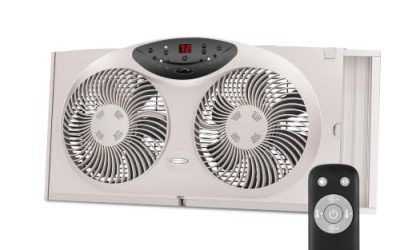
The shinic 9-inch twin window fan is our pick for the best twin window fan because its listing covers the full set of features that make a twin fan genuinely useful, rather than just one or two of them. It combines two 9-inch fans in a single housing with three speeds, three airflow modes, a programmable thermostat, an LED display, and a remote control. That combination suits the most common use case for a twin window fan: cooling a bedroom or living room in the evening and keeping the air moving through the night.
The three airflow modes are the heart of this fan. Intake mode draws fresh outdoor air into the room, exhaust mode pushes warm indoor air outside, and circulate mode exchanges air in both directions at the same time. Many basic twin fans offer only intake and exhaust, and some require the whole unit to be turned around in the window to switch between them. Here, the reversible airflow is built into the fan itself, so changing direction is a control setting rather than a physical chore.
Three speeds — low, medium, and high — let you balance airflow against noise. Low speed suits sleeping, when a gentle flow of air and a soft background hum are enough. Medium speed works for daytime use in a home office or living room. High speed is for clearing out a hot room quickly, for example after cooking or when the sun has been shining through the windows all afternoon. The thermostat adds a further layer of control: according to the listing, it can be set between 60 and 85 degrees Fahrenheit, and the fan switches on and off automatically to hold the room near the chosen temperature. An LED display shows the current setting clearly, so you can check it at a glance without guessing.
The remote control is a practical addition rather than a luxury. A window fan is usually mounted across the room from the bed or the sofa, and the remote lets you change speed or mode without getting up. The unit also includes detachable standing feet and a built-in carry handle, so it can be used freestanding on a table or desk when a window is not available or not suitable. A foam seal strip is included in the box to help close gaps around the unit once it is installed.
Window fit is one of the most common reasons a window fan gets returned, and this model addresses it with an expandable width of 23.8 to 37 inches. That range covers many standard double-hung, vertical slider, and casement windows. Before ordering, measure the width of your window opening and compare it with that range, allowing for the accordion extender panels that fill the space on either side of the fan housing. The listing states an 80-watt power draw on a standard 120-volt plug-in connection, six blades, and ETL listing for safety certification. The model number is BP6-9D, and the unit is sold by HARMOS Home Appliance with shipping from Amazon.
What Is a Twin Window Fan?
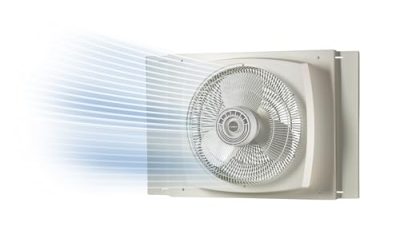
A twin window fan is a window-mounted fan with two fan blades or two fan heads in one housing. The two fans usually sit side by side and can often be controlled together or, on some models, independently. The housing includes expandable side panels that fill the window opening around the fan, so outdoor air passes through the fan blades rather than leaking around the edges of the unit.
Twin window fans also differ from box fans and tower fans in an important way. A box fan sits inside the room and recirculates the air that is already there. A window fan sits in the boundary between indoors and outdoors and actually moves air across that boundary. That is why a window fan can lower the temperature of a room in the evening while a box fan can only make the same warm air feel cooler against the skin.
How to Choose the Best Twin Window Fan
Measure Your Window First
Window fit should be the first check, before speeds, remotes, or thermostats. Measure the width of the window opening where the fan will sit, and check the fan’s stated fit range. A fan that is too narrow for the opening will leave gaps, and gaps let air bypass the fan and reduce its effect. A fan that is too wide simply will not fit. Expandable accordion panels help, but they can only stretch so far. Also check the height of the opening: most twin window fans are designed for double-hung and slider windows, and a very short opening may not accommodate the housing. If you rent, check whether your lease or building rules restrict window installations, and keep the original packaging so the fan can be removed and stored without damage.
Reversible Airflow and Operating Modes
Reversible airflow is the feature that separates a good twin window fan from a basic one. Intake mode brings outdoor air in, exhaust mode sends indoor air out, and circulate or exchange mode does both at once. Electronic reversing, controlled by a button or remote, is more convenient than manual reversing, which requires turning the whole unit around in the window. When comparing models, check whether each fan in the pair can be set independently, because independent control allows one side to intake while the other exhausts. Also look at how the modes are labelled on the controls: clear labels matter when you are adjusting the fan in the dark.
Speed Settings
Three speeds are the standard for twin window fans, usually labelled low, medium, and high. Two-speed models exist and can be fine for small rooms, but three speeds give more room to find a setting that moves enough air without being distracting. Speed also affects noise: a fan on high will always be audible, so the low setting is the one that matters most for bedrooms.
Thermostat Control
A programmable thermostat turns a window fan from a manual appliance into something closer to automatic climate control. You set a target temperature, and the fan runs when the room is warmer than that target and stops when the room cools down. This is most useful overnight: the fan can run while the evening air is cool and switch itself off in the early hours when the room has cooled enough. Without a thermostat, you either leave the fan running all night or wake up to switch it off. Check the thermostat range on the listing — a range that starts around 60 degrees and reaches into the mid-80s covers normal indoor conditions — and check whether the display shows the current room temperature or only the set point.
Remote Control and Ease of Use
A remote control is worth having when the fan is mounted in a window across the room from where you sit or sleep. The best remotes control power, speed, and mode, so you never need to reach the unit itself. Button controls on the unit should be large enough to use without looking closely, and an LED display should be readable from a few steps away. Some displays can be dimmed, which is a small detail that matters a lot in a dark bedroom. A carry handle and detachable feet add versatility, letting the same fan serve as a table fan when needed.
How to Install a Twin Window Fan
Installing a twin window fan is usually a ten-minute job that needs no tools, but a careful installation performs noticeably better than a rushed one.
First, choose the right window. A window on the shaded side of the house is better for intake in the afternoon, while a window that catches the evening breeze works well for night cooling. For whole-home airflow, place the fan in one room and open a window in a room on the opposite side of the house so air can travel through.
Second, clean the window track and sill before fitting the fan. Dust and grit in the track can stop the sash from closing firmly against the top of the unit, leaving a gap.
Third, set the fan in the opening with the controls facing into the room, extend the accordion panels to fill the width, and lower the sash until it rests snugly on top of the housing. Use the included foam seal strip to close any remaining gaps around the edges. The sash and the seal are what force air to travel through the fan blades instead of around them.
Fourth, plug the fan in and test each mode before you need it. Run intake, exhaust, and circulate in turn, and check that the panels stay in place and the unit does not vibrate against the frame. If the fan rattles, the sash is usually not pressing firmly enough on the housing, or the unit is sitting slightly unevenly in the track. In rain, a fan with water-resistant motors is safer, and any window fan should be removed or protected during heavy storms. When the season ends, remove the fan, clean the blades and grille, and store it indoors.
Getting the Most Out of a Twin Window Fan
Night Cooling
The most effective use of a twin window fan is night cooling. After sunset, outdoor air is usually cooler than indoor air, which has absorbed heat all day. Set the fan to intake or circulate in the early evening, open a window in another room so air has somewhere to go, and let the fan draw the cool air through the house. A thermostat can switch the fan off once the room reaches the set temperature, so the room is cool by bedtime without running the fan all night.
Cross-Ventilation
A single window fan can only do so much on its own. It works best as part of a cross-ventilation path: air enters through one window and leaves through another. If the fan is set to intake, open a window across the house so the incoming air can push warm air out. If the fan is set to exhaust, open a window in the room you want to cool so fresh air is drawn in to replace the exhausted air.
Using the Fan as a Table Fan
Some twin window fans, including our pick, come with detachable feet that allow tabletop use. This is useful in rooms where the windows do not suit a window fan, or when you want direct airflow at a desk. On a table, circulate mode works well because there is no window to exchange air through. Keep the fan stable on a flat surface, keep the cord away from walkways, and keep the grille clear of curtains, papers, and other light objects that could be drawn toward the blades.
Care and Maintenance
A twin window fan needs little maintenance, but a small amount of regular care keeps it running quietly and efficiently. Dust the blades and grille every few weeks during the season, because a layer of dust on the blades reduces airflow and can make the fan noisier. A soft brush or a vacuum with a brush attachment works well, and a removable grille makes the job much easier. Check the accordion panels and foam seal at the start of each season: foam compresses over time and may need replacing to keep the seal tight. At the end of the warm season, remove the fan from the window, clean it thoroughly, and store it indoors in a dry place. Leaving a window fan in place through winter wastes heat and exposes the motor to cold and damp.
Frequently Asked Questions
Are twin window fans better than single window fans?
For most rooms, yes. Two fans move more air than one fan of the same size, and they make exchange mode possible, where one fan draws air in while the other pushes air out. A single window fan can still be a good choice for a very small room or a narrow window that cannot fit a twin unit, but for a standard bedroom or living room, a twin fan is the more capable option.
What size window does a twin window fan fit?
It depends on the model. Our verified pick fits windows from 23.8 to 37 inches wide, which covers many standard double-hung and slider windows. Always measure your own window opening before ordering and compare the measurement with the fit range stated on the listing, including whether the range accounts for the expandable side panels.
Can a twin window fan cool a room on a hot day?
Only if the outdoor air is cooler than the indoor air. A window fan moves air; it does not create cold air. In the evening, at night, and in the early morning, outdoor air is usually cooler, and a twin fan can bring that cooler air inside very effectively. In the middle of a hot afternoon with the windows closed, a window fan cannot lower the room temperature, and air conditioning is the right tool for that job.
Should the fan blow in or out?
It depends on the time of day and what you want to achieve. Blow in when the outdoor air is cooler than the indoor air, typically in the evening and overnight. Blow out when the indoor air is warmer or stuffier than the outdoor air, for example after cooking or when the house has heated up during the day. Circulate mode, where one fan blows in and the other blows out, is a good general setting when you want a continuous exchange of air.
Do twin window fans use much electricity?
Compared with air conditioning, no. A twin window fan typically draws well under one hundred watts — our pick is listed at 80 watts — which is a small fraction of what a room air conditioner uses. Running a window fan for night cooling is one of the lowest-cost ways to improve comfort in mild weather, and a thermostat can reduce running time further by switching the fan off once the room reaches the target temperature.
Can I leave a twin window fan in the window all year?
You can, but it is not ideal. A fan left in the window through winter lets cold air leak in around the housing and panels, and the motor is exposed to cold and damp. It is better to remove the fan at the end of the warm season, clean it, and store it indoors. Reinstalling it takes only a few minutes when warm weather returns.
Conclusion
The best twin window fans share a short list of qualities: they fit the window properly, they reverse airflow without a struggle, they offer enough speeds to be useful in both the daytime and the night, and they include the controls — a thermostat and a remote — that make them easy to live with. Our verified pick, the shinic 9-inch twin window fan, covers all of those points on its listing, with three speeds, three airflow modes, thermostat control from 60 to 85 degrees Fahrenheit, a remote, and an expandable fit for windows from 23.8 to 37 inches wide.
Before you buy any twin window fan, measure your window, decide whether you need intake, exhaust, or both, and check the listing for the features that match how you will actually use it. Installed well and used at the right time of day, a twin window fan is a simple, low-cost way to keep a room feeling fresh and comfortable through the warm months.
More from Amazon
Programs that pair well with the guide above. Offers and eligibility are set by Amazon and may change.
A free business account with business pricing and bulk-buying tools for work, shop or home office.
Create a business accountFree shipping on eligible items, Prime Video and more. Eligible new members can start with a free trial.
Start a Prime free trialAudiobooks and podcasts to listen to on the go. Eligible new members can start with a free trial.
Try Audible freeAd-free music streaming. Eligible new subscribers can start with a free trial.
Try Music Unlimited freeAs an Amazon Associate we earn from qualifying purchases.