Key takeaways
- Five office chairs built for long daily sitting, compared on seat endurance, lumbar support types, and the adjustments that still matter after hour six.
Sitting for eight, ten, or twelve hours a day exposes weaknesses that a quick showroom sit never reveals. A cushion that feels plush at minute five can pack down by month six, and a backrest that seems supportive in the morning may leave your lower back aching before dinner. The chairs below were chosen for people who genuinely sit a lot: remote workers, students, writers, and anyone whose desk is where the day happens.


Each pick is a true office chair with the hardware long days demand: a seat that holds its shape or suspends your weight, lumbar support you can position or that adapts on its own, and adjustments for seat depth, armrests, and recline tension. They span mesh and cushioned designs at several sizes and capacities, so there is a realistic option whether you are petite, tall, or simply tired of replacing a worn-out chair every couple of years.
Quick Picks
As an Amazon Associate we earn from qualifying purchases.
| Product | Best for | Key spec from title |
|---|---|---|
| Hbada E3 Air Ergonomic Office Chair | Larger sitters who want wrap-around support | 3-zone dynamic lumbar support |
| SIHOO M57 Ergonomic Mesh Office Chair | All-mesh comfort that cannot flatten | 330 lb capacity, full mesh seat and back |
| HON Ignition 2.0 Mid Back Task Chair | Upright workers in compact spaces | Advanced synchro-tilt control |
| Nouhaus Ergo3D Ergonomic Office Chair | Restless sitters on hard floors | 135-degree recline, dynamic lumbar support |
| SIHOO Doro C300 Ergonomic Office Chair | Set-and-forget automatic support | Self-adaptive lumbar support |
How to Choose
Start With the Seat, Not the Backrest
By hour six, the seat matters more than anything behind you. Dense molded foam keeps its shape for years, while thin padding over a hard pan compresses and leaves you sitting on the frame. A full-mesh seat takes the opposite approach, suspending your weight so there is no foam to flatten, though some sitters find the hammock feel too firm. Look for a waterfall front edge that does not press behind your knees, and check the seat width and depth against your body: a pan that is too deep forces you to perch forward, away from the backrest.
Match the Lumbar Support to Your Back
Lumbar support comes in three broad styles, and the right one depends on how much you move. A fixed curve built into the backrest suits people who sit in one steady posture. An adjustable pad that slides up, down, and in or out lets you place pressure exactly at your belt line, which matters because lumbar curves sit at different heights on different bodies. Dynamic systems flex or track your spine as you shift and recline, so support does not vanish when you lean back to think. Whichever style you choose, support that misses your lower back is decoration.
Prioritize the Adjustments You Will Actually Use
A long spec sheet means little if the controls you need are missing. Seat depth adjustment is the quiet essential: it leaves two or three fingers of space behind your knees while keeping your back against the lumbar support. Armrests that move in three or four directions let your shoulders drop instead of hunching toward your ears. Tilt tension matched to your weight, plus a lock that holds a slight recline, encourages the small posture changes that keep stiffness away. A headrest only earns its place if it adjusts in height and angle to meet your neck when you lean back.
Check Fit, Capacity, and Your Floor
Before ordering, measure your desk height and compare it with the chair’s seat height range; your feet should rest flat with your elbows near desk level. Respect the stated weight capacity, and treat it as a durability signal as much as a safety limit, since chairs run near their maximum tend to wear cylinders and mechanisms faster. If your home office has hardwood or laminate, look for soft casters or a model that bundles rollerblade-style wheels, which roll quietly and spare the finish. Finally, check the chair’s overall footprint so the base and reclined back clear your wall and shelving.
The 5 Best Options
Hbada E3 Air Ergonomic Office Chair
The Hbada E3 Air Ergonomic Office Chair is built around its three-zone lumbar system, which adjusts in height and depth and adds rotating side wings that wrap the waist as you shift. That suits sitters whose back pain moves around during the day. The seat and back are breathable mesh, so long sessions in a warm room stay comfortable, and the headrest and armrests both adjust in three directions to match your posture at the desk or in a recline. It is also one of the roomier picks here, with a wide frame and a high weight rating for larger sitters.
Specs
- 3-zone dynamic lumbar support with height and depth adjustment
- 3D adjustable headrest and 3D adjustable armrests
- Breathable mesh seat and backrest
- Recline up to 140 degrees
- Maximum weight capacity: 330 lb
- SGS Class 4 gas lift cylinder
Best for: Larger sitters who want lumbar support that wraps around and adjusts in several directions.
Watch out for: The mesh seat has a firmer, suspended feel than a thick foam cushion, and the wide frame needs a roomy desk setup.
ASIN: B0CQ4J5NGW
SIHOO M57 Ergonomic Mesh Office Chair
The SIHOO M57 Ergonomic Mesh Office Chair takes the classic all-mesh route: both the seat and the high back are suspended mesh, so there is no foam to pack down over years of daily use and no heat buildup during summer afternoons. Its lumbar pad adjusts in height and depth with a knob you can fine-tune while seated, and the headrest lifts and tilts to support your neck during recline breaks. Three-way armrests and a three-position tilt lock round out a practical package for people who want proven, simple mechanics at a home office desk.
Specs
- Full mesh seat and high backrest
- Lumbar support adjustable in height and depth
- 3D adjustable armrests: height, forward and back, pivot
- Headrest lifts up to 3.9 in and tilts 45 degrees
- Recline up to 126 degrees with three lock positions
- Seat height adjusts from 18.11 to 21.65 in
- Maximum weight capacity: 330 lb
- Aluminum alloy five-star base
Best for: Warm rooms and foam skeptics who want a seat that cannot flatten over time.
Watch out for: The minimum seat height is on the taller side, so shorter sitters may need a footrest to keep their feet flat.
ASIN: B07BDFW1Y7
HON Ignition 2.0 Mid Back Task Chair
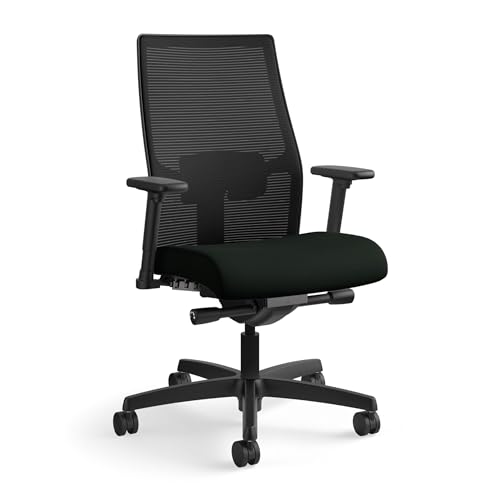
The HON Ignition 2.0 Mid Back Task Chair comes from a contract-furniture maker that equips full offices, and it shows in the mechanism: an advanced synchro-tilt lets the backrest and seat move in a natural ratio as you recline, which keeps your feet planted and your eyes on the screen. The mesh back breathes through long afternoons, the lumbar support adjusts to your belt line, and the arms move in height and width to fit different shoulder breadths. It skips a headrest, so it suits people who work upright and change position often rather than leaning back for long stretches.
Specs
- Advanced synchro-tilt control
- Adjustable lumbar support
- Height and width adjustable arms
- Mesh backrest
- Maximum weight recommendation: 300 lb
- Overall dimensions: 24.75 x 27 x 43.5 in
- Seat depth: 18.75 in
Best for: Upright workers who recline in short bursts and want an office-grade mechanism feel.
Watch out for: There is no headrest, and the arms adjust in height and width only, so forearm angle takes more care to dial in.
ASIN: B06Y3PGPR2
Nouhaus Ergo3D Ergonomic Office Chair

The Nouhaus Ergo3D Ergonomic Office Chair uses a springy elastomer mesh for both seat and back, and its lumbar zone is dynamic rather than dialed in: it flexes and follows as you shift, lean, or twist toward a second monitor. That suits restless sitters who change posture every few minutes and do not want to keep readjusting a pad. The armrests move in four directions, the headrest adjusts in height and angle, and the chair reclines to 135 degrees with a lock at any point. A spare set of blade wheels is included for hard floors.
Specs
- HD ElastoMesh seat, back, and headrest
- 4D armrests: height, depth, width, and pivot
- Dynamic lumbar support that reacts to your movement
- 2D adjustable headrest with tilt
- Recline up to 135 degrees with recline lock
- Class 4 heavy-duty hydraulic gas lift
- ADC12 aluminum five-point base with blade wheels
- Maximum load: 275 lb; recommended for heights from 5 ft 4 in to 6 ft 1 in
- Seat depth: 16.3 in
Best for: Fidgety sitters on hard floors who move constantly and want support that follows them.
Watch out for: The 275 lb capacity and 16.3 in seat depth run small, so tall or larger sitters should look at the Hbada or SIHOO picks instead.
ASIN: B07L4ZQMDX
SIHOO Doro C300 Ergonomic Office Chair

The SIHOO Doro C300 Ergonomic Office Chair is the set-and-forget option: its self-adaptive lumbar support tracks your lower back automatically as you sit down, shift, and recline, with no knobs to fuss over. A flexible triangular frame lets the mesh back follow side-to-side movement, and the weight-sensing mechanism balances the recline tension to your body instead of asking you to crank a dial. The backrest height adjusts in four steps to place support correctly for different torso lengths, and the coordinated armrests swing with the backrest as you lean back for a call or a breather.
Specs
- Self-adaptive dynamic lumbar support
- Flexible triangular frame with breathable mesh back
- Ultra-soft 3D coordinated armrests
- Intelligent weight-sensing recline mechanism
- Recline positions at 110, 120, and 130 degrees
- Backrest height adjustable across 4 levels, 2.36 in range
- Adjustable headrest
- Supports up to 330 lb (150 kg)
Best for: People who never adjust their chair and want support that sets itself.
Watch out for: The automatic lumbar cannot be fine-tuned manually, so sitters who like a very firm, fixed push may prefer the M57.
ASIN: B0C3T865C2
Which One Fits Your Situation
You Sit Ten Hours or More and Run Warm
Choose a full-mesh chair and skip foam entirely. The SIHOO M57 and Hbada E3 Air suspend both seat and back in mesh, so air keeps moving and there is no cushion to trap heat or flatten by evening. The Doro C300 adds a self-adaptive lumbar zone if you dislike making adjustments. Pair any of them with short standing breaks; even the best mesh seat rewards a posture change every hour.
Your Lower Back Aches by Mid-Afternoon
Prioritize lumbar support you can place precisely. The Hbada E3 Air adjusts in height and depth and adds wrap-around wings, while the SIHOO M57 uses a knob to set how firmly its pad pushes. Set the support at your belt line, sit fully back so your pelvis stays in contact, and use a slight recline rather than perching upright all day. If pain persists, treat the chair as one part of the fix and adjust your screen height too.
You Are Tall, Broad, or Heavier Than Average
Start with capacity and seat dimensions, not brand names. The Hbada E3 Air is a big-and-tall design rated to 330 lb with a wide seat, and the SIHOO M57 matches that rating with a 20-inch-wide mesh pan. Check seat depth against your thigh length so the edge does not dig in, and confirm the seat height range lets your feet rest flat. The Nouhaus Ergo3D, at 275 lb with a shallower seat, is the one to skip in this group.
Your Office Is a Corner of a Small Room
The HON Ignition 2.0 mid back is the tidy fit here: a moderate footprint, no headrest poking above your desk line on camera, and arms that narrow in width to slide under most desks. Its synchro-tilt still supports a full workday, and the mesh back keeps a small, sun-warmed room from feeling stuffy. Measure your knee space and the reclined depth before ordering, since even compact chairs lean back farther than new owners expect.
Common Mistakes
- Buying for the first five minutes: showroom-plush foam often packs down within months, so judge a seat by its density, suspension design, and build rather than first impressions.
- Setting the seat too high or too deep, then blaming the backrest when your legs ache and you slide forward, out of the lumbar support.
- Cranking the lumbar pad to maximum firmness; support should fill the curve of your lower back, not shove it forward.
- Locking the chair bolt upright all day; a slight recline with matched tension spreads the load and invites small, healthy movements.
- Ignoring the floor: hard casters on hardwood grind the finish and resist rolling, which quietly discourages the position changes your body needs.
Frequently Asked Questions
Is mesh or foam better for sitting all day?
Neither wins outright. Mesh suspends your weight, breathes in warm rooms, and cannot pack down, but it feels firmer and its frame edges matter. Dense foam feels plusher and spreads pressure evenly at first, yet low-density padding flattens with daily use. For very long days, high-quality versions of either beat a cheap version of the other.
How long should a good office chair last with daily use?
A chair used eight to ten hours a day should give you years of service if its cylinder, mechanism, and seat are built for that load. Contract-grade models like the HON carry long warranties because offices run them hard. Budget mesh chairs typically show wear sooner in arm pads and tilt locks. Rotating the chair out for breaks and keeping casters clean extends any chair’s life.
Do I need a headrest if I sit all day?
Only if you actually recline. A headrest does its work when you lean back for calls, reading, or thinking, and it must adjust in height and angle to meet your neck rather than push your head forward. If you work upright at a keyboard nearly all day, a well-shaped backrest and correct lumbar placement matter far more than a headrest you rarely touch.
What seat height and depth should I look for?
Your feet should rest flat on the floor with your knees at roughly a right angle, and the seat edge should leave two or three fingers of space behind your knees. Many adults land in a seat height range around 18 to 21 inches. If your thighs are long, prioritize a deeper seat or a depth slider; if you are shorter, a shallower pan or a footrest keeps circulation comfortable.
More from Amazon
Programs that pair well with the guide above. Offers and eligibility are set by Amazon and may change.
A free business account with business pricing and bulk-buying tools for work, shop or home office.
Create a business accountFree shipping on eligible items, Prime Video and more. Eligible new members can start with a free trial.
Start a Prime free trialAudiobooks and podcasts to listen to on the go. Eligible new members can start with a free trial.
Try Audible freeAd-free music streaming. Eligible new subscribers can start with a free trial.
Try Music Unlimited freeAs an Amazon Associate we earn from qualifying purchases.