Key takeaways
- Find the best office chairs for long term sitting, with adjustable lumbar support, breathable mesh backs and armrests that adapt to full workdays.
Sitting for eight hours a day turns a chair from background furniture into the single biggest influence on how your body feels at the end of the workday. A flat seat, a fixed backrest or armrests stuck at the wrong height force your shoulders up, your lower back into a curve and your legs into numbness, and those small discomforts compound across weeks of desk work. The real decision is not which chair looks best in a photo, but which one lets you shift position, keep your feet flat and your forearms level through a whole working day.

This guide is for people who work from home, study or run a small office and spend most of the day seated at a desk. Each chair below was picked from the name and specifications shown on its Amazon product page, with a focus on adjustable lumbar support, breathable mesh, seat depth and armrests that move in more than one direction.
Quick Picks
As an Amazon Associate we earn from qualifying purchases.
| Product | Best for | Key spec from title |
|---|---|---|
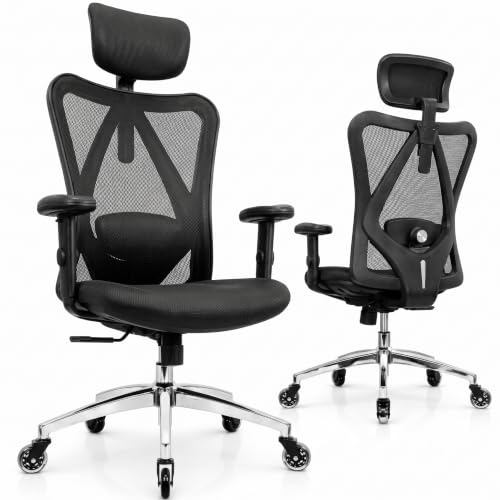
| Duramont Ergonomic Office Chair | All-day desk work with a thick cushioned seat | Adjustable desk chair with lumbar support and rollerblade wheels |
| SIHOO M57 Ergonomic Mesh Office Chair | Staying cool through long sessions in a warm room | High back mesh chair with 3D armrests and lumbar support |
| COLAMY Ergonomic Mesh Office Chair with Footrest | Stretching out between calls and long documents | High back mesh chair with footrest, headrest and 4D flip-up armrests |
| Ticova Ergonomic Office Chair | Fine-tuning every adjustment to fit one person | High back desk chair with adjustable lumbar support, headrest and 3D armrest |
| Nouhaus Ergo3D Ergonomic Office Chair | A premium-feeling mesh chair for a dedicated home office | Mesh office chair with 4D adjustable armrest and adjustable headrest |
How to Choose
Lumbar support that actually moves
Fixed lumbar bumps help only if they happen to land on your lower back, and most do not. Look for lumbar support that slides up and down and pushes in and out, so the pad meets the natural curve of your spine. The Duramont chair lists 4D lumbar adjustment, while the Ticova lets you change both the height and depth of its lumbar pad. Sit in the chair, slide the support until it fills the hollow above your hips, then check that it stays there when you lean back. If a listing only says “lumbar support” without describing any movement, treat it as a fixed curve and keep looking.
A seat that fits your legs, not just your hips
Seat depth decides whether your thighs rest fully or your calves press against the front edge. When the seat is too deep, the edge cuts circulation behind your knees; too shallow, and your thighs carry no weight at all. A sliding seat, like the one on the COLAMY mesh chair, lets taller and shorter sitters both reach the backrest while keeping two or three fingers of space behind the knees. Check the seat width too, because a narrow seat squeezes wider hips after an hour. Measure your current chair, note where it pinches, and compare that number with the dimensions on the product page before ordering.
Armrests that meet your elbows where they are
Armrests are the adjustment people forget until their shoulders ache. Your forearms should rest level with the desk while your shoulders stay relaxed and dropped, which usually means armrests that move up, down, forward and back. The SIHOO M57 and Nouhaus Ergo3D both offer multi-directional armrests, and the COLAMY adds flip-up arms that swing out of the way when you pull close to the desk. If you use a keyboard tray or a standing desk at sitting height, measure the gap between the armrest top and the desk surface first. Fixed armrests that sit too high will push your shoulders up all day.
Mesh or cushion, and how the chair breathes
Mesh backs let air pass through and keep your back from heating up during a long afternoon, which is why four of the five chairs here use a mesh back. A thick foam cushion, like the one on the Duramont, spreads weight across the seat and suits people who find bare mesh seats too firm. The trade-off is real: mesh stays cool but can feel hard after several hours, while foam feels soft at first and holds more heat. A warm office with afternoon sun favours mesh, while a cool basement office makes a padded seat more appealing. Either way, the backrest should flex as you lean, not hold you rigid.
The 5 Best Options
Duramont Ergonomic Office Chair
The Duramont is the most adjustable chair in this roundup, built around a lumbar pad that moves in four directions so it can be placed against the exact curve of your lower back. Its thick seat cushion suits long stretches of typing, and the breathable mesh back keeps air moving while the headrest and armrests adjust to your height. Rollerblade wheels roll smoothly across hard floors without the rattle of standard casters, and the recline lets you lean back between tasks. It is a strong default choice when you want one chair to handle a full workday without a long list of compromises.
Specs
- Adjustable desk chair with lumbar support and rollerblade wheels
- High back chair with breathable mesh
- Thick seat cushion, headrest and armrests
- Reclines with adjustable tilt tension
- 4D adjustable lumbar support that moves up, down, in and out
- Backed by a 5-year warranty
Best for: People who want maximum adjustability and a cushioned seat for full workdays at a desk.
Watch out for: Assembly takes time and several steps, so set aside an unhurried hour and a clear floor space before you start.
SIHOO M57 Ergonomic Mesh Office Chair
The SIHOO M57 is a straightforward mesh chair that does the fundamentals well: a high back, an adjustable headrest, a lumbar pad you can move to fit your spine and armrests that adjust in three directions. Mesh covers both the seat and the back, so heat never builds up during long sessions, and the tilt function lets you rock back slightly when you need a break from upright typing. Its frame holds larger sitters comfortably, and the chair suits anyone who wants a cool, breathable seat without paying for a premium brand badge.
Specs
- High back mesh office chair with 3D armrests
- Adjustable lumbar support and adjustable headrest
- Breathable mesh seat and back
- Tilt function with tilt lock
- Big and tall design that holds up to 330 lbs
- Chrome five-star base with caster wheels
Best for: Working long hours in a warm room where a mesh seat and back keep you comfortable.
Watch out for: The mesh seat feels firmer than a foam cushion, so sitters who prefer a soft seat may want a thin seat pad.
COLAMY Ergonomic Mesh Office Chair with Footrest
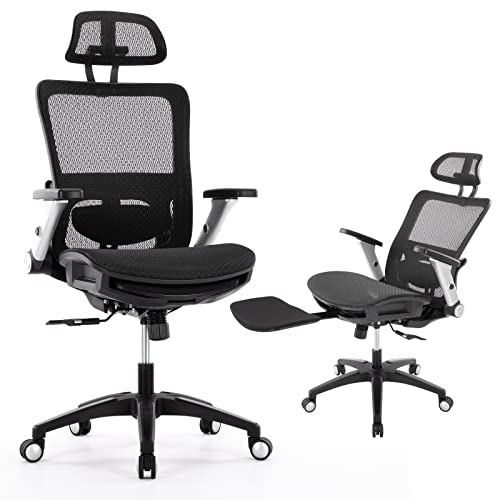
The COLAMY stands out because of its retractable footrest, which lets you stretch your legs out during a long call or while reading a document, then tuck it away when you return to typing. The high mesh back, adjustable headrest and lumbar support cover the usual comfort bases, and the 4D flip-up armrests move in four directions and swing up when you need to slide the chair under a desk. A tilt lock holds your chosen recline angle, so the chair works for both focused work and a short rest between tasks.
Specs
- Ergonomic mesh office chair with footrest
- High back computer executive desk chair with headrest
- 4D flip-up armrests
- Adjustable tilt lock and lumbar support
- Slide seat for adjusting seat depth
- Mesh back with breathable design
Best for: People who like to stretch their legs out and recline briefly during long work sessions.
Watch out for: The footrest adds moving parts, so check that it locks firmly in place and folds away cleanly before relying on it daily.
Ticova Ergonomic Office Chair

The Ticova M8 is the chair to pick when you want to fine-tune everything. Its lumbar support adjusts in both height and depth, the headrest moves in height and angle, and the 3D armrests shift up, down, forward, back and sideways, so each contact point can be set to your body rather than the other way around. The seat uses high-density foam shaped with a waterfall edge that takes pressure off the backs of the thighs, and the mesh back keeps airflow going. A rocking tilt of up to 130 degrees gives you room to lean back when a long document needs reading rather than typing.
Specs
- High back desk chair with adjustable lumbar support
- Adjustable headrest with height and angle adjustment
- 3D armrest with height, angle and forward-backward adjustment
- High-density foam cushion with W-shaped waterfall edge
- Rocking tilt up to 130 degrees with adjustable resilience
- Breathable mesh back
Best for: One person who wants to dial in every adjustment, from lumbar depth to armrest angle.
Watch out for: With so many adjustments, the first setup takes patience; adjust one control at a time and sit for a few minutes before changing the next.
Nouhaus Ergo3D Ergonomic Office Chair

The Nouhaus Ergo3D brings a more refined feel to a home office, with a mesh high back, a 3D lumbar support system and 4D armrests that move in every direction that matters. The adjustable headrest supports your neck during long reading sessions, and the synchro-tilt mechanism keeps the seat and backrest moving together as you recline, so your posture stays supported rather than collapsing. Blade wheels roll quietly, and the chair’s clean lines suit a dedicated office that doubles as a room guests see. It is the pick here when the chair needs to look as considered as the rest of the room.
Specs
- Mesh office chair with 4D adjustable armrest
- 3D lumbar support
- Adjustable headrest and wheels
- Mesh high back home office desk chair
- Synchro-tilt recline mechanism
- Blade wheels for smooth rolling
Best for: A dedicated home office where a premium-looking mesh chair with deep adjustability is the priority.
Watch out for: The chair is heavier than budget mesh models, so moving it between rooms takes more effort.
Which One Fits Your Situation
You work eight hours a day at one desk
Pick the Duramont. Its 4D lumbar pad, thick memory foam seat and adjustable headrest cover the longest days, and the rollerblade wheels make it easy to shift position without standing. Set the lumbar pad against your lower back first, then adjust the seat height so your feet rest flat.
Your office gets warm in the afternoon
Pick the SIHOO M57. Mesh on both the seat and back lets air circulate all day, and the high back with adjustable headrest keeps you supported without trapping heat. It is the simplest choice when temperature, not cushioning, is your main complaint during a long working day.
You want to stretch out between tasks
Pick the COLAMY with the footrest. Pull the footrest out during calls or reading, recline to the tilt lock, then tuck it away when you need to type again. The flip-up armrests also let you slide right up to the desk when the footrest is stowed.
You share the chair or have an unusual body shape
Pick the Ticova. Lumbar height and depth, headrest angle, 3D armrests and a 130-degree tilt give you more ways to fit the chair to your body than any other pick here. Write down your settings once you find them, so you can reset the chair quickly after someone else uses it.
Common Mistakes
- Buying a chair with fixed lumbar support and hoping your back matches its curve.
- Choosing a seat that is too deep, so the front edge presses into the backs of your knees.
- Setting armrests too high, which pushes your shoulders up and strains your neck all day.
- Picking a mesh chair for a cold room or a thick foam seat for a hot one, then blaming the chair.
- Skipping assembly care, then living with a wobbly base or a tilt lever that never worked properly.
- Ignoring desk height, so the chair fits your body but your keyboard still sits too high or too low.
Frequently Asked Questions
How long should I sit in one position in an office chair?
Even the best chair is not meant to hold you still all day. Stand, walk or stretch for a few minutes every hour, and shift your posture between upright typing and a slight recline. A good chair supports those changes instead of locking you into one pose.
Is a mesh back better than a padded back for long sitting?
Mesh wins in warm rooms because air passes through and keeps your back cool, while a padded back feels warmer and softer. Neither is better for everyone. Choose mesh if you overheat at your desk, and padding if your office stays cool and you prefer a softer feel.
Do I need a headrest on an office chair?
A headrest helps when you lean back to read, take calls or rest between tasks, because it supports your neck instead of leaving it hanging. If you sit bolt upright and type all day, it matters less. Adjustable headrests suit more people than fixed ones.
What should I check first when the chair arrives?
Check the lumbar pad position, seat height and armrest height before judging comfort. Sit with your feet flat, knees near a right angle and forearms level with the desk, then adjust one control at a time. If discomfort continues for weeks, speak with a healthcare professional rather than forcing yourself to adapt.
More from Amazon
Programs that pair well with the guide above. Offers and eligibility are set by Amazon and may change.
A free business account with business pricing and bulk-buying tools for work, shop or home office.
Create a business accountFree shipping on eligible items, Prime Video and more. Eligible new members can start with a free trial.
Start a Prime free trialAudiobooks and podcasts to listen to on the go. Eligible new members can start with a free trial.
Try Audible freeAd-free music streaming. Eligible new subscribers can start with a free trial.
Try Music Unlimited freeAs an Amazon Associate we earn from qualifying purchases.