Key takeaways
- Hardness that matches your household: Acacia sits around 1,700 on the Janka scale, mango near 1,070, and pine as low as 380. If you have kids, dogs, or a habit of setting hot pans down without thinking, lean hard toward acacia or another dense hardwood. Pine will take a beating and show every bit of it.
- Solid boards versus veneer over MDF: Look for listings that specify solid wood tops rather than “wood finish.” A solid top can be sanded and refinished decades from now; a veneer chip is permanent. Check the edge photos — solid boards show continuous grain wrapping around the corner.
- Finish type over finish color: A catalyzed lacquer or polyurethane topcoat resists water rings far better than an oil or wax finish. Oil looks and feels gorgeous, but plan on re-oiling annually and treating spills fast.
- Leg geometry and knee clearance: Trestle and pedestal bases seat more people comfortably than four corner legs, which is why 63-inch tables labeled “for 6” often aren’t. Measure the apron height and confirm you’ve got at least 24 inches of clearance under it.
- Assembly quality signals: Metal-to-wood connections with threaded inserts hold up; bare wood screws driven into end grain loosen within a year. If the listing shows barrel nuts or steel brackets, that’s a good sign the maker thought past the first month.
What's inside
Walk into any furniture showroom and you’ll hear “solid wood” thrown around like it settles the question. It doesn’t. Acacia, pine, rubberwood, and mango all wear the same rustic stain, but they behave completely differently once they’re living in your house — taking dents from a dropped cast iron pan, swelling in a humid August kitchen, or shrugging off a spilled glass of red. I’ve refinished enough hand-me-down tables in my garage to know that the species under the finish decides whether you’re wiping up a spill or sanding out a scar.
This guide breaks down which woods actually earn their keep on a dining table, how hardness ratings translate to real family use, and what to look for in construction that catalog photos never show. Then I walk through six popular 63-inch tables that hit the sweet spot for four to six people, with honest notes on the wood each one uses and who it suits best.
As an Amazon Associate we earn from qualifying purchases.


How to Choose a Woods For Dining Table (2026)
- Hardness that matches your household: Acacia sits around 1,700 on the Janka scale, mango near 1,070, and pine as low as 380. If you have kids, dogs, or a habit of setting hot pans down without thinking, lean hard toward acacia or another dense hardwood. Pine will take a beating and show every bit of it.
- Solid boards versus veneer over MDF: Look for listings that specify solid wood tops rather than “wood finish.” A solid top can be sanded and refinished decades from now; a veneer chip is permanent. Check the edge photos — solid boards show continuous grain wrapping around the corner.
- Finish type over finish color: A catalyzed lacquer or polyurethane topcoat resists water rings far better than an oil or wax finish. Oil looks and feels gorgeous, but plan on re-oiling annually and treating spills fast.
- Leg geometry and knee clearance: Trestle and pedestal bases seat more people comfortably than four corner legs, which is why 63-inch tables labeled “for 6” often aren’t. Measure the apron height and confirm you’ve got at least 24 inches of clearance under it.
- Assembly quality signals: Metal-to-wood connections with threaded inserts hold up; bare wood screws driven into end grain loosen within a year. If the listing shows barrel nuts or steel brackets, that’s a good sign the maker thought past the first month.
The Best Woods For Dining Table (2026)s Reviewed
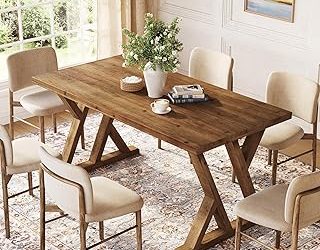
Devoko 6 Person Acacia Wood Dining Table
Acacia is the standout wood here — dense, naturally water-resistant, and rich with the kind of color variation you normally pay a premium for. The indoor-outdoor rating isn’t marketing fluff either; acacia handles humidity swings better than nearly anything in this price range, making it the pick I’d give a first-time buyer without hesitation.
63″ Live Edge Solid Wood Dining Table, Sculptural Legs
The live edge gives you that one-of-a-kind slab look without slab pricing, and the sculptural legs read genuinely modern rather than farmhouse-by-default. Just know that live edge means the profile varies board to board, so what arrives won’t perfectly match the listing photo — that’s the nature of the thing, not a defect.
TRIBWOOD 63″ Live Edge Pine Dining Table
Pine is a softwood, full stop, and this table will collect dents from day one. If you want a piece that patinas into something with history, that’s a feature — and pine takes stain beautifully if you ever want to change direction. For a formal dining room that stays pristine, look elsewhere.
Solid Wood Diamond Parquetry Dining Table with S-Scroll Legs
The diamond parquetry top is real joinery work, and it hides minor surface wear far better than a flat plank top because the eye reads the pattern first. The S-scroll legs commit hard to traditional styling, so measure your room’s visual weight before ordering — this one anchors a space.
63″ Solid Wood Dining Table, Natural Finish
The natural finish is the sleeper feature: unstained wood shows scratches far less obviously than dark walnut, where every scuff reads as a bright line. Straightforward four-leg construction means fast assembly and easy leveling on uneven floors.
Frequently Asked Questions
Which wood is genuinely the most durable for a dining table?
Hard maple and white oak top the practical list, with acacia close behind and far more affordable. All three resist denting well and refinish cleanly. Avoid pine and poplar if longevity without wear matters more to you than character.
Do I need to seal a solid wood dining table myself?
Most tables ship pre-finished, so no. But run a water droplet test on an underside corner — if it beads, you’re sealed; if it darkens the wood, add a wipe-on polyurethane coat before the table sees dinner.
Will a solid wood table crack in dry winter air?
It can, especially near forced-air vents. Keep indoor humidity between 35 and 50 percent, don’t push the table against a radiator, and use a humidifier in winter if you’re in a cold climate.
How do I fix a water ring or minor dent?
For rings on a poly finish, try a light rub with 0000 steel wool and mineral oil. Dents in softer wood often lift with a damp cloth and a warm iron, steaming the compressed fibers back up.
Final Thoughts
If you want the table you’ll still like in ten years, the Devoko acacia is the strongest all-around buy — the wood does the heavy lifting on durability and moisture resistance. The diamond parquetry walnut table is worth the extra look if you want real joinery and a top that camouflages wear, and the 63-inch natural finish option is the pragmatic choice for a busy household that would rather not see every scratch.