Key takeaways
- Airflow with a penalty built in: Island hoods lose capture area on all four sides, so budget roughly 25–30% more CFM than you’d want on a wall. A 700 CFM island unit behaves closer to a 500 CFM wall hood in practice.
- Width beats the burners: Match or exceed your cooktop width by at least 3 inches per side. A 30-inch range under a 36-inch hood is the sweet spot if your ceiling and island footprint allow it.
- Duct path before checkout: Crawl the attic first. A straight vertical run to the roof is ideal; every 90-degree elbow costs you real airflow. If the joists won’t cooperate, plan on recirculating mode and factor in charcoal filter replacements.
- Filter type and cleanup reality: Baffle filters trap grease better and survive the dishwasher indefinitely. Multi-layer mesh works fine but degrades faster and clogs sooner under heavy wok or fry use.
- Mounting hardware and ceiling height: Check that the chimney extension covers your span — most kits top out around 9 to 10 feet. You’ll need blocking between joists or a proper mounting plate; drywall anchors alone won’t hold 60+ pounds of steel.
What's inside
Hanging a hood over an island is a different beast than bolting one to a wall. There’s no backsplash to help corral steam, no cabinet to hide the ductwork, and no stud bay to anchor into — just joists, drywall, and a very visible piece of stainless steel that everyone at the dinner party will stare at. Get the sizing or the airflow wrong and you end up with a chrome sculpture that hums politely while bacon smoke drifts into the living room.
I’ve mounted a handful of these, patched more ceiling holes than I’d like to admit, and learned which specs actually matter once the drill is in your hand. Below are the island hoods worth your time in 2026, plus the buying criteria I’d hand a friend before they climb the ladder.
As an Amazon Associate we earn from qualifying purchases.



How to Choose an Island Kitchen Hood (2026)
- Airflow with a penalty built in: Island hoods lose capture area on all four sides, so budget roughly 25–30% more CFM than you’d want on a wall. A 700 CFM island unit behaves closer to a 500 CFM wall hood in practice.
- Width beats the burners: Match or exceed your cooktop width by at least 3 inches per side. A 30-inch range under a 36-inch hood is the sweet spot if your ceiling and island footprint allow it.
- Duct path before checkout: Crawl the attic first. A straight vertical run to the roof is ideal; every 90-degree elbow costs you real airflow. If the joists won’t cooperate, plan on recirculating mode and factor in charcoal filter replacements.
- Filter type and cleanup reality: Baffle filters trap grease better and survive the dishwasher indefinitely. Multi-layer mesh works fine but degrades faster and clogs sooner under heavy wok or fry use.
- Mounting hardware and ceiling height: Check that the chimney extension covers your span — most kits top out around 9 to 10 feet. You’ll need blocking between joists or a proper mounting plate; drywall anchors alone won’t hold 60+ pounds of steel.
The Best Island Kitchen Hood (2026)s Reviewed
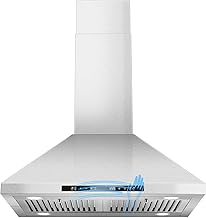
36″ Island Range Hood, 1200 CFM Stainless Steel
This is the one I’d pick for anyone who actually sears, fries, or runs a gas cooktop hard — 1200 CFM gives you the overhead to overcome an island’s poor capture geometry. Just plan for 8-inch duct and a makeup air strategy, because at full tilt this thing moves serious volume.
VIKIO HOME 30″ Island Range Hood, 390 CFM
At 390 CFM it’s the quiet, modest option, best suited to electric or induction cooktops in smaller kitchens where a roaring blower would dominate the room. The dual-sided controls are genuinely useful on an island since you can reach it from either side without walking around.
Cosmo COS-668ICS750 Lumin 30″ Ducted, 380 CFM
Cosmo’s build quality shows in the seams and the soft-touch panel, and the glass visor gives it a lighter visual footprint than a full stainless box. It’s ducted-only in spirit — treat the 380 CFM rating as a firm ceiling and don’t ask it to handle a six-burner.
36″ Island Range Hood, 700 CFM Black Painted Stainless
The matte black finish is the reason to buy this one; it disappears against dark ceilings and hides fingerprints far better than brushed steel. 700 CFM across 36 inches is a sensible middle ground for most home cooks.
30″ Island Range Hood, 700 CFM with Baffle Filters
Strong CFM-per-inch on a compact chassis, and the stainless baffle filters mean you’re never buying replacements. The gesture control is a nicer feature than it sounds when your hands are covered in flour.
Frequently Asked Questions
How high should an island hood hang?
Aim for 30 to 36 inches above the cooktop surface. Lower captures better but you’ll bump your head reaching across; taller looks airy but loses effectiveness fast, especially on lower CFM units.
Can I install one of these myself?
The mounting and electrical hookup are within reach for a confident DIYer, assuming you can access the joists from above. Cutting a roof penetration for ductwork is where I’d bring in help unless you’re comfortable with flashing and sealing.
Is ductless mode actually worth it?
It handles odor and some grease via charcoal filters, but heat and humidity stay in the room. Duct it if there’s any reasonable path — recirculating is a compromise, not an equal option.
Why are island hoods louder than wall hoods?
They’re centered in the room with nothing to absorb sound, and they often run at higher speeds to compensate for weak capture. Check sone ratings if noise matters, and remember that a larger hood at low speed beats a small one at max.
Final Thoughts
For serious cooking, the 36-inch 1200 CFM stainless unit is the only one here with real headroom to spare. If your kitchen is more moderate, the 36-inch black painted 700 CFM model offers the best blend of coverage and looks, while the Cosmo Lumin remains the pick for anyone prioritizing clean design and dependable build quality over raw airflow.