Key takeaways
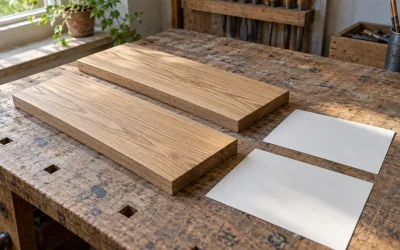
- Top material and thickness: Laminated hardwood around 1″ or thicker takes hammer blows and clamp pressure without denting through. Rubberwood and oak butcher-block tops are forgiving on tools and can be sanded flat again years later; steel tops shrug off solvents and heat but transmit noise and can mar workpieces.
- Frame rigidity over load numbers: A 2500 LB rating tells you what it holds standing still, not how it behaves under lateral force. Look for welded or bolted cross-bracing, gussets at the leg-to-apron joint, and thick-gauge tube. Give any bench a shove test before you trust it with a router.
- Fixed legs or casters: Wheels earn their keep in a shared garage where the bench moves for car access, but you want locking casters with real brakes and ideally leveling feet you can drop down. If the bench never moves, skip casters and gain stiffness.
- Storage that matches your work: Drawers suit small parts, sockets, and bits. Open shelving handles bulky items and paint cans. A pegboard back panel keeps hand tools at eye level and off the surface, which is the single biggest cause of clutter creep.
- Power, light, and working height: Integrated outlets remove extension cord tangle, and a task light beats a shop ceiling fixture for detail work. Adjustable height matters more than people expect: roughly 34–36″ suits general assembly, lower for planing, higher for electronics and precision work.
What's inside
Anyone who has tried to true up a door on a wobbly folding table knows the problem: the bench fights you. Cheap tops flex under a hand plane, thin legs walk across the slab when you’re driving screws, and by the third project you’re stacking scrap plywood underneath just to keep things level. A garage workbench isn’t a surface — it’s the reference plane every other cut and joint gets measured against, and if it moves, everything downstream inherits the error.
This guide breaks down the benches worth putting your money into for 2026, based on what actually matters when you’re wrenching, gluing, sanding, or soldering. We look at top material and thickness, frame rigidity, load ratings that mean something in practice, and the storage and power features that keep you from walking back to the toolbox every four minutes. Whether you need a mobile station that tucks against the wall or a fixed anchor for heavy fabrication, there’s a pick below that fits.
As an Amazon Associate we earn from qualifying purchases.


🛒 Best Price Today on Amazon
Prime members get fast, free shipping on everything above, plus member-only deals. New members get a 30-day free trial — cancel anytime.
How to Choose a Garage Workbench (2026)
- Top material and thickness: Laminated hardwood around 1″ or thicker takes hammer blows and clamp pressure without denting through. Rubberwood and oak butcher-block tops are forgiving on tools and can be sanded flat again years later; steel tops shrug off solvents and heat but transmit noise and can mar workpieces.
- Frame rigidity over load numbers: A 2500 LB rating tells you what it holds standing still, not how it behaves under lateral force. Look for welded or bolted cross-bracing, gussets at the leg-to-apron joint, and thick-gauge tube. Give any bench a shove test before you trust it with a router.
- Fixed legs or casters: Wheels earn their keep in a shared garage where the bench moves for car access, but you want locking casters with real brakes and ideally leveling feet you can drop down. If the bench never moves, skip casters and gain stiffness.
- Storage that matches your work: Drawers suit small parts, sockets, and bits. Open shelving handles bulky items and paint cans. A pegboard back panel keeps hand tools at eye level and off the surface, which is the single biggest cause of clutter creep.
- Power, light, and working height: Integrated outlets remove extension cord tangle, and a task light beats a shop ceiling fixture for detail work. Adjustable height matters more than people expect: roughly 34–36″ suits general assembly, lower for planing, higher for electronics and precision work.
The Best Garage Workbench (2026)s Reviewed
Eltean 55″ Rolling Workbench with 6 Drawers
This is the pick for a garage that pulls double duty as a parking spot — six drawers swallow a full socket set and hand tools, and the whole unit rolls clear when you need the floor. The 1000 LB rating is the lowest here, which is honest for a mobile cabinet bench, so treat it as an assembly and repair station rather than a place to press bearings.
48″ Heavy Duty Steel Workbench with Pegboard
An all-metal build with a 2000 LB capacity and adjustable lower shelf, this one is the utility workhorse: nothing to scorch, nothing to stain, easy to wipe down after an oil change. The steel top rings under a hammer and will scuff softer workpieces, so keep a sacrificial hardboard sheet handy for woodworking.
48″ Workbench with 1.2″ Laminated Oak Top
The thickest top in this lineup paired with a reinforced steel frame and a 2500 LB rating — this is the closest thing here to a traditional joinery bench. That 1.2″ oak lamination gives you real clamping depth for dogs and holdfasts, and it can be resurfaced with a belt sander when it gets chewed up.
Height Adjustable 60″×22″ Rubber Wood Workbench
The 60″ span is the sweet spot if you work with longer stock, and the built-in power outlet plus pegboard makes it a genuinely complete station out of the box. Height adjustment is the real draw: drop it for hand planing, raise it for detail electronics, and your back will notice the difference over a long session.
Eltean 48″ Workbench with Drawers and Light
A 2500 LB capacity paired with drawer storage and an integrated light makes this the best all-rounder for a single-bench shop. The overhead light removes the shadow problem you get standing between a ceiling fixture and your work, which matters more than it sounds for wiring and small-parts assembly.
Frequently Asked Questions
What height should a garage workbench be?
Around 34–36″ works for most general assembly and repair, roughly wrist height when standing. Go a few inches lower for hand-tool woodworking where you push down through the tool, and higher for electronics or model work where you’re leaning in. Adjustable models like the OLBRUS 48″ let you split the difference by task.
Do I actually need a 2000 or 2500 LB load rating?
Rarely for the static weight, but the rating is a useful proxy for build quality. A bench engineered to hold 2500 LB uses heavier steel and better bracing, which is what keeps it from racking sideways when you’re hammering or torquing. That stability is the real benefit.
Wood top or steel top?
Wood for anything involving fasteners, glue-ups, or delicate finishes — it’s quieter, gentler on workpieces, and takes bench dogs. Steel for mechanical work, welding-adjacent tasks, and anything where solvents, grease, or heat are in play. Many makers run a wood bench and cover it with a steel or hardboard sheet as needed.
Are rolling workbenches stable enough for real work?
With locking casters, yes for assembly, repair, and light fabrication. There’s always a small amount of give compared to a fixed frame, so if your primary work is hand planing or press-fitting, choose a bench with fixed legs and leveling feet instead.
Final Thoughts
For most home shops, the Eltean 48″ with drawers and integrated light is the strongest all-around buy — heavy capacity, storage where you need it, and proper task lighting in one unit. Serious woodworkers should go for the 48″ bench with the 1.2″ laminated oak top for its clamping depth and resurfaceable slab, while anyone sharing garage space with a car will get more out of the Eltean 55″ rolling bench and its six drawers.