Key takeaways
- Match PSI and GPM to your machine: The cleaner’s rating is a ceiling, not a target. A 4000 PSI head on a 1900 PSI electric washer will still spin, just slowly and with weak results. Flow matters more than pressure here, so aim for at least 2.0 GPM, and 2.5 GPM or better if you want a 16-inch or wider head to perform.
- Check the quick-connect size before you buy: Most consumer washers use a 1/4-inch male plug. Larger commercial-leaning cleaners often use 3/8-inch, which means an adapter or a swapped fitting. Neither is a dealbreaker, but discovering it mid-project is aggravating.
- Deck width versus your real workload: A 20-inch head covers ground fast but demands serious flow and gets awkward around planters and stair treads. Fourteen inches is the sweet spot for mixed work; 15 to 16 inches suits open driveways without starving a midsize gas unit.
- Housing material and wheel setup: Stainless steel shrugs off the grit and mineral-heavy water that eats painted steel. Four caster wheels help the head glide instead of grabbing, which is the difference between steering it and wrestling it.
- Included extensions and spare nozzles: Extension wands let you stand upright rather than hunching over, and nozzles are wear items. Kits that ship with spares save you a parts hunt six months in.
What's inside
Anyone who has spent a Saturday afternoon dragging a zero-degree tip across a concrete patio knows the problem. You get clean stripes, sure, but you also get zebra patterns that never quite blend, etched lines where you lingered too long, and a lower back that files a formal complaint by dinnertime. A pressure washer wand is a precision instrument. Broad flatwork needs something else entirely.
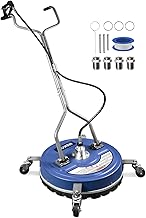
That something is a surface cleaner: a shrouded spinning bar with two or four nozzles that sweeps a wide, even path at consistent standoff distance. Below I have pulled together the models worth your money in 2026, spanning compact 14-inch units for decks and walkways up to a 20-inch beast built for long driveways. I have also included a short buying section covering the specs that actually matter, particularly the connector sizing mistake that trips up first-time buyers.
As an Amazon Associate we earn from qualifying purchases.




🛒 Best Price Today on Amazon
Prime members get fast, free shipping on everything above, plus member-only deals. New members get a 30-day free trial — cancel anytime.
How to Choose a Surface Cleaner For Pressure Washer (2026)
- Match PSI and GPM to your machine: The cleaner’s rating is a ceiling, not a target. A 4000 PSI head on a 1900 PSI electric washer will still spin, just slowly and with weak results. Flow matters more than pressure here, so aim for at least 2.0 GPM, and 2.5 GPM or better if you want a 16-inch or wider head to perform.
- Check the quick-connect size before you buy: Most consumer washers use a 1/4-inch male plug. Larger commercial-leaning cleaners often use 3/8-inch, which means an adapter or a swapped fitting. Neither is a dealbreaker, but discovering it mid-project is aggravating.
- Deck width versus your real workload: A 20-inch head covers ground fast but demands serious flow and gets awkward around planters and stair treads. Fourteen inches is the sweet spot for mixed work; 15 to 16 inches suits open driveways without starving a midsize gas unit.
- Housing material and wheel setup: Stainless steel shrugs off the grit and mineral-heavy water that eats painted steel. Four caster wheels help the head glide instead of grabbing, which is the difference between steering it and wrestling it.
- Included extensions and spare nozzles: Extension wands let you stand upright rather than hunching over, and nozzles are wear items. Kits that ship with spares save you a parts hunt six months in.
The Best Surface Cleaner For Pressure Washer (2026)s Reviewed
Westinghouse Universal 16.5″ Surface Cleaner
The 16.5-inch stainless deck and 4400 PSI rating make this the pick if you own a capable gas washer and want to cut driveway time roughly in half compared with a 14-inch head. It runs smooth and quiet for its size, though anything under about 2.5 GPM will leave the bar spinning too lazily to earn that extra width.
MEKOH 20″ Heavy-Duty Surface Cleaner
Twenty inches of coverage with a dual-handle setup that genuinely improves control, this is the one for long concrete runs and shop floors where you are covering hundreds of square feet at a stretch. Note the 3/8-inch quick-connect: pair it with a high-flow gas unit, or the size advantage works against you.
Hourleey 14″ Surface Cleaner
A well-executed 14-inch stainless unit with four wheels and two extension wands, sized right for patios, sidewalks, and composite decking where a wider head would fight you at the edges. It is the most broadly compatible option here, working respectably on midrange electrics as well as gas machines.
Westinghouse Universal 15″ Surface Cleaner
Rated to 3400 PSI, this is the sensible middle ground for a homeowner-grade washer in the 2.2 to 2.5 GPM range. You get meaningfully more coverage than a 14-inch head without outrunning your pump’s ability to keep the bar moving.
LidoDola 14″ Surface Cleaner
The most complete kit of the group, shipping with two extension wands plus two replacement nozzles, which is thoughtful given that nozzles are the first thing to wear out. Stainless housing and four casters put its build on par with pricier 14-inch competitors.
Frequently Asked Questions
Will a surface cleaner work with my electric pressure washer?
Often yes, if the machine produces at least 2.0 GPM and around 1800 PSI. Stick to a 14-inch head. Larger decks need flow that most electrics simply cannot deliver, and the bar will drag rather than spin.
Why am I still seeing faint stripes?
Usually a partially clogged nozzle or moving too fast. Pull the nozzles, flush them, and overlap each pass by a few inches at a slow walking pace. Uneven wheel height on a rutted slab can also lift one side of the bar.
Can I use these on wood decking?
Yes, and it is safer than a wand because the shroud holds a fixed distance. Start at low pressure on an out-of-sight board, keep moving with the grain, and stay under roughly 1500 PSI on softwoods.
Do I need a 3/8-inch fitting or a 1/4-inch?
Check your wand’s existing quick-connect. Nearly all consumer washers use 1/4-inch. A 3/8-inch cleaner just needs an inexpensive brass adapter, so it is a minor step rather than an obstacle.
Final Thoughts
For most homeowners the Hourleey 14-inch hits the best balance of compatibility, build quality, and maneuverability around furniture and garden beds. Step up to the Westinghouse 16.5-inch if you have a strong gas unit and a driveway worth the extra coverage, or go straight to the MEKOH 20-inch when you are clearing large flatwork and want the job done in one pass.