Key takeaways
- Weave density over thread softness: Run your thumb across a swatch and press. A tight, dense weave resists snagging and grinding. Loose open weaves feel luxurious in your hand and disintegrate on a chair that gets pulled out three times a day.
- Yardage math before you order: Standard drop-in dining seats need roughly half a yard each, plus four inches on every side to wrap and staple. For six chairs, three yards is comfortable. Buying short mid-project means dye-lot mismatch on the reorder.
- Stain behavior, not just stain claims: Solution-dyed and treated synthetics release spills; untreated natural linen absorbs them permanently. If your table sees pasta sauce and toddlers, prioritize a wipeable face or a washable cover you can throw in the machine.
- Pattern scale relative to the seat: A dining seat is a small canvas. Large damask repeats get cropped awkwardly unless you center them deliberately, which eats yardage. Small-scale texture and tonal jacquards read as intentional from any angle.
- Backing and stretch direction: Fabric with a light backing pulls taut without distorting the weave — critical on rounded seat corners. For slipcovers, four-way stretch grips contoured seats; two-way stretch bags out at the front edge.
What's inside
Reupholstering a dining chair is one of those projects that looks intimidating until you’ve done it once. The staple gun part is easy. Picking the fabric is where most people stall out, because the stakes feel high: order the wrong yardage or the wrong weave, and you’ve spent a Saturday stretching material that pills within six months or shows every drip of red wine. Dining chairs live a harder life than any other seating in the house — food, elbows, kids climbing on them, chair legs dragging across the seat edge — and a lot of pretty upholstery fabric simply isn’t built for it.
This guide covers both routes: cut-by-the-yard fabric for anyone ready to pull the seat deck and reupholster properly, and stretch slipcovers for renters, borrowed furniture, or chairs you’d rather not commit to permanently. I’ve broken down what actually matters when you’re standing in front of a fabric listing — abrasion resistance, weave tightness, backing, and how the material behaves under a staple gun — plus the specific products worth your money in 2026.
As an Amazon Associate we earn from qualifying purchases.



How to Choose a Fabrics For Dining Room Chairs (2026)
- Weave density over thread softness: Run your thumb across a swatch and press. A tight, dense weave resists snagging and grinding. Loose open weaves feel luxurious in your hand and disintegrate on a chair that gets pulled out three times a day.
- Yardage math before you order: Standard drop-in dining seats need roughly half a yard each, plus four inches on every side to wrap and staple. For six chairs, three yards is comfortable. Buying short mid-project means dye-lot mismatch on the reorder.
- Stain behavior, not just stain claims: Solution-dyed and treated synthetics release spills; untreated natural linen absorbs them permanently. If your table sees pasta sauce and toddlers, prioritize a wipeable face or a washable cover you can throw in the machine.
- Pattern scale relative to the seat: A dining seat is a small canvas. Large damask repeats get cropped awkwardly unless you center them deliberately, which eats yardage. Small-scale texture and tonal jacquards read as intentional from any angle.
- Backing and stretch direction: Fabric with a light backing pulls taut without distorting the weave — critical on rounded seat corners. For slipcovers, four-way stretch grips contoured seats; two-way stretch bags out at the front edge.
The Best Fabrics For Dining Room Chairs (2026)s Reviewed
TinaKim Thick Chair Upholstery Fabric, Faux Linen
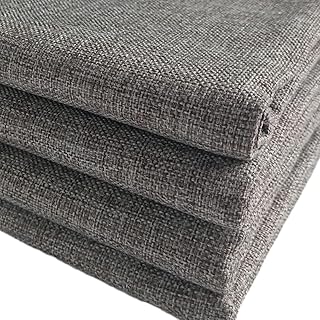
This is the fabric I’d hand a first-time reupholsterer: heavy enough to hide the old foam’s imperfections, with enough body that it doesn’t ripple when you tension it across a seat frame. The 57-by-72-inch cut covers three to four standard drop-in seats, and the flaxen tone hides crumbs far better than true white linen.
Faux Linen Needlework Fabric, 3.3 Yards
At 3.3 yards by 57 inches, this is sized almost exactly for a six-chair set with room for mistakes, which is why it’s my pick for full dining suites. The grey-blue has a subtle slub texture that reads as real linen without linen’s tendency to wrinkle-set permanently under a seated body.
Damask Tapestry Chenille Upholstery Fabric
Chenille tapestry is the durability champion here — the woven-in pattern means wear doesn’t strip a printed surface, and the 60-inch width gives you generous wrap room. Sold by the yard, so order one extra to align the sage-and-gold repeat across all your seats consistently.
Promindfly 3D Jacquard Dining Chair Covers, Set of 6
The dimensional jacquard does real work: raised texture disguises the seams that make cheap slipcovers look like slipcovers. Anti-scratch construction holds up to cat claws, and the set-of-six pricing beats reupholstering a whole dining set by a wide margin.
Waterproof Jacquard Seat Covers, Set of 4
These are seat-only covers with an actual moisture barrier, which makes them the right answer for households with young kids or chairs with expensive original upholstery underneath. They wash clean and re-stretch without losing grip at the corners.
Frequently Asked Questions
How much fabric do I need per dining chair?
Budget 0.5 to 0.75 yards for a standard drop-in seat, and closer to a full yard for a chair with an upholstered back panel. Measure your seat, add four inches on all sides, then add ten percent for pattern matching.
Is real linen a bad choice for dining chairs?
Not bad, just demanding. Pure linen breathes beautifully and ages well, but it absorbs oils and wrinkles under body weight. Faux linen blends give you the look with meaningfully better recovery and stain release.
Do I need to remove the old fabric before reupholstering?
If the existing layer is smooth and dry, you can staple over it — it adds padding. Strip it if it’s compressed, stained, holds odor, or if the added bulk would prevent the seat from dropping back into the frame.
Slipcovers or reupholstery for a rental?
Slipcovers, without question. Stretch covers require no tools, come off for washing, and preserve whatever’s underneath. Save reupholstery for chairs you own and plan to keep.
Final Thoughts
If you’re cutting and stapling, the Faux Linen Needlework 3.3-yard cut gives a six-chair set the most forgiving margin for error, while the Damask Tapestry Chenille is the pick when longevity matters more than budget. For anyone who wants results this afternoon with zero tools, the Promindfly 3D Jacquard set of six delivers the biggest visual change per dollar.