Key takeaways
- Identify the coating, not just the wood: Oiled and hardwax finishes feel warm and can be refreshed with a rag; catalyzed lacquer and UV poly resist moisture better but need professional repair. Ask which one you’re buying before the wood species even enters the conversation.
- Test the sheen against your lighting: Satin and matte hide fingerprints and swirl marks far better than semi-gloss. If you have a pendant fixture or south-facing windows, high-gloss will broadcast every crumb and every wipe streak.
- Check whether the surface is solid or a veneer: Solid tops can be sanded and refinished multiple times over their lifespan. Veneers and laminates cannot, so any deep gouge is permanent, which matters more if you have kids or hobbyists at the table.
- Look at the edge profile and end grain: Rounded or chamfered edges hold finish much longer than sharp arrises, where the coating thins and wears through first. End grain drinks up more finish and often darkens unevenly on cheaper builds.
- Plan for seasonal movement: Solid wood expands and contracts, and rigid finishes can hairline-crack along glue joints in dry winter air. Breadboard ends, floating fasteners, and a humidifier are your friends here.
What's inside
Anyone who has spent a weekend sanding a tabletop knows the finish is where a dining table lives or dies. A gorgeous grain pattern under a thin, chalky topcoat will show every water ring from a sweating glass, while an over-lacquered slab can look like a bowling lane under pendant lights. The trouble is that product listings rarely tell you whether you’re getting an oiled surface, a UV-cured polyurethane, or a printed melamine layer over particleboard, and those three behave nothing alike once real dinners start happening on them.
This guide comes at the question from a maker’s bench rather than a showroom floor. I’ve looked at what these finishes actually are, how they respond to a damp cloth and a mineral-oil wipe-down, whether they can be spot-repaired at home when a fork tine digs in, and how the sheen reads in ordinary room light. Below you’ll find the tables worth considering in 2026, plus the shortlist of things I check before committing to any surface I’ll be eating off for a decade.
As an Amazon Associate we earn from qualifying purchases.


How to Choose a/an Finish Dining Room Table (2026)
- Identify the coating, not just the wood: Oiled and hardwax finishes feel warm and can be refreshed with a rag; catalyzed lacquer and UV poly resist moisture better but need professional repair. Ask which one you’re buying before the wood species even enters the conversation.
- Test the sheen against your lighting: Satin and matte hide fingerprints and swirl marks far better than semi-gloss. If you have a pendant fixture or south-facing windows, high-gloss will broadcast every crumb and every wipe streak.
- Check whether the surface is solid or a veneer: Solid tops can be sanded and refinished multiple times over their lifespan. Veneers and laminates cannot, so any deep gouge is permanent, which matters more if you have kids or hobbyists at the table.
- Look at the edge profile and end grain: Rounded or chamfered edges hold finish much longer than sharp arrises, where the coating thins and wears through first. End grain drinks up more finish and often darkens unevenly on cheaper builds.
- Plan for seasonal movement: Solid wood expands and contracts, and rigid finishes can hairline-crack along glue joints in dry winter air. Breadboard ends, floating fasteners, and a humidifier are your friends here.
The Best Finish Dining Room Table (2026)s Reviewed
BAKEVE Bamboo Dining Table, 47.2″ Walnut
Bamboo takes a stain beautifully because its density is consistent, so this walnut-toned finish reads even across the whole top rather than blotching the way soft pine tends to. The FSC certification is a real credential, and the tight strand structure shrugs off dents better than most hardwoods in this price bracket.
Acacia Verve 48″ Solid Wood Dining Table, Caramel
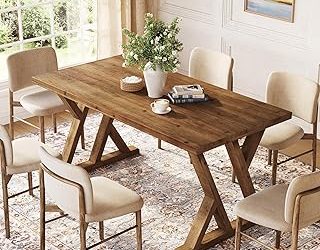
Acacia has wild, high-contrast grain, and the rustic natural finish here leans into it instead of trying to level everything into uniformity. Because it’s solid stock, you can sand out a bad scratch and blend in a fresh coat of oil yourself, which is genuinely rare at this size and price.
VASAGLE MAEZO Extendable Dining Table, Honey Brown
The tapered legs and curved transitions are the details that separate this from flat-pack sameness, and the honey brown coating is applied evenly enough that the leaf matches the fixed top when extended. Watch the seam area with liquids, since extension gaps are always the weak point in any finish system.
71″ Imitation Marble Dining Table with LED Lights, White
This is a fully sealed, non-porous surface, which means zero maintenance and no oiling schedule, and the marble striping is printed convincingly enough to pass at conversational distance. Just know that a chip in the coating can’t be blended out, and the LED grille detail commits you to a distinctly contemporary look.
55″ Farmhouse Table with Drawers, Walnut & Black
The two-tone treatment is smart from a wear standpoint: the walnut top carries the visual weight while the black base absorbs scuffs from shoes and chair legs without showing them. Drawer interiors are typically left unfinished on tables like this, so a light coat of shellac inside is a worthwhile hour of your time.
Frequently Asked Questions
How do I tell an oiled finish from a polyurethane one?
Put a single drop of water on an inconspicuous spot and wait a minute. On oil or hardwax, it will darken the wood slightly and absorb; on poly or lacquer, it beads and sits on top. The bead test also tells you how urgently you need coasters.
Can I refinish a factory-finished table myself?
Yes, if it’s solid wood. Sand through the old coating with 120 grit, work up to 180 or 220, then apply your finish of choice in thin coats. Veneered tops are much riskier because the face layer can be under a millimeter thick and burns through fast.
What actually removes white water rings?
Those cloudy rings are trapped moisture in the finish layer, not damage to the wood. A low iron over a cotton cloth, moved constantly, will often draw it out in under a minute. Failing that, a light rub with mineral spirits or a very fine abrasive pad usually clears it.
Is matte or glossy better for daily family use?
Matte and satin, without much debate. They scatter light, so scratches and fingerprints blend into the surface texture instead of catching the eye. Gloss looks sharper on day one and considerably worse after six months of real use.
Final Thoughts
For a finish you can maintain and repair yourself, the Acacia Verve 48″ is the standout here, with genuinely refinishable solid stock and grain worth showing off. The BAKEVE Bamboo table is the smarter buy if you want consistency and dent resistance without babying the surface, while the 71″ Imitation Marble table makes sense for anyone who would rather seal the whole question shut and never think about oiling again.