Key takeaways
- Cooling type: Compressor units pull down to the 30s and hold there regardless of room temperature, which is what you want for beer and soda. Thermoelectric coolers run quieter and cheaper but typically manage only 30 to 40 degrees below ambient, so a hot garage will defeat them.
- Real can capacity: Advertised counts assume standard 12 oz cans stacked without a gap. Tall boys, 16 oz craft cans, and wine bottles cut that number by a third or more. If you drink from oddball packaging, measure your tallest bottle and compare it to the shelf spacing before committing.
- Shelf adjustability: Removable, repositionable wire shelves are the single feature that separates a fridge you tolerate from one you love. Fixed shelves force you to lay bottles down; adjustable ones let you pull a rack out entirely and stand a growler upright.
- Placement and ventilation: Freestanding beverage fridges vent from the back and sides, not the front. That means a true built-in slot will choke them. Leave two to three inches of clearance, keep the unit off carpet, and check which side the door hinges on before you plan the cabinet.
- Noise and control: Digital thermostats with an external readout beat blind dials, especially if you’re storing wine alongside soda. Check the decibel rating too. Anything over roughly 40 dB becomes noticeable in a bedroom or a quiet home office.
What's inside
Anyone who has ever cleared a shelf of the kitchen fridge to make room for a case of seltzer knows the problem: drinks are bulky, they get buried behind leftovers, and the one you want is always the warm one at the back. A dedicated beverage fridge solves that in a way no amount of Tetris with the crisper drawer will. But the category is crowded with near-identical black boxes, and the spec sheets bury the things that actually matter once the unit is bolted into your bar cabinet or wedged under a desk.
I’ve spent enough weekends building out basement bars and dorm-adjacent setups to know which details you feel every single day. This guide covers what to look for in a drinks fridge for 2026, from compressor versus thermoelectric cooling to shelf geometry and door swing, then walks through the units that hold up best in real installs. Whether you need 130 cans behind glass or a 6-can cube for a nightstand, there’s a right answer here.
As an Amazon Associate we earn from qualifying purchases.


How to Choose a Mini Fridge For Drinks (2026)
- Cooling type: Compressor units pull down to the 30s and hold there regardless of room temperature, which is what you want for beer and soda. Thermoelectric coolers run quieter and cheaper but typically manage only 30 to 40 degrees below ambient, so a hot garage will defeat them.
- Real can capacity: Advertised counts assume standard 12 oz cans stacked without a gap. Tall boys, 16 oz craft cans, and wine bottles cut that number by a third or more. If you drink from oddball packaging, measure your tallest bottle and compare it to the shelf spacing before committing.
- Shelf adjustability: Removable, repositionable wire shelves are the single feature that separates a fridge you tolerate from one you love. Fixed shelves force you to lay bottles down; adjustable ones let you pull a rack out entirely and stand a growler upright.
- Placement and ventilation: Freestanding beverage fridges vent from the back and sides, not the front. That means a true built-in slot will choke them. Leave two to three inches of clearance, keep the unit off carpet, and check which side the door hinges on before you plan the cabinet.
- Noise and control: Digital thermostats with an external readout beat blind dials, especially if you’re storing wine alongside soda. Check the decibel rating too. Anything over roughly 40 dB becomes noticeable in a bedroom or a quiet home office.
The Best Mini Fridge For Drinks (2026)s Reviewed
hOmeLabs Beverage Refrigerator, 120 Cans
This is the safe recommendation for a reason: solid compressor cooling, a reversible glass door, and shelves that actually come out cleanly when you need to fit a bottle of prosecco. It runs a touch louder than the thermoelectric competition, but it holds temperature in a warm room, which is where the cheap units fold.
Electactic Mini Fridge, 130 Can
At 3.2 cubic feet with digital temperature control, this one hits the sweet spot for a finished basement bar or a shared office. The readout is genuinely useful for dialing in a single temperature that works for both lagers and lighter whites.
EUHOMY Mini Fridge, 130 Can
EUHOMY has been iterating on this chassis for years and it shows in the fit and finish, particularly the door seal and the interior lighting. Removable shelves plus reliable digital control make it the easiest of the 130-can units to reconfigure around awkward bottles.
Feelfunn 3.2 Cu.Ft, 126 Can
Four adjustable shelves is the standout here, giving you more layout options than most competitors at this size. It’s a strong pick if your inventory is a mix of cans, tall boys, and the occasional wine bottle rather than one uniform format.
BEICHEN 4L Portable Mini Fridge
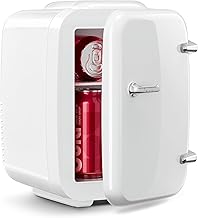
Six cans, AC/DC power, and a warming mode make this a genuinely different tool rather than a smaller version of the others. Perfect for a nightstand, a truck cab, or skincare duty, and quiet enough that you’ll forget it’s running.
Frequently Asked Questions
Can I build a beverage fridge into cabinetry?
Only if the manufacturer specifically rates it as built-in, which none of these freestanding units are. You can frame an opening around one, but leave generous side and rear clearance so the condenser can breathe, or you’ll shorten its life considerably.
How cold do these actually get?
Compressor models like the hOmeLabs and EUHOMY typically reach the mid-30s Fahrenheit. Small thermoelectric units cool relative to room temperature instead, so expect noticeably warmer results in an unconditioned space.
Will a drinks fridge work for wine?
For short-term chilling, absolutely. For long-term storage, a beverage cooler runs colder and drier than ideal, and the glass door exposes bottles to light. Treat it as a serving fridge, not a cellar.
What does one cost to run?
Most 3.2 cubic foot models draw somewhere around 80 to 100 kWh per year, which lands in the range of a dollar or two monthly depending on your rates. Keeping it full and out of direct sun helps.
Final Thoughts
For most builds, the hOmeLabs 120-can unit is the dependable default, with the EUHOMY 130-can as the pick if you want better shelf flexibility and a tighter door seal. If space is genuinely tight, the Feelfunn 1.7 Cu.Ft 68-can model scales the same idea down to a bedroom or a small office without giving up the glass door.