Key takeaways
- Drawer count vs. drawer depth: Twelve shallow drawers sound impressive, but a mixed layout beats a uniform one. You want slim trays for wrenches and sockets plus two or three deep drawers that swallow a cordless drill, an angle grinder, and a full impact set without you playing Tetris.
- Slide quality: Ball-bearing slides glide when loaded; friction slides bind the moment you put 40 pounds of sockets in. Open and close a drawer full of steel a few hundred times and the difference stops being subtle.
- Casters and lockability: Look for at least two locking swivel casters. An unlocked chest that drifts while you’re leaning on it is genuinely dangerous, and cheap hard plastic wheels stall on extension cords, gravel, and expansion joints.
- Modularity: A detachable top box is the most underrated feature here. Pull it off, carry it to the driveway or upstairs, and you’ve got a portable kit instead of a fixed cabinet. Three-in-one designs add a middle section or lower cart for bulk items.
- Security and finish: Central locking matters in a shared garage or rental shop. Powder-coated steel resists shop solvents better than painted finishes, and included liners keep tools from sliding and scuffing the drawer bottoms.
What's inside
Anyone who has spent a Saturday afternoon hunting for a 10mm socket knows the real bottleneck in a home shop isn’t tools — it’s where they live. Coffee cans, plastic totes, and that one drawer of mystery hardware work fine until you’re mid-project with a car on jack stands or a half-assembled dresser on the bench. Then every minute spent digging is a minute your glue is setting or your knuckles are getting cold.
A rolling tool chest fixes that by giving every wrench, chisel, and bit driver a fixed address, and it rolls the whole kit to wherever the work is. This guide walks through the current crop of value-priced rolling chests — 5-drawer carts up to 46-inch 12-drawer units — and explains what actually matters when you’re comparing steel boxes that all look similar in photos. Deals shift constantly, so live pricing is below.
As an Amazon Associate we earn from qualifying purchases.


🛒 Best Price Today on Amazon
Prime members get fast, free shipping on everything above, plus member-only deals. New members get a 30-day free trial — cancel anytime.
How to Choose a Tool Chest (2026)
- Drawer count vs. drawer depth: Twelve shallow drawers sound impressive, but a mixed layout beats a uniform one. You want slim trays for wrenches and sockets plus two or three deep drawers that swallow a cordless drill, an angle grinder, and a full impact set without you playing Tetris.
- Slide quality: Ball-bearing slides glide when loaded; friction slides bind the moment you put 40 pounds of sockets in. Open and close a drawer full of steel a few hundred times and the difference stops being subtle.
- Casters and lockability: Look for at least two locking swivel casters. An unlocked chest that drifts while you’re leaning on it is genuinely dangerous, and cheap hard plastic wheels stall on extension cords, gravel, and expansion joints.
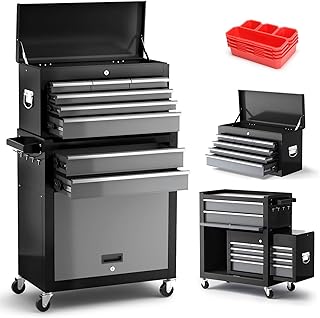
- Modularity: A detachable top box is the most underrated feature here. Pull it off, carry it to the driveway or upstairs, and you’ve got a portable kit instead of a fixed cabinet. Three-in-one designs add a middle section or lower cart for bulk items.
- Security and finish: Central locking matters in a shared garage or rental shop. Powder-coated steel resists shop solvents better than painted finishes, and included liners keep tools from sliding and scuffing the drawer bottoms.
The Best Tool Chest Deals (2026) Reviewed
42″ 8-Drawer Rolling Tool Chest with Detachable Top
This is the sweet spot for most home shops: eight drawers, a lift-off top box, and side hooks for clamps and extension cords, all in a 42-inch footprint that still fits along a garage wall. Liners and a tray divider come in the box, so you’re organized the day it arrives rather than three trips to the hardware store later.
8-Drawer 3-in-1 Rolling Tool Chest, Lockable
The three-section layout earns its keep — top box for hand tools, mid-drawers for sockets and drivers, and a lower cabinet for the awkward stuff like oil jugs, paint cans, and a shop vac hose. Full lockdown across all three sections makes it a solid pick if your workspace is shared.
LDHTHOPI 8-Drawer Rolling Tool Chest
It ships assembled, which is a bigger deal than it sounds — you skip an hour of fiddly panel alignment and the classic mid-build discovery of a missing bolt. The sliding drawers lock, the top box detaches, and the red finish makes it easy to spot in a cluttered bay.
46″ 12-Drawer Rolling Tool Chest
For anyone whose collection has outgrown a mid-size cart, this is the upgrade: twelve drawers across 46 inches of heavy-duty steel, with dividers and liners included so you can sort by tool type instead of by size. Give it a proper footprint — this is a stay-put anchor, not a hallway rover.
5-Drawer Rolling Tool Cabinet Cart
The nimble option, and a smart choice for smaller garages, apartment workshops, or as a rolling second station beside a bigger chest. Five lockable drawers cover a working hand-tool kit without eating floor space you don’t have.
Frequently Asked Questions
How much weight can these chests actually hold?
Most steel units in this class handle several hundred pounds total, with per-drawer limits in the 40 to 90 pound range. Load heavy items — impact wrenches, socket sets, vises — into the bottom drawers to keep the center of gravity low and reduce tip risk.
Is a detachable top box worth paying extra for?
If your projects ever leave the bench, yes. Being able to grab the top section and take it to a car, a deck, or a neighbor’s place turns one fixed cabinet into a chest plus a portable toolbox.
Will these survive an unheated garage?
Powder-coated steel handles temperature swings fine, but humidity is the enemy of bare tools. Toss a few silica or VCI rust inhibitor packs into your drawers and you’ll avoid surface rust on chrome sockets and plane irons.
How long does assembly take?
Budget 45 to 90 minutes for flat-pack models with a helper and a magnetic driver. Pre-assembled units like the LDHTHOPI mostly need casters installed and a level surface check.
Final Thoughts
For most makers, the 42-inch 8-drawer chest with a detachable top hits the best balance of capacity, mobility, and price. Step up to the 46-inch 12-drawer unit if your collection is already spilling out of totes, or grab the 5-drawer rolling cart if floor space is your real constraint — a small chest you actually use beats a big one you can’t fit.