Key takeaways
- Measure before you browse: A fixture should span roughly two-thirds of your island’s length, hanging 30 to 36 inches above the countertop. Sketch your island on paper, mark the existing junction box, and confirm the fixture’s minimum and maximum drop before adding anything to a cart.
- Check the adjustment hardware: Chain-and-cord systems let you fine-tune height on installation day; fixed downrods do not. Rods give a cleaner, more rigid look but require you to know your ceiling height exactly. Chains forgive mistakes.
- Match bulbs to the work you do: Prep surfaces want 2700K to 3500K for warmth without yellowing your cutting board. Multi-temperature LEDs let you shift cooler for detail tasks. Verify dimmer compatibility with integrated LED units, since not all play nicely with older wall dimmers.
- Inspect the canopy and mounting plate: Thin stamped steel flexes and telegraphs every ceiling imperfection. Thicker gauge metal sits flush, holds screws properly, and does not sag under a glass-heavy fixture two years down the line.
- Plan for one box or several: Multi-pendant sets need separate junction boxes unless you install a canopy adapter or add a box. Linear fixtures solve this in a single existing location, which is why they dominate retrofit projects.
What's inside
Anyone who has stood on a step stool with a wire nut in one hand and a fixture canopy sliding down their forearm knows the truth: island lighting is the one upgrade that punishes guesswork. The mounting box is rarely centered where you want it, the ceiling height fights your drop length, and the fixture that looked balanced in a product photo turns out to be six inches too short for a 7-foot slab of quartz. Add in warm-versus-cool color temperature debates, dimmer compatibility, and the fact that most kitchens have exactly one junction box where you need two, and it is easy to see why so many islands end up lit by whatever came with the house.
This guide approaches the problem the way a maker would: measuring first, understanding the hardware second, and buying last. Below you will find fixtures worth installing, chosen for adjustable drop hardware, honest build quality in the parts that actually bear weight, and shade designs that spread light across a work surface instead of blinding whoever is chopping onions. We cover linear bars for long islands, multi-pendant sets for flexible layouts, and integrated LED options for anyone who never wants to change a bulb again.
As an Amazon Associate we earn from qualifying purchases.


How to Choose a Kitchen Island Lighting (2026)
- Measure before you browse: A fixture should span roughly two-thirds of your island’s length, hanging 30 to 36 inches above the countertop. Sketch your island on paper, mark the existing junction box, and confirm the fixture’s minimum and maximum drop before adding anything to a cart.
- Check the adjustment hardware: Chain-and-cord systems let you fine-tune height on installation day; fixed downrods do not. Rods give a cleaner, more rigid look but require you to know your ceiling height exactly. Chains forgive mistakes.
- Match bulbs to the work you do: Prep surfaces want 2700K to 3500K for warmth without yellowing your cutting board. Multi-temperature LEDs let you shift cooler for detail tasks. Verify dimmer compatibility with integrated LED units, since not all play nicely with older wall dimmers.
- Inspect the canopy and mounting plate: Thin stamped steel flexes and telegraphs every ceiling imperfection. Thicker gauge metal sits flush, holds screws properly, and does not sag under a glass-heavy fixture two years down the line.
- Plan for one box or several: Multi-pendant sets need separate junction boxes unless you install a canopy adapter or add a box. Linear fixtures solve this in a single existing location, which is why they dominate retrofit projects.
The Best Kitchen Island Lighting (2026)s Reviewed
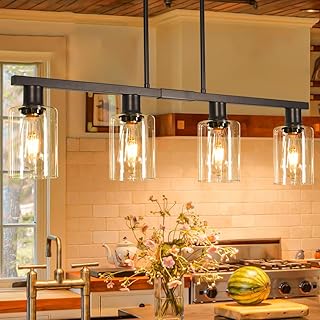
DSMJFU 4-Light Black Bar Island Light
A clean linear bar with clear glass cylinders and genuinely adjustable drop hardware, which makes it forgiving on ceilings between eight and ten feet. The exposed-bulb design means your filament choice matters, so budget for four decent Edison-style LEDs to finish the look properly.
CH9176BK-4IS 4-Light Linear Chandelier
The industrial-farmhouse crossover done without fuss: matte black frame, clear glass, adjustable chain. The chain adjustment is the selling point here, letting you dial in the final height after the canopy is already secured rather than committing during rough-in.
MELUCEE 7-Light 43.3″ LED Linear Fixture
At 43 inches and 35 watts, this integrated LED bar suits islands where bulb changes are a nuisance and even coverage matters more than decorative sparkle. The five selectable color temperatures from 3000K to 6000K make it the most adaptable pick on this list, particularly in kitchens that double as homework tables.
35.4″ Wood and Matte Black 4-Light Chandelier
Mixed-material fixtures anchor a kitchen the way a butcher block anchors a countertop, and the wood beam here softens the black metal without drifting into rustic cliché. Its 35.4-inch length fits standard 5- to 6-foot islands well; measure carefully if yours runs longer.
2-Pack 10.2″ Black and Gold Dome Pendants
Dome shades throw focused downward light, which is exactly what you want over a sink or a defined prep zone. Buying a pair gives you layout freedom, but confirm you have two junction boxes or are willing to add one before ordering.
Frequently Asked Questions
How high should island lighting hang?
Aim for 30 to 36 inches between the countertop and the bottom of the shade. Taller ceilings can push toward 36 inches; if anyone in the household is over six feet, sit at the island and check sightlines before final tightening.
Can I install these myself?
If you are comfortable killing the circuit at the breaker, testing with a non-contact tester, and joining wires with proper connectors, most of these fixtures are a straightforward afternoon. Anything requiring a new junction box, a ceiling fan brace, or work inside your panel warrants a licensed electrician.
Linear bar or multiple pendants?
One junction box means a linear bar unless you enjoy drywall patching. Pendants offer better spacing control and a more custom result, but the wiring work scales with each additional light.
Do I need dimmers?
Strongly recommended. Full brightness suits prep work; 30 percent turns the same island into evening ambient lighting. Confirm your fixture and bulbs are dimmable, and pair integrated LEDs with an LED-rated dimmer.
Final Thoughts
For most retrofits, the DSMJFU 4-Light bar and the CH9176BK-4IS deliver the best combination of adjustable hardware and timeless clear-glass styling on a single existing junction box. If you want maintenance-free light with tunable color temperature over a longer island, the MELUCEE 7-Light LED is the smarter long-term buy.