Key takeaways
- Rub count over everything: Dining seats need at least 15,000 double rubs on the Wyzenbeek scale. Listings that skip this number are usually decorative-weight goods dressed up as upholstery — fine for a pillow, wrong for a chair you eat dinner in every night.
- Weave tightness: Run your thumbnail across the surface. Loose basketweaves and slubby textures snag on belt buckles and chair backs, and once a thread pulls on a seat deck the whole panel looks tired. Tight, flat weaves age better under compression.
- Stretch direction: Fabric with slight give in one direction wraps foam corners without puckering. Rigid jacquards and vinyls need relief cuts and patience at the corners; softer faux linens forgive sloppy pleating.
- Yardage per seat, honestly: A standard 16″ drop-in pad eats roughly half a yard once you account for the 3″ wrap under the frame. Six chairs means three yards minimum, and four if the fabric has a pattern you need to line up. Buy the extra half yard — remnant math never works out.
- Cleanability matches your household: Woven textiles wick spills into the foam. Vinyl and coated surfaces wipe clean and go back to looking new. Be realistic about who sits in these chairs before you commit to something absorbent.
What's inside
Reupholstering dining chairs is one of the few weekend projects where the payoff is immediate and obvious. Pull the seat pads off, staple on something better, put them back — the room looks different by dinner. The hard part isn’t the labor, it’s standing in front of a wall of fabric options trying to figure out which one survives a toddler with spaghetti, a dog who thinks chairs are furniture-shaped stairs, and about four thousand sit-downs a year. Pick wrong and you’re back at it in eight months, prying out staples you set yourself.
What follows is a working maker’s take on dining chair fabric: what holds up on a seat deck, what stretches nicely over a curved foam edge, and what fights you the whole way. I’ve grouped picks by the situations that actually come up — bulk yardage for a full six-chair set, wipeable surfaces for households with kids, and heavier woven goods for formal seating. Measurements, cleaning realities, and the yardage math are all covered below.
As an Amazon Associate we earn from qualifying purchases.




How to Choose a Fabric For Upholstering Dining Chairs (2026)
- Rub count over everything: Dining seats need at least 15,000 double rubs on the Wyzenbeek scale. Listings that skip this number are usually decorative-weight goods dressed up as upholstery — fine for a pillow, wrong for a chair you eat dinner in every night.
- Weave tightness: Run your thumbnail across the surface. Loose basketweaves and slubby textures snag on belt buckles and chair backs, and once a thread pulls on a seat deck the whole panel looks tired. Tight, flat weaves age better under compression.
- Stretch direction: Fabric with slight give in one direction wraps foam corners without puckering. Rigid jacquards and vinyls need relief cuts and patience at the corners; softer faux linens forgive sloppy pleating.
- Yardage per seat, honestly: A standard 16″ drop-in pad eats roughly half a yard once you account for the 3″ wrap under the frame. Six chairs means three yards minimum, and four if the fabric has a pattern you need to line up. Buy the extra half yard — remnant math never works out.
- Cleanability matches your household: Woven textiles wick spills into the foam. Vinyl and coated surfaces wipe clean and go back to looking new. Be realistic about who sits in these chairs before you commit to something absorbent.
The Best Fabric For Upholstering Dining Chairs (2026)s Reviewed
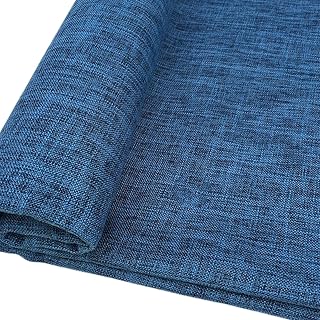
TinaKim Thick Upholstery Fabric, Faux Linen (Grey Blue)
This is the safe default for a first-time reupholstery job — substantial enough that the staple crown bites without tearing through, with just enough hand to smooth over foam corners. The 57″ width means you can get two seat panels side by side from a single cut, which makes the 2-yard cut go further than the number suggests.
TinaKim Velvet Upholstery Cloth for Dining Chairs (Light Green, 6 Yards)
Six yards is the right buy for a full dining set, and velvet on a seat deck reads far more expensive than the effort involved. One caution from experience: velvet has a nap direction, so mark your arrows on the back of every panel before cutting or you’ll end up with chairs that read two different shades under overhead light.
Faux Leather Vinyl Upholstery Fabric, 1.3mm (Cocoa)
If your dining chairs see kids, sauce, or anything with a stem and a glass, this is the practical answer. The composite backing gives it enough body to hold a crisp wrapped edge, and the 1.3mm thickness resists the pinholing that thinner vinyls develop around staple lines after a season of use.
Damask Upholstery and Drapery Jacquard (Sand)
A woven jacquard brings genuine texture and pattern to formal seating, with the durability that comes from a dense structure rather than a printed surface. Budget an extra half yard for pattern centering — a damask motif landing off-center on a seat pad undoes all your careful work.
Faux Linen Needlework Fabric, 3.3 Yards x 57″
The 3.3-yard cut is an odd but useful size that covers four to five chairs with a little left over for a matching bench or cushion. It’s a softer hand than the thicker TinaKim goods, so pair it with a layer of muslin over the foam if your seats get heavy daily use.
Frequently Asked Questions
How much fabric do I need for six dining chairs?
Plan on three to four yards at 57″ width for standard drop-in seat pads. Measure the pad’s width and depth, add 6″ to each dimension for the wrap, then lay out your panels on paper before cutting. Patterned fabric needs roughly 25% more.
Can I upholster over the existing fabric?
You can, and it saves an hour of staple removal, but only if the old layer is clean, dry, and not compressed into a hard shell. Adding bulk changes how the pad seats in the frame, so test-fit one chair before doing all six.
Do I need to replace the foam?
If the pad doesn’t spring back when you press it, yes. New fabric over dead foam still feels like a dead chair. A 2″ high-density foam sheet plus a thin batting wrap is inexpensive and makes the biggest difference in comfort.
What staples work best?
A manual or pneumatic staple gun with 1/4″ to 3/8″ crown staples covers most hardwood chair frames. Go shorter on thin plywood decks — a staple that punches through the underside is a snag waiting to happen.
Final Thoughts
For most dining rooms, the TinaKim Thick Faux Linen is the easiest fabric to work with and the hardest to get wrong. If your chairs live a harder life, the 1.3mm Faux Leather Vinyl wipes clean indefinitely and holds a sharp wrapped edge, while the TinaKim Velvet in 6 yards is the pick when you want a full set to look genuinely upgraded rather than merely repaired.