Key takeaways
- Material and repairability: Solid hardwood or rubberwood tops can be sanded, planed, and refinished indefinitely. Particle board with a laminate face is cheaper and flat out of the box, but once you gouge or soak it, that spot stays ruined. Choose based on how rough you plan to be.
- Thickness over footprint: A 1.5″ slab resists deflection far better than a 3/4″ panel of the same width. If you plan to hammer, chisel, or mount a vise, thickness buys you stability that no amount of extra surface area will.
- Clamping access: Look for overhanging edges, dog holes, or T-track. A top flush with an apron on all four sides is genuinely frustrating — you’ll spend more time inventing workarounds than working. Dog holes on a 96mm grid open up an entire ecosystem of holdfasts and stops.
- Height and your actual body: Roughly 34″ to 36″ suits general assembly and power tool work; hand planing wants something closer to hip height. Adjustable legs are worth paying for if you switch between tasks or share the bench.
- Mobility versus mass: Casters let you reclaim floor space, but wheels transmit vibration and can creep during heavy work. If you go mobile, insist on locking casters and enough weight to stay planted.
What's inside
Every project you’ve ever botched can probably be traced back to the surface it happened on. A top that flexes under clamp pressure, a laminate skin that swells the first time you spill mineral spirits, legs that walk sideways when you’re planing a board — these are the quiet saboteurs of a home shop. Most people buy a workbench once, regret it for a decade, and blame their own skills. The top is doing at least half the work in any bench, and it’s the part that decides whether your bench feels like a tool or an obstacle.
This guide sorts through the workbench tops and complete benches worth your money in 2026, from solid butcher block slabs you finish yourself to portable vise stations and rolling carts for tight garages. I’ve focused on what actually matters day to day: how the surface handles clamping, dents, moisture, and repeated abuse, and whether the price reflects real structure or just a thick coat of paint over particle board.
As an Amazon Associate we earn from qualifying purchases.




🛒 Best Price Today on Amazon
Prime members get fast, free shipping on everything above, plus member-only deals. New members get a 30-day free trial — cancel anytime.
How to Choose a/an Workbench Tops (2026)
- Material and repairability: Solid hardwood or rubberwood tops can be sanded, planed, and refinished indefinitely. Particle board with a laminate face is cheaper and flat out of the box, but once you gouge or soak it, that spot stays ruined. Choose based on how rough you plan to be.
- Thickness over footprint: A 1.5″ slab resists deflection far better than a 3/4″ panel of the same width. If you plan to hammer, chisel, or mount a vise, thickness buys you stability that no amount of extra surface area will.
- Clamping access: Look for overhanging edges, dog holes, or T-track. A top flush with an apron on all four sides is genuinely frustrating — you’ll spend more time inventing workarounds than working. Dog holes on a 96mm grid open up an entire ecosystem of holdfasts and stops.
- Height and your actual body: Roughly 34″ to 36″ suits general assembly and power tool work; hand planing wants something closer to hip height. Adjustable legs are worth paying for if you switch between tasks or share the bench.
- Mobility versus mass: Casters let you reclaim floor space, but wheels transmit vibration and can creep during heavy work. If you go mobile, insist on locking casters and enough weight to stay planted.
The Best Workbench Tops (2026)s Reviewed
CAMMOO 48×24 Garage Work Bench with Storage & Pegboard
This is the closest thing to a turnkey shop station on the list: rubberwood top rated to 2000 lb, integrated pegboard, LED task lighting, and ETL-listed outlets so you’re not running an extension cord across the floor. The adjustable height and built-in power make it a strong single purchase for a garage corner that needs to do everything.
Unfinished Birch Butcher Block Countertop, 60″ x 25″ x 1.5″
A genuine solid birch slab at a fair price, sanded smooth and ready for whatever finish you prefer — boiled linseed oil for a working surface, poly if you want spill resistance. At 1.5″ thick and five feet long it’s rigid enough to build a proper bench around, and you can flatten it with a hand plane years from now.
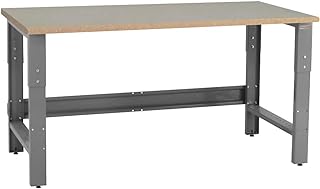
BenchPro Table & Workbench, 1″ Particle Board Top
Honest, no-frills, and height adjustable from 30″ to 36″, which is unusual at this price. The 1″ particle board top won’t survive abuse, but for electronics, packing, hobby work, or as a sacrificial base you skin with hardboard, it’s a sensible value.
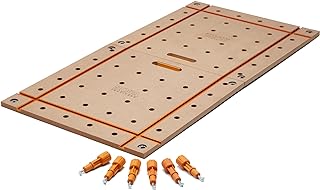
BORA Centipede T-Track Workbench Top
The 3/4″ dog hole grid plus T-track turns this into a legitimate MFT-style clamping platform, and paired with a Centipede base it collapses flat for storage. This is the pick for anyone working out of a shared garage or hauling gear to a jobsite.
Smart Workstation Pro Vise Top with Jaw Cushions
European beech construction and integrated jaws make this a portable clamping station rather than a full bench — think trim carpentry, instrument repair, or apartment woodworking. It grips awkward shapes securely and stores in a closet, which is a real advantage when you don’t have floor space to spare.
Frequently Asked Questions
What thickness should a workbench top be?
For general home shop work, 1.5″ of solid wood is the sweet spot — stiff enough for vise mounting and hand tool work without becoming unmanageably heavy. Go to 2″ or laminate two layers if you plan serious hand planing or heavy metalwork.
Is particle board acceptable for a workbench?
For light assembly, soldering, or crafts, yes, and it’s dead flat out of the factory. It fails under moisture and point loads though, so treat it as a base and screw a replaceable 1/4″ hardboard sheet on top.
How should I finish an unfinished butcher block top?
A penetrating oil like boiled linseed or a hardwax oil is ideal for a working bench: it repels moisture, doesn’t chip, and you can spot-repair scratches by wiping on more oil. Skip glossy polyurethane, which peels under clamp pressure and makes glue squeeze-out harder to scrape cleanly.
Are rolling workbenches stable enough for real work?
Good ones are, provided the casters lock and the bench carries some mass. Expect a little vibration during aggressive sawing or hammering; if that bothers you, a fixed bench bolted or shimmed against a wall is the better answer.
Final Thoughts
If you want one purchase that solves the whole problem, the CAMMOO 48×24 bench delivers a durable rubberwood surface with storage, lighting, and outlets already sorted. Builders who’d rather design their own base should start with the unfinished birch butcher block slab — it’s the best raw material per dollar here and will outlast most of the shop around it. And for anyone short on space, the BORA Centipede T-Track top gives you serious clamping capability that folds away when the car needs its spot back.