Key takeaways
- Hinge and locking mechanism: This is the single failure point on any flip-up design. Look for a welded or heavy-gauge stamped hinge with a quick-release safety pin, not a friction fit. The pin should hold the ladder both in the down position and stowed up, so wind and wake can’t drop it back into the water on its own.
- Step width and profile: Narrow round rungs cut into wet feet and get slippery fast. Extra-wide steps in the 4-inch range with a punched or ribbed non-slip surface make a real difference when you’re climbing out cold and tired. Overall ladder width of 18 to 20 inches lets you plant both feet naturally.
- Step count versus freeboard: Measure from the top of your deck to the waterline at its lowest seasonal point. You want at least two rungs submerged at normal water level. Four steps suit most residential docks with 12 to 18 inches of freeboard; high-deck or fluctuating-level installations need six or seven.
- Material and corrosion resistance: Marine-grade aluminum with stainless fasteners is the baseline. In salt water, check that the manufacturer specifies stainless hardware rather than plated steel — galvanized bolts will bleed rust streaks down your decking within a season and seize in the hinge.
- Mounting reality check: Rated capacity means nothing if the deck board underneath splits. Plan to through-bolt into a joist or add a backing block, and dry-fit the ladder before drilling to confirm the flip-up arc clears your dock edge, bumpers, and any cleats.
What's inside
Anyone who has spent a summer maintaining a dock knows the ladder is the first thing to fail. Fixed ladders sit in the water year-round, collecting algae on the lower rungs, taking hits from wake and drifting debris, and freezing into the ice if you’re on a northern lake. By August the bottom step is slick enough to be genuinely dangerous, and by spring the whole assembly has been twisted out of alignment. A flip-up ladder solves the problem mechanically rather than with maintenance: the rungs swing clear of the waterline when nobody is swimming, so the parts that matter stay dry, clean, and intact.
This guide is written from a build-and-install perspective rather than a catalog one. I’ve broken down what actually determines whether a flip-up dock ladder holds up over multiple seasons — hinge design, tube wall thickness, step width, and how the mounting hardware transfers load into your deck framing — then reviewed the models worth your time in 2026. Whether you’re mounting to a pressure-treated wood dock, an aluminum frame, or a pontoon transom, there’s a match below.
As an Amazon Associate we earn from qualifying purchases.


🛒 Best Price Today on Amazon
Prime members get fast, free shipping on everything above, plus member-only deals. New members get a 30-day free trial — cancel anytime.
How to Choose a/an Flip-Up Dock Ladder (2026)
- Hinge and locking mechanism: This is the single failure point on any flip-up design. Look for a welded or heavy-gauge stamped hinge with a quick-release safety pin, not a friction fit. The pin should hold the ladder both in the down position and stowed up, so wind and wake can’t drop it back into the water on its own.
- Step width and profile: Narrow round rungs cut into wet feet and get slippery fast. Extra-wide steps in the 4-inch range with a punched or ribbed non-slip surface make a real difference when you’re climbing out cold and tired. Overall ladder width of 18 to 20 inches lets you plant both feet naturally.
- Step count versus freeboard: Measure from the top of your deck to the waterline at its lowest seasonal point. You want at least two rungs submerged at normal water level. Four steps suit most residential docks with 12 to 18 inches of freeboard; high-deck or fluctuating-level installations need six or seven.
- Material and corrosion resistance: Marine-grade aluminum with stainless fasteners is the baseline. In salt water, check that the manufacturer specifies stainless hardware rather than plated steel — galvanized bolts will bleed rust streaks down your decking within a season and seize in the hinge.
- Mounting reality check: Rated capacity means nothing if the deck board underneath splits. Plan to through-bolt into a joist or add a backing block, and dry-fit the ladder before drilling to confirm the flip-up arc clears your dock edge, bumpers, and any cleats.
The Best Flip-Up Dock Ladder (2026)s Reviewed
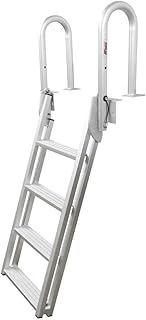
JIF Marine Hinged Flip-Up Dock Ladder, 4-Step
The 750 lb rating combined with 4-inch wide steps and a quick-release safety pin makes this the most confident all-rounder here, and the lift-up geometry is clean enough that it clears typical dock bumpers without modification. Welds are tidy and the hardware is genuinely marine-grade, which is where cheaper ladders cut corners.
Dockmate Wide 5-Step Flip-Up Ladder
The standout feature is the pair of handrails, which transform the experience for kids, older swimmers, or anyone climbing out in chop — you get three points of contact instead of two. The extra step and 750 lb capacity make it the right pick for higher decks or salt-water installs where corrosion resistance is non-negotiable.
Dock Edge Flip Up Wide Step Ladder, 7 Step
Fully welded construction and seven wide rungs make this the specialist choice for tall docks, seawalls, and reservoirs with significant water-level swing. It’s heavy and priced accordingly, but a welded frame eliminates the bolted joints that loosen and rattle over years of use.
VEVOR Flip-Up Dock Ladder, 4-Step
Strong value at a 350 lb rating with non-slip wide steps and a pull-rope assist that makes flipping the ladder up from deck level genuinely easy. Ideal for pontoons and seasonal freshwater docks; I’d upgrade the supplied fasteners to stainless if you’re near salt.
Extreme Max 3005.4227 Slanted 4-Step
The slanted geometry is the reason to buy this one — angled rungs are far more natural to climb than a vertical ladder, especially for anyone with limited mobility. The round-tube frame is comfortable in hand, though the 300 lb capacity puts it at the lighter-duty end of this list.
Frequently Asked Questions
How many steps do I actually need?
Measure your deck height above the water at the lowest point of the season, then add enough rungs to keep two steps submerged. Most residential docks land on four steps; anything over roughly 30 inches of freeboard should go to five or more.
Can I install one of these myself?
Yes, and it’s usually a one-afternoon job with a drill, a socket set, and a helper. The critical part is through-bolting into solid framing rather than lag-screwing into a single deck board, and using a marine sealant on the fastener holes to keep water out of the wood.
Will an aluminum ladder survive salt water?
Marine-grade aluminum handles salt well, but the fasteners decide the outcome. Swap in 316 stainless bolts if the ladder ships with anything less, rinse the hinge periodically, and give the pivot a shot of marine grease at the start of each season.
Do flip-up ladders help with winter storage?
Considerably. Flipping the ladder up and pinning it keeps the rungs out of forming ice, which is what bends and destroys fixed ladders. For severe freeze-thaw regions, pull the ladder off its brackets entirely and store it in the garage.
Final Thoughts
For most docks, the JIF Marine 4-Step hits the best balance of capacity, step comfort, and hardware quality at a reasonable price. Step up to the Dockmate Wide 5-Step if you want handrails and salt-water durability, or the fully welded Dock Edge 7-Step when deck height and water-level swing demand serious reach.