Key takeaways
- Desk workers: short stretching breaks for the hips, hamstrings, chest and shoulders help counter long hours of sitting.
- Calisthenics and bodyweight trainees: with a pull-up and dip attachment, the ladder covers hanging, pulling, pressing and core work in one station.
- People following a rehab or posture program: the evenly spaced rungs allow precise, supported positions that therapists use for stretching and corrective exercise.
- Climbers, dancers and martial artists: grip training, active flexibility and leg-swing drills all benefit from a solid fixed support.
- Families: one ladder can serve adults for training and children for supervised climbing, as long as it is rated and installed for the heaviest user.
Buying a Swedish ladder for adults is less straightforward than it looks. Listings often use “stall bar,” “wall gym,” and “gymnastics ladder” interchangeably, while the real differences are in timber quality, anchor layout, included attachments, wall compatibility, and how much room you need to move safely. A good-looking ladder is not automatically a good training station.
This guide takes a practical, hands-on DIY maker approach. I’ve focused on construction, adjustability, exercise options, installation considerations, and everyday usability so you can choose a wall-mounted setup that suits stretching, mobility work, calisthenics, or general home training.
Our top picks



As an Amazon Associate we earn from qualifying purchases at no extra cost to you. Ratings are shown as listed on Amazon.
Who a Swedish Ladder Suits Best
A Swedish ladder is one of the most versatile pieces of home equipment for its footprint, but it suits some goals better than others. It is a particularly good fit for:
- Desk workers: short stretching breaks for the hips, hamstrings, chest and shoulders help counter long hours of sitting.
- Calisthenics and bodyweight trainees: with a pull-up and dip attachment, the ladder covers hanging, pulling, pressing and core work in one station.
- People following a rehab or posture program: the evenly spaced rungs allow precise, supported positions that therapists use for stretching and corrective exercise.
- Climbers, dancers and martial artists: grip training, active flexibility and leg-swing drills all benefit from a solid fixed support.
- Families: one ladder can serve adults for training and children for supervised climbing, as long as it is rated and installed for the heaviest user.
It is a weaker choice if your main goal is heavy barbell strength training, or if you rent and cannot fix anything securely to the walls. In those cases a freestanding rack or a doorway bar may suit you better, as covered in the comparison further down.
🛒 Best Price Today on Amazon
Prime members get fast, free shipping on everything above, plus member-only deals. New members get a 30-day free trial — cancel anytime.
How to Choose a Swedish Ladder For Adults (2026)
- Build quality: Look for solid wood components, smoothly finished rungs, sturdy side rails, and hardware that feels appropriate for repeated loading.
- Wall structure: Plan to anchor the ladder into suitable studs, masonry, or another structurally sound surface; drywall alone is not enough.
- Attachments: Pull-up bars, dip bars, straps, and suspension points expand training options, but removable parts are useful when you need a clear wall.
- Dimensions: Measure ceiling height, wall width, floor clearance, and the space needed for swinging straps or extending your legs during mobility exercises.
- Safety details: Check the stated load rating, inspect fasteners regularly, and use a qualified installer if you are uncertain about the wall or mounting method.
Wood Types and Frame Materials
The timber in a Swedish ladder decides how the rungs feel in your hands, how well they resist dents and how much flex you notice under load. Listings rarely explain the differences, so here is what each common material means in practice.
- Pine: the most common choice on budget and mid-priced ladders. It is lighter and cheaper but softer, so rungs can dent or wear faster where feet and hands land most. Thicker rungs and sound joinery make up for much of that.
- Beech: the traditional European choice for wall bars. It is a dense, fine-grained hardwood that stays smooth under the hands and resists denting well, which is why many therapy and school models use it.
- Ash and oak: strong hardwoods used on premium ladders. Ash has a long history in gymnastics equipment because it combines strength with a little natural give.
- Mahogany and other exotic hardwoods: found on higher-end models chosen partly for appearance. Strength depends on the specific timber, so judge by the stated rating rather than by the name.
- Steel and wood hybrids: steel uprights with wooden rungs. The frame is stiffer and less prone to racking, while the wooden rungs still feel warm and grippy. These suit heavier users and anyone who plans dynamic work on attachments.
Whatever the material, look for smoothly sanded rungs with no splinters at the joints, a durable finish that is not slippery, and rungs that sit firmly in the side rails without rotation.
Sizing: Height, Width, Rung Spacing and Clearance
A Swedish ladder that does not suit your ceiling or your body is frustrating to use, so measure before you shortlist anything.
- Height: most adult models stand around 7 to 8 feet tall. Leave enough room above the top rung for your head and hands during hanging and pull-ups, and remember that a pull-up bar fitted at the top needs clearance above it as well.
- Width: narrow ladders around 30 inches suit stretching and small rooms. Wider frames of about 36 inches or more give space for wide-grip hangs, side-lying stretches and two-handed work at shoulder width.
- Rung spacing: rungs are usually spaced roughly 6 inches apart. Closer spacing gives more positions for stretching and rehab work; wider spacing is common on budget models with fewer rungs.
- Rung diameter: thicker rungs, around 1.5 inches, are comfortable for adult hands during hangs. Very thin rungs feel harsh under body weight.
- Stand-off from the wall: the rungs must sit far enough from the wall for your fingers to wrap all the way around. Some designs offset the top section outward so pull-ups and hanging leg raises do not end with knees against the wall.
- Floor space in front: plan on a clear zone of roughly 6 to 8 feet in front of the ladder for straps, dips and leg-swing stretches, plus space to the sides for lateral mobility drills.
Weight Ratings: What the Numbers Really Mean
Stated capacities on adult Swedish ladders range widely, from around 220 pounds to 880 pounds on some solid hardwood models. Treat those numbers carefully.
A rating usually describes how much load the frame can hold when it is installed exactly as instructed into a suitable wall. It does not account for dynamic forces. Dropping into a dead hang, swinging, kipping or doing fast dips can put far more force through the frame and fixings than your body weight alone. As a rule of thumb, choose a rating with a comfortable margin above your body weight, and a larger margin if you plan explosive work or will have two people using it.
The rating also only applies to the frame. Removable pull-up and dip attachments often carry their own, lower limits, and the wall fixings are frequently the true weak point. A heavy-rated ladder on poorly anchored screws is only as strong as those screws.
Attachments That Add Real Value
Attachments turn a stretching ladder into a compact home gym, but only some of them earn their place.
- Pull-up bar: the most useful add-on for adults. Look for one that clamps or bolts securely and sits far enough from the wall for full range of motion.
- Dip bar or station: adds pressing work for chest and triceps. Height-adjustable designs suit users of different sizes.
- Suspension straps: anchor points for rows, assisted squats and core work. Check that the anchor point and straps carry a stated rating.
- Resistance band hooks: simple but handy for rehab, mobility and assisted pull-up progressions.
- Removable designs: attachments that lift off quickly matter when the ladder shares space with a living room or children’s play area.
The Best Swedish Ladder For Adults (2026)s Reviewed
Swedish Ladder with Pull-Up and Dip Station
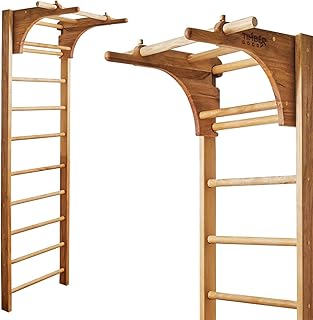
This solid-pine Swedish ladder combines a nine-anchor frame with adjustable pull-up and dip accessories, making it one of the more versatile choices for a home gym. It suits adults who want one compact station for assisted stretching, hanging work, dips, and bodyweight exercises, although careful wall anchoring is essential.
DHT Wood Stall Bar
The DHT Wood Stall Bar uses nine strategically positioned rods and a suspension-trainer design aimed at home, gym, school, and clinic use. Its straightforward layout should appeal to buyers who prefer a clean mobility station that can also support straps and controlled bodyweight training.
Multi-Function Gymnastics Swedish Ladder
This wall-mounted wooden gymnastics bar is designed for mixed household use, with a format that works for both adults and children. It is a sensible pick for families seeking stretching and coordination equipment, but adults should verify the dimensions and rated capacity before using it for demanding movements.
GMWD Swedish Ladder Stall Bar
GMWD’s stall bar adds pull-up and dip attachments to a nine-rod wooden frame, giving it a broader exercise range than a basic ladder. The design is well suited to core work, stretching, and balance drills, while the removable or adjustable elements can make it easier to tailor the station to different users.
Solid Beech Swedish Ladder with Removable Bars
Made from solid beech, this wall stall bar emphasizes a substantial frame and includes a removable pull-up bar and dip bar. Its generous stated load capacity is attractive for adult training, but treat any published rating as dependent on correct installation, suitable fixings, and a sound supporting wall.
VEVOR 9-Level Swedish Ladder — Best Budget Steel-and-Wood Frame
As an Amazon Associate we earn from qualifying purchases at no extra cost to you.

VEVOR’s nine-level ladder is one of the least expensive ways to put a full-height Swedish ladder on the wall without dropping to a children’s model. The listing describes a solid wood and carbon steel construction with a stated 330-pound load rating, which is a sensible figure for most adults doing stretching, hanging and controlled bodyweight work. It is also listed as compatible with 3.15 x 3.15-inch power rack accessories, so you may be able to add some rack-style attachments over time.
It suits beginners and budget-conscious home gyms that want a mobility station first and a strength station second. With nine levels, there are fewer rung positions than on therapy-focused ladders, so fine-grained stretching progressions are more limited. Check exactly which straps and attachments are included before ordering. It usually costs around $90–$110.
Pros
- Very low price for an adult-height ladder
- Stated 330-pound rating with a steel-reinforced frame
- Listed compatibility with common rack accessories
Cons
- Fewer rungs than premium models
- Included attachments vary, so read the listing closely
JOYMOR Gymnastics Swedish Ladder — Best Simple Stretching Ladder

The JOYMOR ladder keeps things straightforward: a wall-mounted wooden stall bar with a pull-up bar, marketed for stretching, physical therapy routines, yoga and general exercise. It is a good fit for adults whose main goals are mobility, posture work and gentle strength training rather than heavy dips or weighted pull-ups.
The appeal is the price and simplicity. There are fewer accessories to assemble and fewer moving parts to check. Because the listing title does not state a load rating, confirm the stated capacity and wall-fixing guidance on the product page before buying, especially if you are a heavier user or plan to hang for long periods. It usually costs around $90–$120, which makes it an easy entry point to see whether a Swedish ladder fits your routine.
Pros
- Affordable and uncomplicated
- Well suited to stretching and therapy-style routines
- Includes a pull-up bar for hanging work
Cons
- Load rating needs checking on the listing
- Fewer extras than multi-station models
PreGymnastic Steel-Frame Stall Bars — Best Mid-Range Hybrid Build

PreGymnastic pairs solid beech wood rods with a steel frame, which gives you the comfortable grip of hardwood rungs and the stiffness of metal uprights. That combination is a strong match for adults who want to use the attachments hard, because a steel frame resists the side-to-side racking that can develop in all-wood frames over time.
The set includes an adjustable pull-up and dip attachment, so it covers strength and flexibility work in one station, and the listing positions it for home gyms and studios as well as family use. The beech rods are a step up from the pine found on many models at this price. As with any hybrid, check the overall height and the anchor positions against your wall before ordering. It usually costs around $180–$220.
Pros
- Beech rungs with a rigid steel frame
- Adjustable pull-up and dip attachment included
- Good value for a hardwood-rung design
Cons
- Industrial look may not suit every room
- Confirm the stated load rating before heavy use
DHT Swedish Ladder 2.0 — Best Premium Multi-Station Ladder

DHT’s second-generation ladder builds on the brand’s simpler stall bar reviewed above with 11 strategically placed rods instead of nine, plus suspension trainer straps and a pull-up and dip bar attachment in the box. The listing targets home, school, physical therapy and gymnastics use, and the white finish gives it a cleaner look than most wooden ladders.
The extra rods add more positions for stretching progressions and rehab drills, while the included straps and pull-up and dip attachment mean there is little to buy separately. It suits adults who want one premium station for mobility, suspension training and bodyweight strength, and who prefer a ladder that looks at home in a living space. The trade-off is price: it usually costs around $530–$600, roughly double many mid-range ladders.
Pros
- 11 rods for finer stretching and rehab positions
- Straps plus pull-up and dip attachment included
- Clean white finish for shared living spaces
Cons
- Premium price
- Light finish shows chalk and scuffs more readily
Beyond Balance Beech Swedish Ladder — Best for Physical Therapy and Pilates

Beyond Balance designs its stall bars specifically for fitness, Pilates and physiotherapeutic scoliosis-specific exercise, often shortened to PSSE. This model uses 15 beech rungs of 1.5-inch diameter, which is a generous rung count and a comfortable grip size for adult hands. The close rung spacing that comes with 15 rungs is exactly what therapists use for precise positioning during corrective exercises and stretching.
It suits adults following a structured rehab or posture program, Pilates instructors and anyone who wants a ladder built around controlled movement rather than heavy strength work. The focus is precision and quality of timber, not accessories, so do not expect bundled pull-up or dip stations. It usually costs around $580–$650.
Pros
- 15 beech rungs for fine positioning
- 1.5-inch rungs suit adult hands
- Designed for therapy and Pilates use
Cons
- High price for a ladder without bundled attachments
- Less suited to dips and heavy strength work
Vita Vibe VSB36-90 Stall Bars — Best Wide Ladder for Tall Users

The Vita Vibe VSB36-90 is a 36-inch-wide, 90-inch-tall stall bar from a brand that focuses on gymnastics and fitness equipment. The width is the main reason to choose it: a 36-inch frame gives taller and broader adults room for wide-grip hangs, side stretches and two-handed work without crowding, and the 90-inch height suits rooms with standard or taller ceilings.
It is a good choice for home gyms, studios and therapy spaces where the ladder is a permanent fixture and several people of different sizes will use it. Vita Vibe also sells add-on attachments for some of its stall bar lines; confirm which ones fit this series before planning a setup around them. At 90 inches, measure your ceiling and leave room above the top rung for hanging. It usually costs around $650–$720.
Pros
- Wide 36-inch frame for larger adults
- Tall 90-inch height for full stretching range
- Well suited to shared studio or clinic use
Cons
- Among the most expensive options here
- Needs a tall ceiling and plenty of wall width
Swedish Ladder Comparison at a Glance
| Model | Build | Main extras | Stated capacity | Price tier | Best for |
|---|---|---|---|---|---|
| Swedish Ladder with Pull-Up and Dip Station | Solid pine, 9 anchors | Adjustable pull-up and dip | Check listing | Mid | All-round home gym |
| DHT Wood Stall Bar | Wood, 9 rods | Suspension trainer design | Check listing | Mid | Clean mobility station |
| Multi-Function Gymnastics Swedish Ladder | Wood | Gymnastics bar layout | Check listing | Mid | Shared family use |
| GMWD Swedish Ladder Stall Bar | Wood, 9 rods | Pull-up and dip attachments | Check listing | Mid | Varied bodyweight work |
| Solid Beech Swedish Ladder | Solid beech | Removable pull-up and dip bars | Up to 880 lb | Mid to upper | Substantial hardwood frame |
| Swedish Ladder Wall Gym with Straps | Wood | Pull-up bar, straps, dip bars | Check listing | Mid | Full-body routines |
| VEVOR 9-Level Swedish Ladder | Wood and carbon steel | Rack-accessory compatible | 330 lb | Budget | Lowest-cost adult ladder |
| JOYMOR Gymnastics Swedish Ladder | Wood | Pull-up bar | Check listing | Budget | Simple stretching |
| PreGymnastic Stall Bars | Beech rods, steel frame | Adjustable pull-up and dip | Check listing | Mid | Hybrid stiffness on a budget |
| DHT Swedish Ladder 2.0 | Wood, 11 rods | Straps, pull-up and dip | Check listing | Premium | All-in-one premium station |
| Beyond Balance Beech Ladder | 15 beech rungs, 1.5 in | Therapy-focused layout | Check listing | Premium | Physical therapy and Pilates |
| Vita Vibe VSB36-90 | 36 in wide, 90 in tall | Add-ons sold separately | Check listing | Premium | Tall users and studios |
Price tiers are approximate: budget models usually sell for under $150, mid-range models for roughly $150–$300 and premium models for $300 and up.
Where to Put a Swedish Ladder in Your Home
The best spot is the one with the strongest wall and enough clear space, not necessarily the room you planned to use. Before ordering, walk through these points:
- Wall construction: a wall with accessible studs, solid masonry or concrete is ideal. Avoid thin partition walls, walls with known plumbing or wiring runs at mounting height, and crumbling plaster.
- Ceiling height: measure from the floor to the ceiling and subtract the ladder height. You need room above the top rung or pull-up bar for your head and hands.
- Clear zone: keep the area in front free of furniture, glass, sharp corners and doors that swing into the space. Straps and leg swings need more room than you expect.
- Flooring: a rubber gym mat or firm exercise mat in front of the ladder protects the floor and gives a safer landing during hanging work.
- Climate: keep wooden ladders away from radiators, heating vents and damp areas such as unventilated basements, which can dry out or swell the timber.
- Everyday visibility: a ladder you pass every day gets used far more than one hidden in a garage. Many owners place it in a spare room, home office or living area for that reason.
How to Install a Swedish Ladder Safely
Installation is where a good ladder becomes safe or unsafe. Always follow the manufacturer’s instructions and supplied hardware guidance first; the steps below explain the planning that instructions often skip.
- Find the structure first. Use a stud finder to mark the framing, then confirm each stud with a small test hole or nail. In many homes, studs sit about 16 inches apart on center, but older and renovated walls vary.
- Compare the anchor points with the studs. If the ladder’s mounting brackets do not line up with the framing, do not settle for drywall anchors. The common solution is a horizontal backer board fixed across several studs, with the ladder then mounted to that board.
- Use fixings suited to the wall. Wood framing calls for structural screws or lag screws driven into solid timber. Brick and concrete need masonry anchors rated for the load, installed to the anchor maker’s depth and spacing requirements.
- Pre-drill and check alignment. Pre-drill pilot holes to avoid splitting the rails, and use a level to keep the ladder plumb. A ladder mounted slightly out of square puts uneven stress on the fixings.
- Let the base sit on the floor if designed to. Many ladders are meant to rest on the floor as well as fix to the wall, which takes much of the vertical load off the anchors.
- Load test gradually. Start with a supported stretch, then a brief hang with your feet near the floor, before moving to full hangs, dips or strap work.
- Re-check after the first week. Wood settles and fixings can bed in. Tighten all bolts after the first week of use and then inspect them monthly.
If you are unsure about the wall construction, hidden wiring or plumbing, or the condition of older plaster and masonry, it is worth paying a qualified installer. The cost is small compared with the consequences of a ladder pulling away from the wall mid-exercise.
Beginner Exercises for Adults
A Swedish ladder supports far more than pull-ups. These movements form a simple starting routine. Keep every movement slow and controlled, stop if anything causes sharp pain, and check with a physical therapist first if you have a shoulder, back or joint condition.
Mobility and stretching
- Supported deep squat: hold a rung at chest height and sink into a squat, using the ladder for balance while the hips and ankles open up.
- Hamstring stretch: place a heel on a rung at hip height or lower, keep the back long and hinge forward gently.
- Shoulder and chest opener: face away from the ladder, hold a rung behind you at hip height and step forward slowly to open the front of the shoulders.
- Side bend: stand side-on, hold a rung overhead with one hand and lean away to stretch the side of the torso.
Strength and core
- Dead hang: hang from a high rung or the pull-up bar for short, controlled sets to build grip and decompress the shoulders. Keep your feet close to the floor at first.
- Hanging knee raises: from a hang, or with your back against the ladder, draw the knees up toward the chest without swinging.
- Incline push-ups: place your hands on a rung at waist height; move to lower rungs as you get stronger.
- Assisted pull-ups and dips: use a lower rung under your feet or a resistance band to take some body weight until you can complete full repetitions.
Two or three short sessions a week, mixing mobility and strength, is a realistic starting point. Many people also keep the ladder for quick daily stretching breaks, which is where a wall-mounted station earns its space.
A Simple Weekly Routine
| Day | Focus | Suggested movements |
|---|---|---|
| Day 1 | Mobility | Supported deep squat, hamstring stretch, shoulder opener, side bend |
| Day 2 | Strength | Dead hang, incline push-ups, assisted pull-ups |
| Day 3 | Rest or light stretching | Two or three favorite stretches for a few minutes |
| Day 4 | Core and strength | Hanging knee raises, assisted dips, dead hang |
| Day 5 | Mobility | Repeat Day 1, holding each stretch slightly longer |
Increase difficulty one variable at a time: longer holds, an extra set, a lower rung for push-ups or less band assistance on pull-ups. Rest days matter as much as training days, especially for grip and shoulders.
Swedish Ladder vs Power Rack vs Doorway Pull-Up Bar
If you are weighing up where to spend on home gym equipment, it helps to know what a Swedish ladder does better and worse than the alternatives.
- Doorway pull-up bar: the cheapest way to add hanging and pull-ups, but it offers almost nothing for stretching, positioning or rehab work, and it blocks a doorway while in use.
- Power rack: the right choice for barbell training and heavy loads, but it takes a large floor footprint and offers limited support for mobility, stretching or therapy exercises.
- Swedish ladder: uses very little floor space and excels at mobility, posture, flexibility and bodyweight strength. With attachments it covers pull-ups and dips, but it is not designed for heavy barbell work.
For most adults focused on flexibility, joint health and bodyweight training, a Swedish ladder delivers the widest range of useful exercises per square foot of floor.
Before You Order: Final Checklist
- Measure ceiling height, wall width and the clear floor zone in front of the wall.
- Locate studs or confirm masonry, and check whether the ladder’s anchor points line up or need a backer board.
- Compare the stated load rating with your body weight, leaving a comfortable margin for dynamic movements.
- Confirm exactly which attachments, straps and fixings are included, and whether attachments have their own load limits.
- Check the timber type, rung count and rung diameter against how you plan to use the ladder.
- Read the warranty length and return terms; large wall-mounted equipment can be costly to send back.
- Inspect every part on delivery for cracks, splits or missing hardware before you start drilling.
Frequently Asked Questions
What exercises can adults do on a Swedish ladder?
Common uses include shoulder and hip mobility drills, supported squats, hamstring stretches, hanging exercises, pull-ups, dips, suspension training, and core work. Start with controlled movements and keep the ladder’s intended load and attachment limits in mind.
Is a Swedish ladder suitable for a small home gym?
Usually, yes. The frame occupies relatively little floor space, but you still need a clear area in front of it for stretching, dips, and straps. Measure the usable exercise zone rather than only the ladder’s outer dimensions.
Can I install one on drywall?
Not by relying on drywall anchors alone. The ladder should be fastened through the wall finish into studs, masonry, or a properly engineered mounting structure. If the stud layout does not align with the frame, consult an experienced installer before drilling.
Are wooden stall bars strong enough for adults?
Quality timber can be very strong, but strength depends on the wood, joinery, hardware, wall fixings, and installation. Inspect the rails and rungs for movement before every session, and stop using the unit if you notice cracking, loosening, or unusual flex.
Can I do pull-ups on any Swedish ladder?
Not comfortably on every model. Rungs mounted close to the wall leave little room for your knees and face during a pull-up. A dedicated pull-up bar attachment, or a ladder with an offset top section, places the bar far enough from the wall for a full range of motion.
Can adults and children share the same Swedish ladder?
Yes, as long as the ladder is rated and sized for adults and installed to suit the heavier user. Remove or secure dip bars and straps when children use it unsupervised, and teach them not to climb above a height you are comfortable with.
Are Swedish ladders used for scoliosis and back rehabilitation?
Wall bars are widely used in physical therapy and in physiotherapeutic scoliosis-specific exercise programs because they allow precise, supported positioning. If you are buying one for rehab, follow a program set by a qualified therapist rather than improvising, and favor models with closely spaced rungs.
Do I need pull-up and dip attachments?
Only if strength training is part of your plan. For mobility, stretching and therapy work, the rungs alone are enough. If you want one station for both, choose a model where the attachments are included or easily added later, and check their individual load limits.
How do I maintain a wooden Swedish ladder?
After the first-week re-check described in the installation steps, inspect the bolts monthly. Wipe the rungs with a damp cloth to remove sweat and chalk, keep the ladder away from radiators and damp areas that can dry out or swell the timber, and replace any rung that shows cracks or movement in its socket.
Final Thoughts
For a flexible all-round setup, the Swedish Ladder with Pull-Up and Dip Station is a strong starting point. The GMWD Swedish Ladder is another capable choice for varied bodyweight work, while the solid beech model stands out if a substantial frame and removable attachments are your priorities. Whichever you choose, spend as much care on wall preparation and installation as you do on the ladder itself.