Key takeaways
- Confirm there’s no water inlet at all: Look at the back panel photos. A true no-ice model has a bare cabinet with no inlet valve bracket, which means no line to freeze, kink, or seep behind the toe kick years later.
- Measure the path, not just the alcove: Doorways, stair turns, and hinge-side clearance kill more installs than cabinet width does. Add an inch on each side for airflow and pull the handles off if the doorway is tight.
- Choose frost-free unless you have a reason not to: Auto-defrost models cycle a heater to keep the evaporator clear. Manual-defrost boxes are cheaper and quieter but you’ll be chipping ice with a plastic scraper twice a year.
- Check the ambient rating for garages and basements: Most fridges are specified for roughly 55–110°F. Below that range the compressor short-cycles and the freezer thaws, so garage installs need a unit rated for it.
- Look for reversible doors and leveling feet with real travel: Reversible hinges let you swing the door away from a wall or peninsula, and long leveling feet let you shim out an out-of-plumb floor so the door self-closes instead of drifting open.
What's inside
Every time I pull a refrigerator away from the wall for a friend, the story is the same: a stiff quarter-inch line snaking off a saddle valve, a green crust of mineral deposit at the fitting, and a subfloor with a suspicious dark ring around it. The ice maker is the single most failure-prone assembly in a modern fridge. It has a fill valve, a solenoid, a heater, a motor, a thermistor, and a water path — five or six things that can quit or drip in an appliance whose compressor will happily run for fifteen years. Skip it and you delete an entire category of service call.
The catch is that manufacturers now bundle icemakers into almost every mid-tier model, so finding a genuinely plumbing-free fridge takes some digging. This guide covers the top-freezer and French-door units worth buying in 2026 without factory ice hardware, plus what to measure and check before you commit — door swing, defrost type, ambient temperature rating, and how much freezer volume you actually reclaim when there’s no ice bin hogging the corner.
As an Amazon Associate we earn from qualifying purchases.


How to Choose a/an Refrigerator Without Ice Maker (2026)
- Confirm there’s no water inlet at all: Look at the back panel photos. A true no-ice model has a bare cabinet with no inlet valve bracket, which means no line to freeze, kink, or seep behind the toe kick years later.
- Measure the path, not just the alcove: Doorways, stair turns, and hinge-side clearance kill more installs than cabinet width does. Add an inch on each side for airflow and pull the handles off if the doorway is tight.
- Choose frost-free unless you have a reason not to: Auto-defrost models cycle a heater to keep the evaporator clear. Manual-defrost boxes are cheaper and quieter but you’ll be chipping ice with a plastic scraper twice a year.
- Check the ambient rating for garages and basements: Most fridges are specified for roughly 55–110°F. Below that range the compressor short-cycles and the freezer thaws, so garage installs need a unit rated for it.
- Look for reversible doors and leveling feet with real travel: Reversible hinges let you swing the door away from a wall or peninsula, and long leveling feet let you shim out an out-of-plumb floor so the door self-closes instead of drifting open.
The Best Refrigerator Without Ice Maker (2026)s Reviewed
KoolMore 28″ 14 Cu Ft Top Freezer
At 28 inches wide with a stainless wrap, this is the sweet spot for a galley kitchen or a workshop fridge, and it’s rated for garage use — which matters if your shop swings below 60°F in winter. Simple mechanical guts, no water path, and enough freezer room for a full week of frozen stock.
BLACK+DECKER 16.4 Cu. Ft. Top Mount (BR1640KW)
The biggest usable box in this roundup with separate fridge and freezer temperature controls, so you can run the freezer hard without turning your lettuce to glass. Auto defrost, white enamel finish, and a footprint that still fits a standard 30-inch apartment opening.
Upstreman 14.6 Cu.Ft. Top Freezer (BD146)
My pick when noise is a factor — it’s ENERGY STAR certified, frost free, and quiet enough for a studio or a room adjacent to a bedroom. The electronic thermostat holds temperature more tightly than a mechanical dial, which shows up in produce that lasts an extra few days.
Upstreman 7.7 Cu.Ft. Double Door (BD75)
A genuine two-door compact with a real freezer compartment rather than a chest-style icebox, sized for a dorm, office, or the corner of a shop. Five thermostat settings and a reversible swing make it easy to fit into an awkward nook.
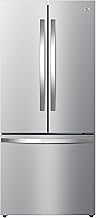
Kenmore 17.5 Cu. Ft. 30″ French Door
French doors in a 30-inch width is a rare combination, and the narrow swing arc is a gift in tight kitchens where a full-size door would clobber the island. Fingerprint-resistant stainless and a bottom freezer drawer that keeps everything in one visible layer.
Frequently Asked Questions
Can I just leave the ice maker turned off instead?
You can, and it removes the mechanical wear, but the water line and fill valve stay pressurized behind the fridge. Shut the supply valve and disconnect the line if you want the leak risk gone.
How much freezer space do I actually gain?
Typically one to two cubic feet in a top freezer, and usually the most reachable real estate in the compartment. It’s the difference between fitting a sheet pan flat and not.
What if I want a dispenser after all?
The Sharp SJF2955KS is the counterpoint — a 28.9 cu. ft. standard-depth French door with an ice and water dispenser and Sharp’s Advanced Cooling Plus system. Buy it knowing you’re adding a plumbing connection.
Are trays and molds a real substitute?
For most households, yes. A pair of silicone cube trays plus an insulated bin in the freezer will out-produce a factory icemaker’s daily yield, and it’s a five-dollar fix when a tray cracks.
Final Thoughts
For most kitchens, the BLACK+DECKER 16.4 Cu. Ft. gives you the most storage per dollar with dual temperature controls, while the Upstreman BD146 is the one I’d install in a quiet space or where energy cost matters. If your opening is 30 inches and you want French doors without a water line, the Kenmore 17.5 cu. ft. is the only sensible answer on this list.