Key takeaways
- Rip capacity: You want 30″ or better to rip a cabinet side from a half sheet without breaking it down first. Anything under 25″ means you’re relying on a track saw for sheet goods, which is a valid workflow but changes what you should buy.
- Fence quality: This is the single spec that separates cabinet-capable from framing-capable. Rack-and-pinion fences that lock parallel every time will save you more grief than extra horsepower ever will. Test it by locking at 12″, unlocking, and returning — you should land dead on.
- Blade diameter and depth of cut: A 10″ blade gives you roughly 3-1/8″ at 90°, enough to cut 3″ thick stock for legs or thick tops. An 8-1/4″ saw caps out around 2-1/2″, which handles sheet goods and 4/4 lumber fine but limits joinery work.
- Dust collection: Cabinet making means hours of MDF and ply dust. Look for a shrouded blade with a 2-1/2″ port. Even a shop vac hooked to a decent shroud pulls 70% of the mess before it reaches your lungs.
- Mobility and setup rigidity: A rolling stand that deploys in under 15 seconds gets used. One that fights you gets skipped, and you end up cutting on sawhorses. Weight is your friend once the legs are locked — flex at the table edge shows up as burn marks and drift.
What's inside
Cabinet work punishes a saw that can’t hold a line. You’re breaking down full sheets of 3/4″ ply, then flipping to face frame stock where a 1/64″ wobble in your rip fence turns into a visible gap at the stile. Most of us aren’t working in a 2,000 sq ft shop with a 5 HP cabinet saw bolted to a concrete slab. We’re in a garage bay, a basement, or a driveway, trying to get furniture-grade cuts out of a saw that has to roll into a corner when the car comes home.
I’ve built enough kitchen boxes and built-ins in cramped spaces to know what actually matters: fence repeatability, rip capacity that clears a 24″ cabinet side, and enough motor to push hardwood without bogging. Below I’ve pulled together the saws and accessories that earn their keep for cabinet work at the hobbyist and pro-adjacent level, plus a buying framework so you’re not guessing at spec sheets.
As an Amazon Associate we earn from qualifying purchases.


🛒 Best Price Today on Amazon
Prime members get fast, free shipping on everything above, plus member-only deals. New members get a 30-day free trial — cancel anytime.
How to Choose a Table Saw For Cabinet Making (2026)
- Rip capacity: You want 30″ or better to rip a cabinet side from a half sheet without breaking it down first. Anything under 25″ means you’re relying on a track saw for sheet goods, which is a valid workflow but changes what you should buy.
- Fence quality: This is the single spec that separates cabinet-capable from framing-capable. Rack-and-pinion fences that lock parallel every time will save you more grief than extra horsepower ever will. Test it by locking at 12″, unlocking, and returning — you should land dead on.
- Blade diameter and depth of cut: A 10″ blade gives you roughly 3-1/8″ at 90°, enough to cut 3″ thick stock for legs or thick tops. An 8-1/4″ saw caps out around 2-1/2″, which handles sheet goods and 4/4 lumber fine but limits joinery work.
- Dust collection: Cabinet making means hours of MDF and ply dust. Look for a shrouded blade with a 2-1/2″ port. Even a shop vac hooked to a decent shroud pulls 70% of the mess before it reaches your lungs.
- Mobility and setup rigidity: A rolling stand that deploys in under 15 seconds gets used. One that fights you gets skipped, and you end up cutting on sawhorses. Weight is your friend once the legs are locked — flex at the table edge shows up as burn marks and drift.
The Best Table Saw For Cabinet Making (2026)s Reviewed
DEWALT DWE7491RS 10″ Table Saw with Rolling Stand
This is the practical answer for most cabinet makers without a dedicated shop — 32-1/2″ of rip clears any cabinet component you’ll cut, and the rack-and-pinion fence returns to the same spot cut after cut, which is exactly what you need when you’re batching out eight identical box sides. The 15 amp motor at 4800 RPM doesn’t complain about ripping hard maple, and the scissor-action stand goes from stored to level in about ten seconds.
DEWALT DWE7485 8-1/4″ Compact Jobsite Saw
Lighter and cheaper than its big brother, this one makes sense if you’re already breaking down sheets with a track saw and want the table saw purely for ripping face frame stock and cutting dados. The 24-1/2″ rip capacity is the real tradeoff, and at 2-1/2″ depth of cut you won’t be resawing, but the fence system carries over from the bigger saw and that’s what matters for joinery accuracy.
DEWALT DWE7485 (Second Configuration)
Worth noting because bundles and kit variations of the DWE7485 show up at different price points, sometimes with an extra blade or a stand included. The saw itself is identical, so buy on whichever package lands cheapest — just verify the guard assembly and riving knife are in the box, since cabinet work involves a lot of narrow rips where the knife earns its place.
10″ Compound Miter Saw with Extension Table
Not a table saw, but no cabinet shop runs without one — crosscutting rails, stiles, and face frame members to repeatable length is miter saw territory, and doing it on a table saw with a sled is slower for volume work. Single bevel 0-45° covers scribe cuts and crown returns, and the 36T blade is adequate for softwood though I’d swap to an 80T for finish-grade plywood.
MXBAOHENG Mini Table Saw S3
This is a specialist tool for a specialist problem: cutting drawer pulls, inlay strips, or scale mockups where a full-size blade is dangerous overkill. Seven-speed control and 1/2″ depth make it genuinely useful for miniature work and small parts, but be clear-eyed that it has nothing to do with production cabinet making.
Frequently Asked Questions
Can a jobsite saw really do cabinet-grade work?
Yes, provided you upgrade the blade and verify the fence is parallel to the blade within a few thousandths. Add a zero-clearance insert and a crosscut sled and a DWE7491RS will produce joinery indistinguishable from a stationary saw’s — you’ll just work slower on thick hardwood.
What blade should I run for plywood and MDF?
An 80-tooth ATB blade for veneered plywood gives clean edges with minimal tearout on both faces. For general ripping, a 24-tooth flat-top or a 40-tooth combination blade keeps the motor happy and reduces burning in hardwood.
Do I need a separate stand?
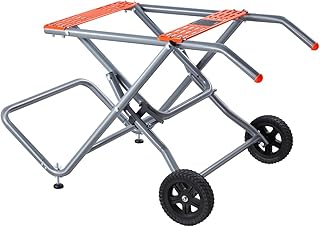
If your saw came without one, or you’re running a benchtop model on sawhorses, a dedicated rolling stand like the VEVOR unit rated to 350 lbs is worth it. A stable base directly affects cut quality — flex under a sheet of ply translates straight into a wandering cut line.
Is 8-1/4″ enough blade for furniture work?
For casework, drawers, and face frames, yes. Once you start cutting thick tabletops, tenons on 3″ legs, or angled bevels in heavy stock, the reduced depth of cut becomes a real constraint and you’ll want the 10″ saw.
Final Thoughts
If you’re building cabinets seriously and can only buy one saw, the DEWALT DWE7491RS is the pick — the 32-1/2″ rip capacity and rack-and-pinion fence handle full-size casework without compromise. The DWE7485 makes sense as a lighter companion if a track saw already handles your sheet breakdown, and pairing either with the VEVOR rolling stand solves the stability problem that quietly ruins otherwise good cuts in a small shop.