Standing in a garage shop staring at a stack of 8/4 walnut, the math gets uncomfortable fast. A table saw can rip it, but it can’t resaw it into bookmatched panels, and it certainly can’t cut the curved apron you sketched last weekend. That’s the gap a 14-inch band saw fills, and it’s why so many furniture builders treat it as the second machine they buy rather than the fifth. The frustration comes when you start shopping: two saws with identical 14-inch throat specs can behave completely differently under load, one tracking a clean veneer slice while the other wanders and burns.
The difference usually comes down to frame rigidity, motor headroom, and how much resaw height you actually get before adding a riser block. This guide walks through six 14-inch machines that hold up in real furniture work — casework, chair parts, drawer sides, shop-sawn veneer — and explains which specs move the needle versus which are marketing filler. Every pick below has been evaluated on the things that matter once the guard closes: blade tension capacity, table stability, dust collection, and whether the fence stays put.
Our top picks


As an Amazon Associate we earn from qualifying purchases at no extra cost to you.
🛒 Best Price Today on Amazon
Prime members get fast, free shipping on everything above, plus member-only deals. New members get a 30-day free trial — cancel anytime.
How to Choose a/an 14 Band Saw (2026)
- Resaw capacity: Standard 14-inch saws give roughly 6 inches under the guide, enough for drawer sides but tight for wide panels. Cast-iron frames accept riser kits to reach 12 inches; welded steel frames often ship with 12 inches built in. Decide which camp you need before spending.
- Motor sizing: One horsepower handles curves and stock under 4 inches all day. If resawing hardwood is part of your plan, 1-1/2 HP or more prevents the bog-down that causes blade drift and burn marks.
- Two-speed drive: A low speed near 1,400 FPM lets you cut aluminum, brass, and plastics without gumming the blade. If you only ever cut wood, single-speed is no loss and one less thing to service.
- Table and trunnion: Solid cast iron kills vibration and keeps the surface flat over decades. Check trunnion width too — narrow castings let the table flex when you lean into a heavy tilted cut.
- Guides and tensioning: Ball-bearing guides above and below the table outperform blocks for thin blades. Look for a quick-release tension lever; releasing tension between sessions extends blade and tire life measurably.
The Best 14 Band Saw (2026)s Reviewed
JET JWBS-14SFX-BLK, 1.75 HP
The 1.75 HP motor and taller frame let this one resaw wide hardwood without a riser block, which removes the alignment headache that riser conversions always introduce. Tension release is fast, the guides adjust without tools, and the dust port actually captures chips instead of packing them into the lower wheel housing.
Powermatic PWBS-14CS, 1-1/2 HP
This is the machine you buy once. The trunnion is unusually beefy for a 14-inch saw, so tilted cuts on thick stock stay square, and the 1-1/2 HP motor has enough reserve for slow, deliberate resaw passes through figured maple.
JET JWBS-14CS, 1 HP
The classic cast-iron 14-inch platform, and a sensible entry point if curves and joinery cuts dominate your work. It accepts a riser block cleanly when your projects outgrow the stock 6-inch capacity, making it a saw you can upgrade rather than replace.
WEN BA1411 Industrial, Dual-Voltage
Dual voltage plus two speeds gives this saw unusual range for the money, and the 120V option means you can run it on an existing garage circuit. The cast-iron table is flat out of the crate, though budget an hour for initial blade tracking setup.
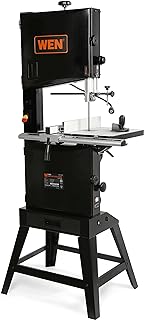
WEN BA1487 with Stand
The included stand and two-speed drive make this the most complete out-of-box package here, ideal for a first band saw in a small shop. Swap the stock blade for a quality 1/2-inch three-TPI and the cut quality jumps immediately.
Frequently Asked Questions
Do I need a riser block?
Only if you plan to resaw stock wider than about 6 inches. Riser blocks add roughly 6 inches of height but require a longer blade and careful column realignment, so buying a taller frame saw is simpler if resawing is a priority.
What blade width should I keep on the saw?
A 1/2-inch, 3-TPI blade covers 80% of furniture work — resawing, ripping, and gentle curves. Keep a 1/4-inch blade nearby for tight radii like cabriole legs or curved brackets.
Is 120V enough, or should I wire 240V?
For 1 HP saws, 120V on a dedicated 15-amp circuit is fine. At 1-1/2 HP and above, 240V reduces amp draw and startup strain, which matters if your circuit already feeds a dust collector.
Why does my blade drift off the line?
Usually blade drift, not operator error. Set your fence to the blade’s natural cutting angle rather than parallel to the miter slot, and verify tension is adequate for the blade width.
Final Thoughts
For serious furniture work where resawing your own veneer is the goal, the JET JWBS-14SFX-BLK and the Powermatic PWBS-14CS are the two machines worth stretching the budget for — both offer the frame rigidity and motor headroom that make thick hardwood cuts predictable. If you’re outfitting a first shop, the WEN BA1487 with stand delivers genuine 14-inch capability at a price that leaves room for good blades and a decent dust collector.