Standing in a garage shop at 9pm with a curved chair leg pattern traced on poplar, you learn fast what a band saw actually does for you. A jigsaw wanders. A scroll saw stalls on anything thicker than half an inch. The band saw cuts a clean continuous curve through real stock, and it resaws thin veneers off a board you already own instead of buying them. The problem is that “benchtop band saw” covers wildly different machines — some are 8-inch woodworking saws built for detail work, others are horizontal 5-inch metal cutters with variable speed. Buying the wrong category is the most common and most expensive mistake here.
This guide sorts them out. I’ve broken down throat depth versus cutting height (the two numbers that actually limit your projects), why blade tensioning systems matter more than motor amps on small saws, and where the metal-cutting machines fit for makers who work in aluminum, brass, and steel stock. Below you’ll find the strongest benchtop options for 2026, with honest notes on who each one suits and where each one runs out of capability.
Our top picks


As an Amazon Associate we earn from qualifying purchases at no extra cost to you.
🛒 Best Price Today on Amazon
Prime members get fast, free shipping on everything above, plus member-only deals. New members get a 30-day free trial — cancel anytime.
How to Choose a Benchtop Band Saw (2026)
- Throat depth vs. cutting height: Throat is how wide a panel you can swing past the frame; height is how thick a board you can slice. An 8-inch throat with 3-1/8-inch height handles cabinet curves and small resawing. A 10-inch throat with 5-1/8-inch height opens up bookmatched panels and thicker bowl blanks.
- Wood or metal — pick your lane: Woodworking saws run 1,800–3,000 FPM. Metal cutting needs 137–472 FPM with variable control, because speed generates heat and heat kills blades. A wood saw will not cut steel, and a metal saw leaves a rough, slow finish in hardwood.
- Blade tension and guide access: Quick-tension levers and tool-free doors turn a blade change from a 15-minute chore into a two-minute one. If you can’t easily reach the guides, you won’t dial them in, and drift is what ruins curves.
- Table tilt and fence quality: A 0–45° tilting table plus a miter gauge covers bevel rips and repeatable crosscuts. A double-sided or reversible fence is genuinely useful — it lets you set up low-profile for resawing without swapping hardware.
- Weight, stand, and dust: Small saws vibrate. A machine with a factory stand runs steadier than one clamped to a wobbly workbench. Check for a real dust port; sawdust packed into the lower wheel housing causes tracking problems.
The Best Benchtop Band Saws Reviewed
WOODSKIL 10-Inch Benchtop Bandsaw with Stand
The most capable saw here for woodworkers, with a 10-inch throat, 5-1/8-inch cutting height, and dual speeds at 2,360/3,000 FPM so you can slow down for tighter radii. The included stand and quick-tension system are what separate this from the smaller class — it’s the one I’d choose if resawing is anywhere in your plans.
SEESII Benchtop Band Saw for Woodworking
A well-rounded 8-inch saw with an 8-inch cutting width, 3-1/8-inch height, and a 0–45° tilting worktable. The double-sided fence and miter gauge make it a strong fit for detailed furniture work — drawer pulls, curved aprons, small template cuts — where precision matters more than raw capacity.
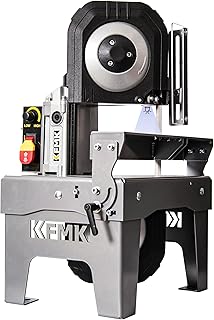
BUCKTOOL 5-Inch Metal Band Saw
This is the metalworking pick: 1.5 HP, 10 amps, and 137–472 FPM variable speed with a 5-inch capacity for round and square stock. The adjustable worktable and extension table let you run it vertically for shaping, which makes it far more versatile than a fixed horizontal chop-style saw.
PeakPursuit 8 Inch Band Saw
A tidy 8-inch machine with a pure copper 3A motor at 1,800 RPM, a 0–45° tilt, fence, and miter gauge. It handles softwood, hardwood, and non-ferrous aluminum comfortably — a sensible first band saw for someone building furniture on a budget without dropping to bargain-bin build quality.
10 Amp Variable Speed Metal Band Saw with Liftable Worktable
Similar spec to the BUCKTOOL with 5-inch capacity and 137–472 FPM, but the liftable worktable is the notable feature — it lets you switch between horizontal stock cutting and vertical freehand work quickly. Good for mixed shops cutting metal, wood, and PVC on one machine.
Frequently Asked Questions
Can a benchtop band saw resaw lumber?
Within limits. An 8-inch saw with 3-1/8 inches of height can slice thin stock for drawer sides or box parts. For serious resawing of 5-inch-plus boards, you need the 10-inch class machine and a sharp, wide resaw blade with a low tooth count — around 3 TPI.
What blade should I start with?
A 1/4-inch, 6 TPI blade is the best all-rounder for furniture work; it turns a reasonably tight radius and still cuts clean in hardwood. Buy two or three at once — blades are consumables, and a dull one causes the drift people blame on the saw.
Why does my cut wander off the line?
Usually blade tension, guide alignment, or a dull blade — in that order. Check that the upper guides sit just above the workpiece and that the thrust bearing is close but not pressing. A drifting blade that consistently pulls one direction often just needs replacing.
Do I need dust collection?
Strongly recommended for wood. Even a small shop vac on the port keeps the lower wheel housing clear, which protects blade tracking and keeps fine dust out of your lungs. Metal cutting produces chips rather than dust, so a chip tray matters more there.
Final Thoughts
For most furniture makers, the WOODSKIL 10-Inch Benchtop Bandsaw is the smart buy — the extra throat depth and cutting height mean you won’t outgrow it in a year. If your work is smaller and detail-driven, the SEESII 8-Inch Benchtop Band Saw delivers a solid tilting table and fence setup for less. And if you’re cutting metal stock, the BUCKTOOL 5-Inch Variable-Speed Band Saw is the right tool for that job — don’t try to make a wood saw do it.