Key takeaways
- Measure your blade length first: Check the plate on your saw or measure an old blade with a tape along its inner loop. A 10-inch benchtop saw typically takes 70-1/2″ or 72″; older 12-inch Craftsman machines run 80″. Guessing here wastes money and shipping time.
- Match tooth count to thickness: Aim for three to six teeth in the cut. Thick hardwood resawing wants 3–4 TPI so the gullets can clear sawdust; thin plywood, veneer, and 3/4″ trim need 10–14 TPI to avoid splintering the underside.
- Pick width by radius, not by strength: A 1/2″ blade tracks beautifully in straight cuts but fights you in tight curves. Drop to 1/4″ for scrollwork, chair backs, and bracket feet where you need a radius under an inch.
- Understand tooth geometry: Hook teeth with deep gullets rip fast and rough — ideal for resawing. Skip and regular tooth patterns leave a smoother wall that needs less sanding before glue-up.
- Buy multipacks for consumables: Blades are wear items. Two- and three-packs cost barely more than singles, and having a spare stops you from limping along on a dull blade because you don’t want to pause the build.
Nothing humbles a shop-built dresser faster than a band saw blade that wanders. You set the fence, feed the walnut slowly, and the cut still drifts a sixteenth off by the end of the board — then you spend twenty minutes at the jointer fixing what should have come off the saw clean. Nine times out of ten the culprit isn’t the saw, the tension, or your technique. It’s a dull, overly fine, or wrongly sized blade grinding its way through stock it was never designed to handle.
Blade choice is the cheapest upgrade in woodworking and the one most people skip. Get the length, width, and tooth count right for the work you actually do — resawing bookmatched panels, cutting cabriole legs, trimming tenon cheeks — and a modest benchtop saw starts behaving like a machine that costs three times as much. Below are the blades I keep hanging on the wall next to my 10-inch saw, plus a straightforward framework for matching a blade to your machine and your project list.
Our top picks



As an Amazon Associate we earn from qualifying purchases at no extra cost to you. Ratings are shown as listed on Amazon.
🛒 Best Price Today on Amazon
Prime members get fast, free shipping on everything above, plus member-only deals. New members get a 30-day free trial — cancel anytime.
How to Choose a Band Saw Blade For Wood (2026)
- Measure your blade length first: Check the plate on your saw or measure an old blade with a tape along its inner loop. A 10-inch benchtop saw typically takes 70-1/2″ or 72″; older 12-inch Craftsman machines run 80″. Guessing here wastes money and shipping time.
- Match tooth count to thickness: Aim for three to six teeth in the cut. Thick hardwood resawing wants 3–4 TPI so the gullets can clear sawdust; thin plywood, veneer, and 3/4″ trim need 10–14 TPI to avoid splintering the underside.
- Pick width by radius, not by strength: A 1/2″ blade tracks beautifully in straight cuts but fights you in tight curves. Drop to 1/4″ for scrollwork, chair backs, and bracket feet where you need a radius under an inch.
- Understand tooth geometry: Hook teeth with deep gullets rip fast and rough — ideal for resawing. Skip and regular tooth patterns leave a smoother wall that needs less sanding before glue-up.
- Buy multipacks for consumables: Blades are wear items. Two- and three-packs cost barely more than singles, and having a spare stops you from limping along on a dull blade because you don’t want to pause the build.
The Best Band Saw Blade For Wood (2026)s Reviewed
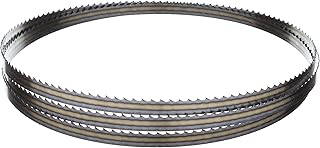
Timber Wolf 1/2″ x 72″, 4 TPI
This is the blade I reach for when resawing figured maple for drawer fronts — the low-tension silicon steel band runs quieter and stays straighter under load than anything else in its price bracket. Expect a clean, almost planed sidewall that needs minimal cleanup before it hits the glue-up.
AYAO 70-1/2″ x 1/2″ x 4 TPI
Purpose-built for Craftsman 921400 and Rikon 10-305/10-306 saws, this hardened-tooth blade is the right answer if your machine takes the shorter 70-1/2″ loop. The 4 TPI hook pattern clears chips aggressively, so it powers through 4-inch stock without bogging a 1/3 HP motor.
FOXBC 72″ x 1/2″ x 6 TPI, 2-Pack
A genuinely versatile middle ground for WEN 3962 and Delta 28-140 owners — 6 TPI is coarse enough for moderate resawing but fine enough for tenon shoulders and 3/4″ hardwood without tear-out. The two-pack means you always have a fresh blade waiting.
FOXBC 80″ x 1/4″ x 14 TPI, 2-Pack
The curve specialist for vintage 12-inch Craftsman saws. The narrow band turns tight radii for cabriole legs and shaped aprons, while the fine tooth pitch leaves edges smooth enough to go straight to a spindle sander.
LENOX Portable Band Saw Blades, 44-7/8″ x 14 TPI, 5-Pack
These bi-metal blades fit portable band saws and shine on thin stock, laminate, and the occasional bolt or bracket in a mixed-material furniture build. Worth noting: 14 TPI is a metal-cutting pitch, so treat it as a trim-and-hardware blade rather than a resawing tool.
Frequently Asked Questions
How do I know when a blade is dull?
Watch for burning, increased feed pressure, and a cut that drifts even with proper tension. A sharp blade should pull itself through hardwood with light hand pressure.
What TPI is best for resawing?
Three to four TPI. Deep gullets carry sawdust out of a tall cut; fine teeth pack solid and burn the kerf.
Can I use a metal-cutting blade on wood?
For thin stock, yes, though it cuts slowly and clogs. It will not resaw effectively.
Why does my blade keep drifting?
Usually blade set wear or low tension. Check both before adjusting your fence — many woodworkers compensate for a bad blade instead of replacing it.
Final Thoughts
For most home furniture builds, the Timber Wolf 1/2″ 4 TPI is the blade worth owning first — it turns a benchtop saw into a credible resaw machine. Pair it with the FOXBC 72″ 6 TPI two-pack for general joinery and the FOXBC 80″ 1/4″ for curved work, and you’re covered from wide panels to shaped legs.